


MHT CET · Physics · Current Electricity
When a galvanometer is shunted by a resistance. 's', its current capacity increases ' \(n\) ' times. If the same galvanometer is shunted by another resistance ' \(\mathrm{s}_1\) ', its capacity will increase to ' \(\mathrm{n}_1\) ' times original current. The value of ' \(n_1\) ' is
- A \(\frac{(\mathrm{n}+\mathrm{s})}{\mathrm{s}_1}\)
- B \(\frac{\mathrm{s}_1(\mathrm{n}-\mathrm{s})-\mathrm{s}_1}{\mathrm{~s}_1}\)
- C \(\frac{(\mathrm{n}+1) \mathrm{s}}{\mathrm{s}_1}\)
- D \(\frac{\mathrm{s}(\mathrm{n}-1)+\mathrm{s}_1}{\mathrm{~s}_1}\)
Answer & Solution
Correct Answer
(D) \(\frac{\mathrm{s}(\mathrm{n}-1)+\mathrm{s}_1}{\mathrm{~s}_1}\)
Step-by-step Solution
Detailed explanation
For galvanometer shunt resistance is given by,
\(s=G\left(\frac{1}{1-I / I_g}\right)\)
Current capacity is given by, \(\mathrm{n}=\mathrm{I} / \mathrm{Ig}\)
\(\begin{aligned}
& \mathrm{s}=\mathrm{G}\left(\frac{1}{1-\mathrm{n}}\right) \\
& \therefore \quad \mathrm{G}=\mathrm{s}(\mathrm{n}-1)...(i)
\end{aligned}\)
When same galvanometer is shunted with resistance ' \(\mathrm{s}_1\) '
\(\begin{aligned}
& \mathrm{s}_1=\mathrm{G}\left(\frac{1}{1-\mathrm{n}_1}\right) \\
& \mathrm{n}_1=\frac{\mathrm{G}+\mathrm{s}_1}{\mathrm{~s}_1}=\frac{\mathrm{s}(\mathrm{n}-1)+\mathrm{s}_1}{\mathrm{~s}_1}
\end{aligned}\)
\(s=G\left(\frac{1}{1-I / I_g}\right)\)
Current capacity is given by, \(\mathrm{n}=\mathrm{I} / \mathrm{Ig}\)
\(\begin{aligned}
& \mathrm{s}=\mathrm{G}\left(\frac{1}{1-\mathrm{n}}\right) \\
& \therefore \quad \mathrm{G}=\mathrm{s}(\mathrm{n}-1)...(i)
\end{aligned}\)
When same galvanometer is shunted with resistance ' \(\mathrm{s}_1\) '
\(\begin{aligned}
& \mathrm{s}_1=\mathrm{G}\left(\frac{1}{1-\mathrm{n}_1}\right) \\
& \mathrm{n}_1=\frac{\mathrm{G}+\mathrm{s}_1}{\mathrm{~s}_1}=\frac{\mathrm{s}(\mathrm{n}-1)+\mathrm{s}_1}{\mathrm{~s}_1}
\end{aligned}\)
See the Complete Solution
Get step-by-step explanations for this and 2.5 Lakh+ more JEE, NEET & CET questions.
- Unlock all solutions
- Practice the full chapter
- Track accuracy across PYQs
4.8 rated on Google Play · 14,000+ reviews
More questions from Physics
- The distance between two coherent sources is 1 mm. The screen is placed at a distance of 1 m from the sources. If the distance of the third bright fringe is 1.2 mm from the central fringe, the wavelength of light used isMHT CET 2017 Easy
- Two bodies ' \(A\) ' and ' \(B\) ' start from the same point at the same instant and move along a straight line. 'A' moves with uniform acceleration ‘A’ and 'B' moves with uniform velocity (V). They meet after time ' \(t\) '. value of ' \(t\) ' isMHT CET 2021 Medium
- The pressure and density of a diatomic gas \(\left(\gamma=\frac{7}{5}\right)\) changes adiabatically from \((\mathrm{P}, \rho)\) to \(\left(\mathrm{P}^{\prime}, \rho^{\prime}\right)\). If \(\frac{\rho^{\prime}}{\rho}=32\) then \(\frac{\mathrm{P}^{\prime}}{\mathrm{P}}\) should beMHT CET 2023 Hard
- For the following reaction, the particle ' \(x\) ' is
\({ }_6^{\mathrm{C}^{11}} \longrightarrow{ }_5^{\mathrm{B}^{11}}+\beta^{+}+\mathrm{X}\)MHT CET 2025 Easy - For which of the following substances, the magnetic susceptibility is independent of temperature?MHT CET 2023 Easy
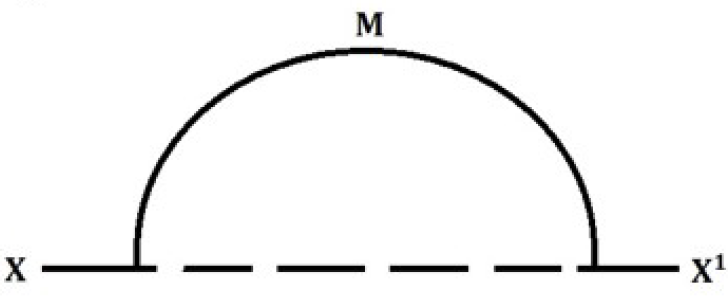
- A thin metal wire of length ' \(L\) ' and mass ' \(M\) ' is bent to form semicircular ring as shown. The moment of inertia about \(\mathrm{XX}^1\) is
 MHT CET 2025 Medium
More PYQs from MHT CET
- Identify false statement among the following.MHT CET 2022 Easy
- Which carbon atom of deoxy Ribose sugar in DNA does NOT contain the
 bond?MHT CET 2018 Medium
 - The equation of wave is given by \(y=10 \sin \left(\frac{2 \pi t}{30}+\alpha\right)\). If the displacement is \(5 \mathrm{~cm}\) at \(\mathrm{t}=0\), then the total phase angle at \(\mathrm{t}=7.5 \mathrm{~s}\) will beMHT CET 2021 Medium
- Which plant hormone does NOT break seed dormancy in plants?MHT CET 2023 Medium
- What is the molar conductivity of \(0 \cdot 1\) M NaCl if it's conductivity is \(1 \cdot 06 \times 10^{-2} \Omega^{-1} \mathrm{~cm}^{-1}\) ?MHT CET 2020 Easy
- A charge \(17.7 \times 10^{-4} \mathrm{C}\) is distributed uniformly over a large sheet of area \(200 \mathrm{~m}^2\). The electric field intensity at a distance \(20 \mathrm{~cm}\) from it in air will be \(\left[\varepsilon_0=8.85 \times 10^{-12} \mathrm{C}^2 / \mathrm{Nm}^2\right]\)MHT CET 2023 Medium