


MHT CET · Physics · Atomic Physics
Using Bohr's model, the orbital period of electron in hydrogen atom in \(\mathrm{n}^{\text {th }}\) orbit is \(\left(\epsilon_{0}=\right.\) permittivity of free space, \(\mathrm{h}=\) Planck's constant, \(\mathrm{m}=\) mass of electron,
\(\mathrm{e}=\) electronic charge \()\)
- A \(\frac{8 \epsilon_{0}^{2} \mathrm{n}^{3} \mathrm{~h}^{3}}{\mathrm{me}^{4}}\)
- B \(\frac{2 \epsilon_{0}^{2} \mathrm{n}^{3} \mathrm{~h}^{3}}{\mathrm{~m} \mathrm{e}^{4}}\)
- C \(\frac{2 \varepsilon_{0} \mathrm{n}^{2} \mathrm{~h}^{2}}{\mathrm{me}^{4}}\)
- D \(\frac{4 \epsilon_{0}^{2} \mathrm{n}^{3} \mathrm{~h}^{3}}{\mathrm{me}^{4}}\)
Answer & Solution
Correct Answer
(D) \(\frac{4 \epsilon_{0}^{2} \mathrm{n}^{3} \mathrm{~h}^{3}}{\mathrm{me}^{4}}\)
Step-by-step Solution
Detailed explanation
(B)
\(\begin{array}{l}
\mathrm{T}=\frac{2 \pi \mathrm{r}}{\mathrm{V}} ; \quad \mathrm{r}=\frac{\mathrm{n}^{2} \mathrm{~h}^{2} \epsilon_{0}}{\pi \mathrm{h} \mathrm{e}^{2}} \\
\mathrm{~V}=\frac{\mathrm{e}^{2}}{2 \pi \epsilon_{\mathrm{o}} \mathrm{n}}
\end{array}\)
putting the values of \(\mathrm{V}\) and \(\mathrm{r}\),
\(T=\frac{4 \epsilon_{0}{ }^{2} \mathrm{n}^{3} \mathrm{~h}^{3}}{\mathrm{me}^{4}}\)
\(\begin{array}{l}
\mathrm{T}=\frac{2 \pi \mathrm{r}}{\mathrm{V}} ; \quad \mathrm{r}=\frac{\mathrm{n}^{2} \mathrm{~h}^{2} \epsilon_{0}}{\pi \mathrm{h} \mathrm{e}^{2}} \\
\mathrm{~V}=\frac{\mathrm{e}^{2}}{2 \pi \epsilon_{\mathrm{o}} \mathrm{n}}
\end{array}\)
putting the values of \(\mathrm{V}\) and \(\mathrm{r}\),
\(T=\frac{4 \epsilon_{0}{ }^{2} \mathrm{n}^{3} \mathrm{~h}^{3}}{\mathrm{me}^{4}}\)
See the Complete Solution
Get step-by-step explanations for this and 2.5 Lakh+ more JEE, NEET & CET questions.
- Unlock all solutions
- Practice the full chapter
- Track accuracy across PYQs
4.8 rated on Google Play · 14,000+ reviews
More questions from Physics
- On the surface of the liquid in equilibrium, molecules of the liquid possessMHT CET 2010 Easy
- The current flowing in a coil is 3 A and the power consumed is 108 W . If the a.c. source is of \(120 \mathrm{~V}, 50 \mathrm{~Hz}\), the resistance in the circuit isMHT CET 2024 Easy
- An electron is moving in an orbit around the nucleus in an atom. Let \(m\), b orbital magnetic moment and \(L\) be angular momentum of the electron, thenMHT CET 2022 Hard
- A stationary wave is formed having 3 nodes along the length of the string 90 cm . The wavelength of the wave isMHT CET 2024 Easy
- Figure shows currents in different parts of electrical circuit. The value of current ' i ' is
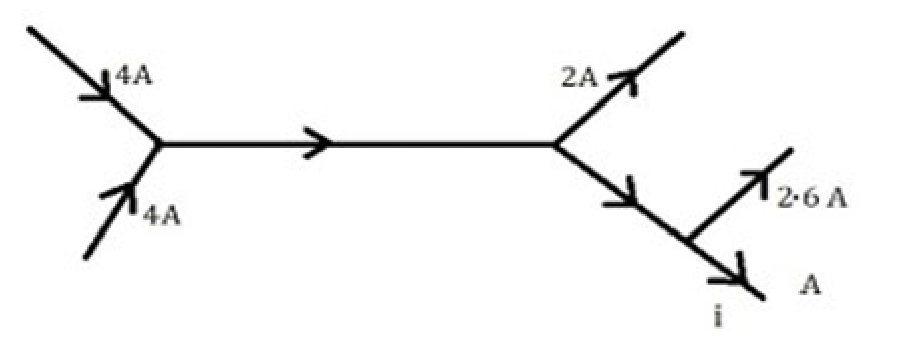 MHT CET 2025 Easy
 - The frequency of a tuning fork is \(220 \mathrm{~Hz}\) and the velocity of sound in air is \(330 \mathrm{~m} / \mathrm{s}\). When the tuning fork completes 80 vibrations, the distance travelled isMHT CET 2021 Medium
More PYQs from MHT CET
- The volume of a gas is \(4 \mathrm{dm}^3\) at \(0^{\circ} \mathrm{C}\). Calculate new volume at constant pressure when the temperature is increased by \(10^{\circ} \mathrm{C}\).MHT CET 2023 Medium
- The increase in pressure required to decrease the \(200 \mathrm{~L}\) volume of a liquid by \(0.008 \%\) in \(\mathrm{kPa}\) is (Bulk modulus of the liquid \(=2100 \mathrm{MPa}\) is )MHT CET 2010 Medium
- Which from following polymers is used as wool substitute?MHT CET 2025 Medium
- A sheet of steel is 40 cm long and 5 cm broad at \(0^{\circ} \mathrm{C}\). The surface area of the sheet increases by \(1.4 \mathrm{~cm}^2\) at \(100^{\circ} \mathrm{C}\). Coefficient of linear expansion of steel isMHT CET 2024 Medium
- Beats are produced by waves \(\mathrm{y}_1=\mathrm{a} \sin 2000 \pi \mathrm{t}\) and \(\mathrm{y}_2=\mathrm{a} \sin 2008 \pi \mathrm{t}\). The number of beats heard per second isMHT CET 2021 Easy
- Rays from a point source of light situated at height \(h\) below the liquid surface having refractive index \(\mu\), forms a circular patch of light of radius \(r\) on the surface. The area of the patch isMHT CET 2022 Hard