


MHT CET · Physics · Mechanical Properties of Fluids
Under isothermal conditions, two soap bubbles of radii ' \(r_1\) ' and ' \(r_2\) ' combine to forms a single soap bubble of radius ' \(R\) '. The surface tension of soap solution is ( \(\mathrm{P}=\) outside pressure)
- A \(\frac{\mathrm{P}\left(\mathrm{R}^3+\mathrm{r}_1^3+\mathrm{r}_2^3\right)}{4\left(\mathrm{r}_1^2-\mathrm{r}_2^2+\mathrm{R}^2\right)}\)
- B \(\frac{\mathrm{P}\left(\mathrm{R}^2+\mathrm{r}_1^2+\mathrm{r}_2^2\right)}{4\left(\mathrm{r}_1^2-\mathrm{r}_2^2+\mathrm{R}^2\right)}\)
- C \(\frac{P\left(R^3-r_1^3-r_2^3\right)}{4\left(r_1^2+r_2^2-R^2\right)}\)
- D \(\frac{\mathrm{P}\left(\mathrm{R}^2-\mathrm{r}_1^2-\mathrm{r}_2^2\right)}{4\left(\mathrm{r}_1^3+\mathrm{r}_2^3-\mathrm{R}^3\right)}\)
Answer & Solution
Correct Answer
(C) \(\frac{P\left(R^3-r_1^3-r_2^3\right)}{4\left(r_1^2+r_2^2-R^2\right)}\)
Step-by-step Solution
Detailed explanation
Pressure inside the first bubble \(=\mathrm{P}+\frac{4 \mathrm{~T}}{\mathrm{r}_1}\)
Pressure inside the second bubble \(=\mathrm{P}+\frac{4 \mathrm{~T}}{\mathrm{r}_2}\)
Using the formula \(\mathrm{PV}=\mathrm{nR} \theta \quad(\theta=\) absolute temp \()\)
\(\left(\mathrm{P}+\frac{4 \mathrm{~T}}{\mathrm{r}_1}\right) \cdot \frac{4 \pi}{3} \mathrm{r}_1^3=\mathrm{n}_1 \mathrm{R} \theta \quad\) ( \(\mathrm{R}\) is molar gas constant)
\(\left(\mathrm{P}+\frac{4 \mathrm{~T}}{\mathrm{r}_2}\right) \cdot \frac{4 \pi}{3} \mathrm{r}_2^3=\mathrm{n}_2 \mathrm{R} \theta\)
and \(\left(\mathrm{P}+\frac{4 \mathrm{~T}}{\mathrm{R}}\right) \cdot \frac{4 \pi}{3} \mathrm{R}^3=\left(\mathrm{n}_1+\mathrm{n}_2\right) \mathrm{R} \theta\)
\(\therefore\left(\mathrm{P}+\frac{4 \mathrm{~T}}{\mathrm{R}}\right) \cdot \frac{4 \pi}{3} \mathrm{R}^3=\left(\mathrm{P}+\frac{4 \mathrm{~T}}{\mathrm{r}_1}\right) \cdot \frac{4 \pi}{3} \mathrm{r}_1^3+\left(\mathrm{P}+\frac{4 \mathrm{~T}}{\mathrm{r}_2}\right) \cdot \frac{4 \pi \mathrm{r}_2^3}{3}\)
\(\therefore\left(\mathrm{P}+\frac{4 \mathrm{~T}}{\mathrm{R}}\right) \mathrm{R}^3=\left(\mathrm{P}+\frac{4 \mathrm{~T}}{\mathrm{r}_1}\right) \mathrm{r}_1^3+\left(\mathrm{P}+\frac{4 \mathrm{~T}}{\mathrm{r}_2}\right) \mathrm{r}_2^3\)
on solving: \(\mathrm{T}=\frac{\mathrm{P}\left(\mathrm{R}^3-\mathrm{r}_1^3-\mathrm{r}_2^3\right)}{4\left(\mathrm{r}_1^2+\mathrm{r}_2^2-\mathrm{R}^2\right)}\)
Pressure inside the second bubble \(=\mathrm{P}+\frac{4 \mathrm{~T}}{\mathrm{r}_2}\)
Using the formula \(\mathrm{PV}=\mathrm{nR} \theta \quad(\theta=\) absolute temp \()\)
\(\left(\mathrm{P}+\frac{4 \mathrm{~T}}{\mathrm{r}_1}\right) \cdot \frac{4 \pi}{3} \mathrm{r}_1^3=\mathrm{n}_1 \mathrm{R} \theta \quad\) ( \(\mathrm{R}\) is molar gas constant)
\(\left(\mathrm{P}+\frac{4 \mathrm{~T}}{\mathrm{r}_2}\right) \cdot \frac{4 \pi}{3} \mathrm{r}_2^3=\mathrm{n}_2 \mathrm{R} \theta\)
and \(\left(\mathrm{P}+\frac{4 \mathrm{~T}}{\mathrm{R}}\right) \cdot \frac{4 \pi}{3} \mathrm{R}^3=\left(\mathrm{n}_1+\mathrm{n}_2\right) \mathrm{R} \theta\)
\(\therefore\left(\mathrm{P}+\frac{4 \mathrm{~T}}{\mathrm{R}}\right) \cdot \frac{4 \pi}{3} \mathrm{R}^3=\left(\mathrm{P}+\frac{4 \mathrm{~T}}{\mathrm{r}_1}\right) \cdot \frac{4 \pi}{3} \mathrm{r}_1^3+\left(\mathrm{P}+\frac{4 \mathrm{~T}}{\mathrm{r}_2}\right) \cdot \frac{4 \pi \mathrm{r}_2^3}{3}\)
\(\therefore\left(\mathrm{P}+\frac{4 \mathrm{~T}}{\mathrm{R}}\right) \mathrm{R}^3=\left(\mathrm{P}+\frac{4 \mathrm{~T}}{\mathrm{r}_1}\right) \mathrm{r}_1^3+\left(\mathrm{P}+\frac{4 \mathrm{~T}}{\mathrm{r}_2}\right) \mathrm{r}_2^3\)
on solving: \(\mathrm{T}=\frac{\mathrm{P}\left(\mathrm{R}^3-\mathrm{r}_1^3-\mathrm{r}_2^3\right)}{4\left(\mathrm{r}_1^2+\mathrm{r}_2^2-\mathrm{R}^2\right)}\)
See the Complete Solution
Get step-by-step explanations for this and 2.5 Lakh+ more JEE, NEET & CET questions.
- Unlock all solutions
- Practice the full chapter
- Track accuracy across PYQs
4.8 rated on Google Play · 14,000+ reviews
More questions from Physics
- The speed of oxygen molecule in a gas is u,If the temperature is doubled and the molecule dissociates into two atoms, the speed will beMHT CET 2019 Easy
- A galvanometer of resistance ' \(G\) ' is shunted by resistance of 'S' ohm. To keep the main current in the circuit unchanged the resistance to be put in series with Galvanometer isMHT CET 2024 Hard
- In hydrogen atom, an electron of charge a revolves in a orbit radius r with speed v. Then, magnetic moment associated with electron isMHT CET 2019 Hard
- Inside a vessel filled with liquid a converging lens is placed as shown in figure. The lens has focal length \(15 \mathrm{~cm}\) when in air and has refractive index \(\frac{3}{2}\). If the liquid has refractive index \(\frac{9}{5}\), the focal length of lens in liquid is
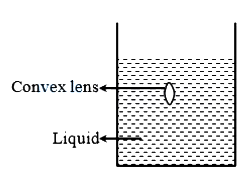 MHT CET 2021 Hard
 - A ray of light is incident at an angle of incidence 'i' on one surface of a thin prism of
small angle 'A'. The ray emerges normally from the opposite surface. If the refractive
index of the material of the prism is ' \(\mu\) ', the angle of incidence 'i' is nearly equal toMHT CET 2020 Easy - Two identical capacitors have the same capacitance ' \(C\) '. One of them is charged to potential \(\mathrm{V}_1\) and other to \(\mathrm{V}_2\). The negative ends of capacitors are connected together. When positive ends are also connected, the decrease in energy of the combined system isMHT CET 2024 Easy
More PYQs from MHT CET
- A hollow cylinder has a charge of ' \(q\) ' \(C\) within it. If \(\phi\) is the electric flux associated with the curved surface B, the flux linked with the plane surface \(A\) will be
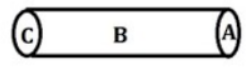 MHT CET 2025 Medium
 - If \(\varphi^{\prime}\) is the angle between the lines \(a x^{2}+2 h x y+b y^{2}=0\), then angle between \(x^{2}+2 x y \sec \theta+y^{2}=0\) isMHT CET 2009 Medium
- If the radius of the spherical Gaussian surface is increased then the electric flux due to a pooint charge enclosed by the surfaceMHT CET 2020 Easy
- An inclined plane makes an angle of \(30^{\circ}\) with the horizontal. A solid sphere rolling down this inclined plane from rest without slipping has a linear acceleration ( \(\mathrm{g}=\) acceleration due to gravity, \(\sin 30^{\circ}=0.5\) )MHT CET 2024 Easy
- The eccentricity of the curve represented by \(x=3(\cos \mathrm{t}+\sin \mathrm{t})\), \(y=4(\cos t-\sin t)\) isMHT CET 2025 Medium
- If \(\mathrm{a} \sin \theta=\mathrm{b} \cos \theta\), where \(\mathrm{a}, \mathrm{b} \neq 0\), then \(\mathrm{a} \cos 2 \theta+\mathrm{b} \sin 2 \theta=\)MHT CET 2021 Medium