


MHT CET · Physics · Capacitance
Two spherical conductors of capacities \(3 \mu \mathrm{F}\) and \(2 \mu \mathrm{F}\) are charged to same potential having radii \(3 \mathrm{~cm}\) and \(2 \mathrm{~cm}\) respectively. If ' \(\sigma_1\) ' and ' \(\sigma_2\) ' represent surface density of charge on respective conductors then \(\frac{\sigma_1}{\sigma_2}\) is
- A \(\frac{1}{3}\)
- B \(\frac{1}{2}\)
- C \(\frac{2}{3}\)
- D \(\frac{3}{4}\)
Answer & Solution
Correct Answer
(C) \(\frac{2}{3}\)
Step-by-step Solution
Detailed explanation
We know, \(\mathrm{C}=\frac{\mathrm{Q}}{\mathrm{V}}\)
As both the charged spheres are at the same potential, the charge on both spheres is
\(\begin{aligned}
& Q_1=C_1 \mathrm{~V} \\
& Q_2=C_2 \mathrm{~V}
\end{aligned}\)
The charge densities of both spheres are
\(\sigma_1=\frac{\mathrm{Q}_1}{\mathrm{~A}_1}=\frac{\mathrm{C}_1 \mathrm{~V}}{4 \pi \mathrm{r}_1^2}\)
Similiarly,
\(\sigma_2=\frac{\mathrm{Q}_2}{\mathrm{~A}_2}=\frac{\mathrm{C}_2 \mathrm{~V}}{4 \pi \mathrm{r}_2^2}\)
Taking the ratios,
\(\begin{aligned}
\frac{\sigma_2}{\sigma_1} & =\frac{\mathrm{C}_2 \mathrm{r}_1^2}{\mathrm{C}_1 \mathrm{r}_2^2} \\
\frac{\sigma_2}{\sigma_1} & =\frac{2 \times 10^{-6} \times(0.03)^2}{3 \times 10^{-6} \times(0.02)^2}=\frac{3}{2} \\
\therefore \quad \frac{\sigma_1}{\sigma_2} & =\frac{2}{3}
\end{aligned}\)
As both the charged spheres are at the same potential, the charge on both spheres is
\(\begin{aligned}
& Q_1=C_1 \mathrm{~V} \\
& Q_2=C_2 \mathrm{~V}
\end{aligned}\)
The charge densities of both spheres are
\(\sigma_1=\frac{\mathrm{Q}_1}{\mathrm{~A}_1}=\frac{\mathrm{C}_1 \mathrm{~V}}{4 \pi \mathrm{r}_1^2}\)
Similiarly,
\(\sigma_2=\frac{\mathrm{Q}_2}{\mathrm{~A}_2}=\frac{\mathrm{C}_2 \mathrm{~V}}{4 \pi \mathrm{r}_2^2}\)
Taking the ratios,
\(\begin{aligned}
\frac{\sigma_2}{\sigma_1} & =\frac{\mathrm{C}_2 \mathrm{r}_1^2}{\mathrm{C}_1 \mathrm{r}_2^2} \\
\frac{\sigma_2}{\sigma_1} & =\frac{2 \times 10^{-6} \times(0.03)^2}{3 \times 10^{-6} \times(0.02)^2}=\frac{3}{2} \\
\therefore \quad \frac{\sigma_1}{\sigma_2} & =\frac{2}{3}
\end{aligned}\)
See the Complete Solution
Get step-by-step explanations for this and 2.5 Lakh+ more JEE, NEET & CET questions.
- Unlock all solutions
- Practice the full chapter
- Track accuracy across PYQs
4.8 rated on Google Play · 14,000+ reviews
More questions from Physics
- The threshold frequency of a metal is ' \(F_0\) '. When light of frequency \(2 \mathrm{~F}_0\) is incident on the metal plate, the maximum velocity of photoelectron is ' \(\mathrm{V}_1\) ' When the frequency of incident radiation is increased to ' \(5 \mathrm{~F}_0\) ', the maximum velocity of photoelectrons emitted is ' \(\mathrm{V}_2\) '. The ratio of \(\mathrm{V}_1\) to \(\mathrm{V}_2\) isMHT CET 2024 Medium
- Two parallel plate air capacitors of same capacity ' C ' are connected in series to a battery of emf ' \(E\) '. Then one of the capacitors is completely filled with dielectric material of constant ' \(K\) '. The change in the effective capacity of the series combination isMHT CET 2024 Medium
- For a particle in uniform circular motionMHT CET 2024 Medium
- Magnetic field at the centre of a circular loop of area ' \(A\) ' is ' \(B\) '. The magnetic moment of the loop will beMHT CET 2024 Medium
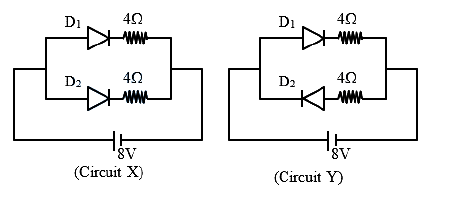
- What are the values of the currents flowing in each of the following diode circuits \(\mathrm{X}\) and \(\mathrm{Y}\) respectively? (Assume that the diodes are ideal)
 MHT CET 2021 Hard
 - A water drop is divided into 8 equal droplets. The pressure difference between the inner and outer side of the big drop will beMHT CET 2024 Medium
More PYQs from MHT CET
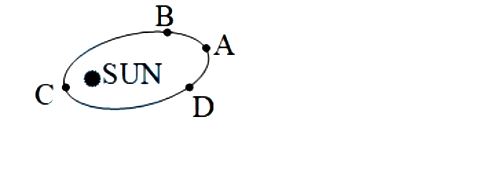
- A planet is moving around the sun in an elliptical orbit at different positions A, B, C, D. The maximum rotational kinetic energy of a planet is at postion.
 MHT CET 2022 Medium
 - Which among the following is a natural biopolymer of monosaccharides?MHT CET 2020 Easy
- How many moles of ethyl bromide is required for formation of 1 mole N, N - Di ethyl ethanamine from ethyl amine?MHT CET 2022 Medium
- The displacement of a particle performing S.H.M is given by \(x=5 \sin (3 t+3)\), where \(x\) is in \(\mathrm{cm}\) and \(t\) is in second. The maximum acceleration of the particle will beMHT CET 2021 Easy
- The equation of perpendicular bisector of the line segment joining \(\mathrm{A}(-2,3)\) and \(\mathrm{B}(6,-5)\) isMHT CET 2021 Easy
- The central carbon atom of a free radical containsMHT CET 2011 Medium