


MHT CET · Physics · Mechanical Properties of Fluids
Two soap bubbles of radii \(r_1\) and \(r_2\) in vacuum coalesce under isothermal conditions. The resulting bubble has a radius equal to
- A \(\sqrt{r_1^2+r_2^2}\)
- B \(\frac{r_1+r_2}{2}\)
- C \(r_1+r_2\)
- D \(\frac{r_1 r_2}{r_1+r_2}\)
Answer & Solution
Correct Answer
(A) \(\sqrt{r_1^2+r_2^2}\)
Step-by-step Solution
Detailed explanation
In Iso-thermal process: \(p V=\mathrm{C}\). The pressure inside bubble is: \(p \propto 1 / r\) and volume is: \(V \propto r^3\).
\(\therefore p V \propto r^2\)
And \(n=\frac{p V}{R T}\), therefore number of moles of gas inside the bubble is proportional to the square of its radius
\(\therefore n \propto r^2\)
On combining bubbles, the total number of moles is conserved: Therefore, \(n_1+n_1=N\)
\(\therefore r_1^2+r_2^2=R^2\)
The above result can also be obtained by total surface energy conservation:
\(2 \times\left(4 \pi R^2\right) \sigma=2 \times\left(4 \pi r_1^2\right) \sigma+2 \times\left(4 \pi r_2^2\right) \sigma\)
or \(R=\sqrt{r_1^2+r_2^2}\)
\(\therefore p V \propto r^2\)
And \(n=\frac{p V}{R T}\), therefore number of moles of gas inside the bubble is proportional to the square of its radius
\(\therefore n \propto r^2\)
On combining bubbles, the total number of moles is conserved: Therefore, \(n_1+n_1=N\)
\(\therefore r_1^2+r_2^2=R^2\)
The above result can also be obtained by total surface energy conservation:
\(2 \times\left(4 \pi R^2\right) \sigma=2 \times\left(4 \pi r_1^2\right) \sigma+2 \times\left(4 \pi r_2^2\right) \sigma\)
or \(R=\sqrt{r_1^2+r_2^2}\)
See the Complete Solution
Get step-by-step explanations for this and 2.5 Lakh+ more JEE, NEET & CET questions.
- Unlock all solutions
- Practice the full chapter
- Track accuracy across PYQs
4.8 rated on Google Play · 14,000+ reviews
More questions from Physics
- A solid ball of volume \(V\) is dropped in a viscous liquid. It experiences a viscous force \(F\). If the solid ball of volume \(2 V\) of same material is dropped in the same fluid, then the viscous force acting on it will beMHT CET 2012 Easy
- In a p-type semiconductor,MHT CET 2022 Medium
- A mass ' \(m\) ' attached to a spring oscillates with a period of 3 second. If the mass is increased by 0.6 kg , the period increases by 3 second. The initial mass ' m ' is equal toMHT CET 2024 Medium
- The intermediate image formed by an objective lens of a compound microscope isMHT CET 2022 Easy
- In Young's double slit experiment, the slit separation is made threefold by keeping remaining setup same, the fringe width becomesMHT CET 2022 Easy
- The resultant logic gate from the combination of following gates is
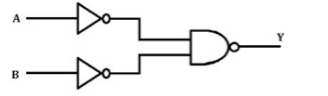 MHT CET 2025 Easy
More PYQs from MHT CET
- The area bounded by the X-axis and the curve \(y=x(x-2)(x+1)\) isMHT CET 2023 Easy
- In one nucleosome, which one of the following histone molecule is NOT double?MHT CET 2018 Medium
- In an intrinsic semiconductor, at an ordinary temperature, the correct relation
between the number of electrons 'ne' and number of holes 'nn' isMHT CET 2020 Easy - A particle is performing uniform circular motion. If ' \(\theta^{\prime},{ }^{\prime} \omega^{\prime},{ }^{\prime} \propto^{\prime}\) and 'a' are its
angular displacement, angular velocity, angular acceleration and centripetal
acceleration respectively, then which of the following is 'WRONG'?
(' \(\mathrm{v}\) ' is its linear velocity )MHT CET 2020 Medium - Which one of the following statements is true? A p-type semiconductor is doped withMHT CET 2024 Easy
- A random variable X has p.m. f. \(\mathrm{P}(\mathrm{X}=x)=\frac{{ }^4 \mathrm{C}_x}{2^4}, x=0,1,2,3,4\) and \(\mu\) and \(\sigma^2\) are mean and variance respectively of random variable \(X\), thenMHT CET 2025 Medium