


MHT CET · Physics · Mechanical Properties of Fluids
Two small drops of mercury each of radius ' \(R\) ' coalesce to from a large single drop. The ratio of the total surface energies before and after the change is
- A \(\sqrt{2}: 1\)
- B \(2^{2 / 3}: 1\)
- C \(2^{1 / 3}: 1\)
- D \(2: 1\)
Answer & Solution
Correct Answer
(C) \(2^{1 / 3}: 1\)
Step-by-step Solution
Detailed explanation
Total surface energy before coalesce
\(
E_1=2\left(4 \pi R^2\right) T
\)
But \(\frac{4}{3} \pi \mathrm{R}^3 \times 2=\frac{4}{3} \pi \mathrm{R}^{13}\)
\(
R^{\prime}=(2)^{1 / 3} R
\)
Total surface energy after coalescing
\(
\begin{aligned}
& \mathrm{E}_2=4 \pi R^{\prime 2} \mathrm{~T}=4 \pi(2)^{2 / 3} R^2 \mathrm{~T} \\
& \frac{\mathrm{E}_1}{\mathrm{E}_2}=\frac{2\left(4 \pi R^2\right) \mathrm{T}}{4 \pi(2)^{2 / 3} \mathrm{R}^2 \mathrm{~T}}=2^{1-\frac{2}{3}}=2^{1 / 3}
\end{aligned}
\)
\(
E_1=2\left(4 \pi R^2\right) T
\)
But \(\frac{4}{3} \pi \mathrm{R}^3 \times 2=\frac{4}{3} \pi \mathrm{R}^{13}\)
\(
R^{\prime}=(2)^{1 / 3} R
\)
Total surface energy after coalescing
\(
\begin{aligned}
& \mathrm{E}_2=4 \pi R^{\prime 2} \mathrm{~T}=4 \pi(2)^{2 / 3} R^2 \mathrm{~T} \\
& \frac{\mathrm{E}_1}{\mathrm{E}_2}=\frac{2\left(4 \pi R^2\right) \mathrm{T}}{4 \pi(2)^{2 / 3} \mathrm{R}^2 \mathrm{~T}}=2^{1-\frac{2}{3}}=2^{1 / 3}
\end{aligned}
\)
See the Complete Solution
Get step-by-step explanations for this and 2.5 Lakh+ more JEE, NEET & CET questions.
- Unlock all solutions
- Practice the full chapter
- Track accuracy across PYQs
4.8 rated on Google Play · 14,000+ reviews
More questions from Physics
- Water rises in a capillary tube of radius \(r\) upto a height \(h\). The mass of water in a capillary is \(m\). The mass of water that will rise in capillary of radius \(\frac{\mathrm{r}}{5}\) will beMHT CET 2025 Medium
- In a radioactive disintegration, the ratio of initial number of atoms to the number of atoms present at time \(t=\frac{1}{2 \lambda}\) is \([\lambda=\) decay constant \(]\)MHT CET 2023 Easy
- The ratio of longest to shortest wavelength emitted in Paschen series of hydrogen atom isMHT CET 2023 Medium
- A metal sphere of radius \(1 \mathrm{~m}\) is charged with \(10^{-2} \mathrm{C}\) in air. Its bulk modulus is
\(10^{11} / 4 \pi^{2}\). The volume strain in the sphere is \(\left(\epsilon_{0}=\right.\) pemittivity of free space)MHT CET 2020 Hard - The work done in blowing a soap bubble of radius R is \(\mathrm{W}_1\) at room temperature. Now the soap solution is heated. From the heated solution another soap bubble of radius 2 R is blown and the work done is \(\mathrm{W}_2\). ThenMHT CET 2024 Medium
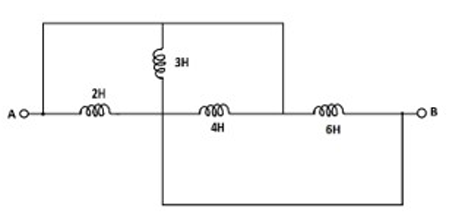
- The equivalent inductance between A and B is equal to
 MHT CET 2025 Medium
More PYQs from MHT CET
- A vector \(\overline{\mathrm{a}}\) has components 1 and \(2 \mathrm{p}\) with respect to a rectangular Cartesian system. This system is rotated through a certain angle about origin in the counter clock wise sense. If, with respect to the new system, \(\bar{a}\) has components 1 and \((p+1)\), thenMHT CET 2023 Hard
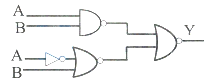
- In the following digital logic circuit, the output Y will be ' 1 ' for inputs
 MHT CET 2023 Easy
 - The value of \(\int_{-1}^1\left(\sqrt{1+x+x^2}-\sqrt{1-x+x^2}\right) \mathrm{d} x\) isMHT CET 2025 Easy
- When an electron is accelerated through a potential ' \(\mathrm{V}\) ', the de-Broglie wavelength associated with it is ' \(4 \lambda\) '. When the accelerating potential is increased to \(4 \mathrm{~V}\), its wavelength will beMHT CET 2023 Medium
- Water rises up to a height of \(4 \mathrm{~cm}\) in a capillary tube. The lower end of the capillary tube is at a depth of \(8 \mathrm{~cm}\) below the water level. The mouth pressure required to blow an air bubble at the lower end of the capillary will be ' \(\mathrm{X}\) ' \(\mathrm{cm}\) of water, where \(\mathrm{X}\) is equal toMHT CET 2021 Medium
- If the function \(P[X=x]=\left\{\begin{array}{cc}\frac{K \cdot 2^x}{x !}, & x=0,1,2,3 \ 0, & \text { otherwise }\end{array}\right.\) Forms p.m.f., then value of \(K\) isMHT CET 2022 Medium