


MHT CET · Physics · Electrostatics
Two point charges ' \(q 1\) ' and 'q2' are separated by a distance ' \(\mathrm{d}\) '. What is the increase in potential energy of the system when ' \(q 2\) ' is moved towards ' \(q 1\) ' by a distance ' \(x\) '?
\((\mathrm{x} < \mathrm{d})\left(\frac{1}{4 \pi \varepsilon_0}=\mathrm{K}, \text { constant }\right)\)
- A \(-\frac{\mathrm{Kq}_1 \mathrm{q}_2 \mathrm{x}}{\mathrm{d}(\mathrm{d}-\mathrm{x})}\)
- B \(-\frac{\mathrm{Kq}_1 \mathrm{q}_2}{\mathrm{~d}(\mathrm{~d}-\mathrm{x})}\)
- C \(\frac{\mathrm{Kq}_1 \mathrm{q}_{2 x}}{\left(\mathrm{~d}^2-\mathrm{x}^2\right)}\)
- D \(\frac{\mathrm{Kq}_1 \mathrm{q}_2 \mathrm{x}}{\left(\mathrm{d}^2-\mathrm{x}^2\right)}\)
Answer & Solution
Correct Answer
(A) \(-\frac{\mathrm{Kq}_1 \mathrm{q}_2 \mathrm{x}}{\mathrm{d}(\mathrm{d}-\mathrm{x})}\)
Step-by-step Solution
Detailed explanation
The potential energy between two charges is given as \(U=\frac{k q_1 q_2}{r}\)
Initial potential energy is \(\mathrm{U}_{\mathrm{f}}=\frac{\mathrm{kq}_1 \mathrm{q}_2}{\mathrm{r}}\)
When charge \(q_2\) moves towards the \(q_1\) the separation between the charges becomes \(\mathrm{d}-\mathrm{x}\)
The final potential energy is \(\mathrm{U}_{\mathrm{f}}=\frac{\mathrm{kq}_1 \mathrm{q}_2}{(\mathrm{~d}-\mathrm{x})}\)
The increase in potential energy is
\(
\begin{array}{ll}
\therefore & \Delta U=U_f-U_f \\
\therefore & \Delta U=\frac{k q_1 q_2}{d}-\frac{k q_1 q_2}{(d-x)} \\
\therefore & \Delta U=k q_1 q_2\left(\frac{1}{d}-\frac{1}{d-x}\right) \\
\therefore & \Delta U=\frac{-k q_1 q_2 x}{d(d-x)}
\end{array}
\)
Initial potential energy is \(\mathrm{U}_{\mathrm{f}}=\frac{\mathrm{kq}_1 \mathrm{q}_2}{\mathrm{r}}\)
When charge \(q_2\) moves towards the \(q_1\) the separation between the charges becomes \(\mathrm{d}-\mathrm{x}\)
The final potential energy is \(\mathrm{U}_{\mathrm{f}}=\frac{\mathrm{kq}_1 \mathrm{q}_2}{(\mathrm{~d}-\mathrm{x})}\)
The increase in potential energy is
\(
\begin{array}{ll}
\therefore & \Delta U=U_f-U_f \\
\therefore & \Delta U=\frac{k q_1 q_2}{d}-\frac{k q_1 q_2}{(d-x)} \\
\therefore & \Delta U=k q_1 q_2\left(\frac{1}{d}-\frac{1}{d-x}\right) \\
\therefore & \Delta U=\frac{-k q_1 q_2 x}{d(d-x)}
\end{array}
\)
See the Complete Solution
Get step-by-step explanations for this and 2.5 Lakh+ more JEE, NEET & CET questions.
- Unlock all solutions
- Practice the full chapter
- Track accuracy across PYQs
4.8 rated on Google Play · 14,000+ reviews
More questions from Physics
- The ratio of work done by an ideal rigid diatomic gas to the heat supplied by the gas in an isobaric process isMHT CET 2024 Easy
- A pendulum bob has a speed \(4 \mathrm{~m} / \mathrm{s}\) at its lowest position. The pendulum is 1 m long. When the length of the string makes an angle of \(60^{\circ}\) with the vertical, the speed of the bob at that position is (acceleration due to gravity, \(g=10 \mathrm{~m} / \mathrm{s}^2, \cos 60^{\circ}=0 \cdot 5\) )MHT CET 2025 Medium
- A mass \(0.4 \mathrm{~kg}\) performs S.H.M. with a frequency \(\frac{16}{\pi} \mathrm{Hz}\). At a certain displacement it has kinetic energy \(2 \mathrm{~J}\) and potential energy \(1.2 \mathrm{~J}\). The amplitude of oscillation isMHT CET 2021 Hard
- A copper ring is held horizontally and a bar magnet is dropped through the ring with its length along the axis of the ring. The acceleration of the falling magnet while it is passing through the ring isMHT CET 2025 Medium
- A metal wire of length ' \(\mathrm{L}\) ' is bent to form a circular coil of number of turns 'n'. The coil is placed in magnetic field 'B' and current is passed through the coil. The maximum torque acting on the coil isMHT CET 2020 Medium
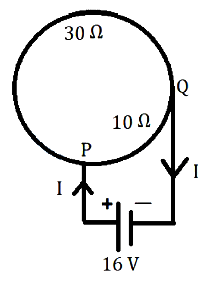
- A circular coil of radius 'R' has a resistance of \(40 \Omega\). Figure shows two points 'P' and 'Q' on the circumference separated by a distance \(\frac{\pi \mathrm{R}}{2}\), which are connected to a \(16 \mathrm{~V}\) battery with internal resistance of \(0.5 \Omega\). What is the value of current 'I' flowing through the circuit?
 MHT CET 2020 Hard
More PYQs from MHT CET
- The equation of wave motion is \(\mathrm{Y}=5 \sin (10 \pi \mathrm{t}\) \(-0.02 \pi x+\pi / 3)\) where \(x\) is in metre and \(t\) in second. The velocity of the wave isMHT CET 2023 Medium
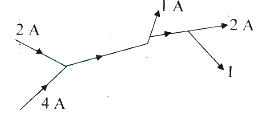
- In the following electrical network, the value of I is
 MHT CET 2024 Easy
 - If \(e_{1}\) and \(e_{2}\) represent the eccentricity of the curves \(16 x^{2}-9 y^{2}=144\) and \(9 x^{2}-16 y^{2}=144\)
respectively. Then, \(\frac{1}{e_{1}^{2}}+\frac{1}{e_{2}^{2}}\) is equal toMHT CET 2010 Easy - In a pure silicon crystal electron-hole concentration is \(10^{16}\) per \(\mathrm{m}^3\) at 301 K . Now \(10^{21}\) atoms of phosphorus are added per cubic metre. The new hole concentration in silicon is (in per \(\mathrm{m}^3\) )MHT CET 2025 Medium
- In Young's double slit experiment, the resultant intensity of light at a point on the screen is 'I' when the path difference is \(\lambda^{\prime}\) '. When the path difference is \(\frac{\lambda}{4}\), the intensity at a point will be \(\left(\lambda=\right.\) wavelength of light, \(\cos 180^{\circ}=-1, \cos 45^{\circ}=\frac{1}{\sqrt{2}}\) )MHT CET 2020 Medium
- Identify the reagent used in following conversion. Pent -3 -enenitrile \(\stackrel{\mathrm{A}}{\longrightarrow}\) pent -3 - enalMHT CET 2021 Medium