


MHT CET · Physics · Capacitance
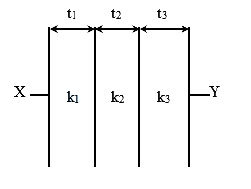
Two parallel plates with dielectric placed between the plates are as shown in figure. The resultant capacity of capacitor will [A = area of plate. \(t_1, t_2\) and \(t_3\) are thickness of dielectric slabs, \(k_1\), \(\mathrm{k}_2\) and \(\mathrm{k}_3\) are dielectric constant.]
- A \(\frac{\mathrm{A} \varepsilon_0}{\left[\frac{\mathrm{t}_1+\mathrm{t}_2+\mathrm{t}_3}{\mathrm{k}_1+\mathrm{k}_2+\mathrm{k}_3}\right]}\)
- B \(\frac{\mathrm{A} \varepsilon_0\left(\mathrm{k}_1 \mathrm{k}_2 \mathrm{k}_3\right)}{\mathrm{t}_1 \mathrm{t}_2 \mathrm{t}_3}\)
- C \(\mathrm{~A} \varepsilon_0\left[\frac{\mathrm{k}_1}{\mathrm{t}_1}+\frac{\mathrm{k}_2}{\mathrm{t}_2}+\frac{\mathrm{k}_3}{\mathrm{t}_3}\right]\)
- D \(\frac{\mathrm{A} \varepsilon_0}{\left[\frac{\mathrm{t}_1}{\mathrm{k}_1}+\frac{\mathrm{t}_2}{\mathrm{k}_2}+\frac{\mathrm{t}_3}{\mathrm{k}_3}\right]}\)
Answer & Solution
Correct Answer
(D) \(\frac{\mathrm{A} \varepsilon_0}{\left[\frac{\mathrm{t}_1}{\mathrm{k}_1}+\frac{\mathrm{t}_2}{\mathrm{k}_2}+\frac{\mathrm{t}_3}{\mathrm{k}_3}\right]}\)
Step-by-step Solution
Detailed explanation
These are three capacitors connected in series.
\(\frac{1}{\mathrm{C}}=\frac{1}{\mathrm{C}_1}+\frac{1}{\mathrm{C}_2}+\frac{1}{\mathrm{C}_3}=\frac{\mathrm{t}_1}{\varepsilon_0 \mathrm{Ak}_1}\) \(+~\frac{\mathrm{t}_2}{\varepsilon_0 \mathrm{Ak}_2}+\frac{\mathrm{t}_3}{\varepsilon_0 \mathrm{Ak}_3}\)
\(\mathrm{C}=\frac{\mathrm{A} \varepsilon_0}{\left[\frac{\mathrm{t}_1}{\mathrm{k}_1}+\frac{\mathrm{t}_2}{\mathrm{k}_2}+\frac{\mathrm{t}_3}{\mathrm{k}_3}\right]}\)
\(\frac{1}{\mathrm{C}}=\frac{1}{\mathrm{C}_1}+\frac{1}{\mathrm{C}_2}+\frac{1}{\mathrm{C}_3}=\frac{\mathrm{t}_1}{\varepsilon_0 \mathrm{Ak}_1}\) \(+~\frac{\mathrm{t}_2}{\varepsilon_0 \mathrm{Ak}_2}+\frac{\mathrm{t}_3}{\varepsilon_0 \mathrm{Ak}_3}\)
\(\mathrm{C}=\frac{\mathrm{A} \varepsilon_0}{\left[\frac{\mathrm{t}_1}{\mathrm{k}_1}+\frac{\mathrm{t}_2}{\mathrm{k}_2}+\frac{\mathrm{t}_3}{\mathrm{k}_3}\right]}\)
See the Complete Solution
Get step-by-step explanations for this and 2.5 Lakh+ more JEE, NEET & CET questions.
- Unlock all solutions
- Practice the full chapter
- Track accuracy across PYQs
4.8 rated on Google Play · 14,000+ reviews
More questions from Physics
- Four point charges each \(+q\) is placed on the circumference of a circle of diameter 2 d in such a way that they form a square. The potential at the centre is proportional toMHT CET 2024 Medium
- At \(273^{\circ} \mathrm{C}\), the emissive power of a perfectly black body is \(R\). It emissive power at \(0^{\circ} \mathrm{Cis}\)MHT CET 2022 Easy
- Water rises upto a height 'h' in a capillary tube on the surface of the earth. The value of ' \(\mathrm{h}\) ' will increase if the experimental setup is kept in \([\mathrm{g}=\) acceleration due
to gravity]MHT CET 2020 Easy - Out of the fundamental forces in nature, maximum and minimum range is respectively forMHT CET 2020 Easy
- An inductance coil has a resistance of \(80 \Omega\). When on AC signal of frequency 480 Hz is applied to the coil, the voltage leads the current by \(45^{\circ}\). The inductance of the coil in henry is \(\left[\sin 45^{\circ}=\cos 45^{\circ}=1 / \sqrt{2}\right]\)MHT CET 2024 Medium
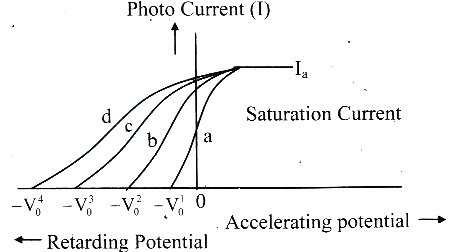
- The figure shows the variation of photocurrent with anode potential for four different radiations. Let \(f_a, f_b, f_c\) and \(f_d\) be the frequencies for the curves \(a, b, c\) and \(d\) respectively
 MHT CET 2024 Easy
More PYQs from MHT CET
- The common name of Benzene-1, 2, 3-triol isMHT CET 2024 Medium
- \(\operatorname{cosec} 2 \theta-\cot 2 \theta=\)MHT CET 2020 Medium
- If \(\mathrm{P}(\mathrm{A})=\frac{2}{5}, \mathrm{P}(\mathrm{B})=\frac{1}{4}\) and \(\mathrm{P}(\mathrm{AUB})=\frac{1}{2}\), then \(\mathrm{P}\left(\mathrm{A}^{\prime} \cup \mathrm{B}^{\prime}\right)=\)MHT CET 2020 Easy
- Which one of the following process occur inside the nucleus during protein synthesis in eukaryotic cells?MHT CET 2017 Hard
- Which one of the following is NOT a characteristic feature of Addison's disease?MHT CET 2025 Medium
- A random variable \(\mathrm{X}\) takes the values \(0,1,2\). Its mean is \(1 \cdot 2 .\) If \(\mathrm{P}(\mathrm{X}=0)=0.3\),
then \(\mathrm{P}(\mathrm{X}=1)=\)MHT CET 2020 Easy