


MHT CET · Physics · Thermal Properties of Matter
Two metal slabs of same cross-sectional area have thicknesses \(d_1\) and ; and thermal conductivities \(K_1\) and \(K_2\) respectively, are connected in series. The free ends of the two slabs are kept at temperatures \(T_1\) and \(T_2\left(T_1>T_2\right)\). The temperature \(T\) of their common junction is
- A \(\frac{K_1 T_1 d_2+K_2 T_2 d_1}{K_1 d_2+K_2 d_1}\)
- B \(\frac{K_1 T_1+K_2 T_2}{K_1+K_2}\)
- C \(\frac{K_1 T_1+K_2 T_2}{T_1+T_2}\)
- D \(\frac{K_1 T_1 d_1+K_2 T_2 d_2}{K_1 d_2+K_2 d_1}\)
Answer & Solution
Correct Answer
(A) \(\frac{K_1 T_1 d_2+K_2 T_2 d_1}{K_1 d_2+K_2 d_1}\)
Step-by-step Solution
Detailed explanation
Heat current, \(\dot{Q}_1=\frac{K_1\left(T_1-T\right) A}{d_1}\)
For second slab,
Heat current, \(\dot{Q}_2=\frac{K_2\left(T-T_2\right) A}{d_2}\)
As slabs are in series same heat current flows through them
\(\dot{Q}_1=\dot{Q}_2\)
\(\therefore \frac{K_1\left(T_1-T\right) A}{d_1}=\frac{K_2\left(T-T_2\right) A}{d_2}\)
Therefore, temperature \(T\) of their common junction is
\(T=\frac{K_1 T_1 d_2+K_2 T_2 d_1}{K_2 d_1+K_1 d_2}\)
For second slab,
Heat current, \(\dot{Q}_2=\frac{K_2\left(T-T_2\right) A}{d_2}\)
As slabs are in series same heat current flows through them
\(\dot{Q}_1=\dot{Q}_2\)
\(\therefore \frac{K_1\left(T_1-T\right) A}{d_1}=\frac{K_2\left(T-T_2\right) A}{d_2}\)
Therefore, temperature \(T\) of their common junction is
\(T=\frac{K_1 T_1 d_2+K_2 T_2 d_1}{K_2 d_1+K_1 d_2}\)
See the Complete Solution
Get step-by-step explanations for this and 2.5 Lakh+ more JEE, NEET & CET questions.
- Unlock all solutions
- Practice the full chapter
- Track accuracy across PYQs
4.8 rated on Google Play · 14,000+ reviews
More questions from Physics
- The percentage error in the measurement of mass and speed of a particular body is \(3 \%\) and \(4 \%\) respectively. The percentage error in the measurement of kinetic energy isMHT CET 2025 Easy
- The angle subtended by the vector \(\vec{A}=4 \hat{\imath}+3 \hat{\jmath}+12 \hat{k}\) with the \(\mathrm{x}\) -axis isMHT CET 2020 Easy
- For a transistor, current gain \((\beta)=50\). To change the collector current by \(350 \mu \mathrm{~A}\), the base current should be changed byMHT CET 2024 Easy
- How many NAND gates are required to form an AND gate?MHT CET 2010 Easy
- A plano-convex lens of refractive index ( \(\mu_1\) ' fits exactly into a plano-concave lens of refractive index \(\mu_2\). Their plane surfaces are parallel to each other. ' \(R\) ' is the radius of curvature of the curved surface of the lenses. The focal length of the combination isMHT CET 2021 Hard
- An aeroplane is flying in a horizontal direction with a velocity of \(540 \mathrm{~km} / \mathrm{hr}\) at a height of \(1960 \mathrm{~m}\). When it is vertically above the point A on the ground, a body is dropped from it. The body strikes the ground at point \(\mathrm{B}\). The distance \(\mathrm{AB}\) is equal to
\(\left(\mathrm{g}=9.8 \mathrm{~m} / \mathrm{s}^2\right)\)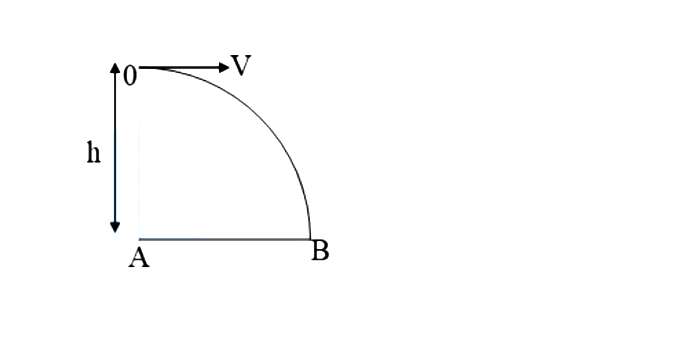 MHT CET 2022 Easy
More PYQs from MHT CET
- A moving coil galvanometer is converted into an ammeter, reading up to \(0.04 \mathrm{~A}\) by connecting a shunt of resistance ' \(3 \mathrm{r}\) ' across it and then into an ammeter reading up to \(0.8 \mathrm{~A}\), when a shunt of resistance ' \(r\) ' is connected across it. What is the maximum current which can be sent through this galvanometer if no shunt is used?MHT CET 2021 Hard
- The equation of plane passing through \((1,0,0)\) and \((0,1,0)\) and making an angle \(45^{\circ}\) with the plane \(x+y-3=0\) isMHT CET 2025 Medium
- Four identical condensers are connected in parallel and then in series. The ratio of equivalent capacitance in series to that in parallel combination isMHT CET 2022 Easy
- The point of intersection of lines represented by isMHT CET 2018 Medium
- A simple pendulum is suspended from ceiling of a lift when lift is at rest its period is 'T'. With what acceleration 'a' should lift be accelerated upward in order to reduce the period to ' \(\frac{\mathrm{T}}{2}\) ?
(take 'g' as acceleration due to gravity)MHT CET 2025 Medium - \(\bar{a}=\hat{i}+j+\hat{k}, \bar{b}=\hat{i}-j+2 \hat{k}\) and \(\bar{c}=x|+(x-1)\rangle-\hat{k}\). If the vector \(\bar{c}\) lies in the plane
of \(\bar{u}\) and \(\bar{b}\), then \(x=\)MHT CET 2020 Easy