


MHT CET · Physics · Rotational Motion
Two loops ' \(A\) ' and ' \(B\) ' of radii ' \(R_1\) ' and ' \(R_2\) ' are made from uniform wire. If moment of inertia of ' \(A\) ' is ' \(I_A\) ' and that ' \(B\) ' is ' \(\mathrm{B}_{\mathrm{B}}\) ', then \(R_2 / R_1\) is \(\left[\frac{I_A}{I_B}=27\right]\)
- A \(1: 6\)
- B \(1: 4\)
- C \(1: 3\)
- D \(1: 2\)
Answer & Solution
Correct Answer
(C) \(1: 3\)
Step-by-step Solution
Detailed explanation
\(\mathrm{I}_{\mathrm{A}}=\mathrm{M}_1 \mathrm{R}_1^2, \mathrm{I}_{\mathrm{B}}=\mathrm{M}_2 \mathrm{R}_2^2...(i)\)
If \(m\) is mass per unit length then \(\mathrm{M}_1=2 \pi \mathrm{R}_1 \mathrm{~m}\) and \(\mathrm{M}_2=2 \pi \mathrm{R}_2 \mathrm{~m}\)
\(\therefore \frac{\mathrm{M}_1}{\mathrm{M}_2}=\frac{\mathrm{R}_1}{\mathrm{R}_2}...(ii)\)
\(\therefore \frac{\mathrm{I}_{\mathrm{A}}}{\mathrm{I}_{\mathrm{B}}}=\frac{\mathrm{M}_1}{\mathrm{M}_2}\left(\frac{\mathrm{R}_1}{\mathrm{R}_2}\right)^2 \ldots\) [From(i)]
\(\frac{I_A}{I_B}==\frac{R_1}{R_2}\left(\frac{R_1}{R_2}\right)^2 \ldots\) [From(ii)]
\(\frac{I_A}{I_B}=\left(\frac{R_1}{R_2}\right)^3\)
\(\begin{array}{ll}\therefore \quad 27=\left(\frac{R_1}{R_2}\right)^3 \quad \ldots\left(\text { given, }, \frac{\mathrm{I}_A}{\mathrm{I}_{\mathrm{B}}}=27\right) \\ \therefore\frac{\mathrm{R}_2}{\mathrm{R}_1}=\frac{1}{3}\end{array}\)
If \(m\) is mass per unit length then \(\mathrm{M}_1=2 \pi \mathrm{R}_1 \mathrm{~m}\) and \(\mathrm{M}_2=2 \pi \mathrm{R}_2 \mathrm{~m}\)
\(\therefore \frac{\mathrm{M}_1}{\mathrm{M}_2}=\frac{\mathrm{R}_1}{\mathrm{R}_2}...(ii)\)
\(\therefore \frac{\mathrm{I}_{\mathrm{A}}}{\mathrm{I}_{\mathrm{B}}}=\frac{\mathrm{M}_1}{\mathrm{M}_2}\left(\frac{\mathrm{R}_1}{\mathrm{R}_2}\right)^2 \ldots\) [From(i)]
\(\frac{I_A}{I_B}==\frac{R_1}{R_2}\left(\frac{R_1}{R_2}\right)^2 \ldots\) [From(ii)]
\(\frac{I_A}{I_B}=\left(\frac{R_1}{R_2}\right)^3\)
\(\begin{array}{ll}\therefore \quad 27=\left(\frac{R_1}{R_2}\right)^3 \quad \ldots\left(\text { given, }, \frac{\mathrm{I}_A}{\mathrm{I}_{\mathrm{B}}}=27\right) \\ \therefore\frac{\mathrm{R}_2}{\mathrm{R}_1}=\frac{1}{3}\end{array}\)
See the Complete Solution
Get step-by-step explanations for this and 2.5 Lakh+ more JEE, NEET & CET questions.
- Unlock all solutions
- Practice the full chapter
- Track accuracy across PYQs
4.8 rated on Google Play · 14,000+ reviews
More questions from Physics
- Two capacitors \(\mathrm{C}_1=3 \mu \mathrm{F}\) and \(\mathrm{C}_2=2 \mu \mathrm{F}\) are connected in series across d.c. source of \(100 \mathrm{~V}\). The ratio of the potential across \(C_2\) to \(C_1\) isMHT CET 2023 Medium
- Five capacitors, each of capacity 'C' are connected as shown in the figure. The resultant capacity between A & B is \(14 \mu \mathrm{~F}\). The capacity of each capacitor is
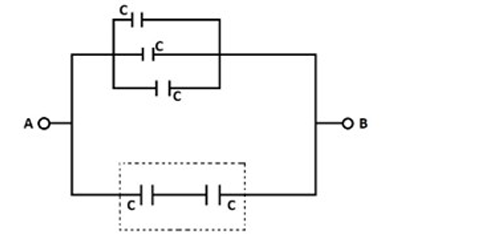 MHT CET 2025 Medium
 - Two wires of same length are made to from a circle and a square. They carry same current. The ratio of the magnetic moment of circle to that of square isMHT CET 2022 Medium
- When 100 V d.c. is applied across a solenoid, a current of 1 A flows in it. When 100 a.c. is applied across it, the current drops to 0.5 A . If the frequency is 50 Hz , the impedance and inductance isMHT CET 2024 Hard
- The end correction of resonance tube is 1 cm . If the shortest length resonating with a tuning fork is 15 cm , the next resonating length will beMHT CET 2024 Easy
- Reverse bias applied to a \(p-n\) junction diodeMHT CET 2022 Easy
More PYQs from MHT CET
- When cell of E.M.F. ' \(E_1\) ' is connected to potentiometer wire, the balancing length is \(l_1\). Another cell of E.M.F. ' \(E_2\) ' \(\left(E_1 \gt E_2\right)\) is connected so that two cells oppose each other, then the balancing length is \(l_2\). The ratio \(\mathrm{E}_1: \mathrm{E}_2\) isMHT CET 2024 Hard
- If \(\alpha, \beta\) and \(\gamma\) are the angles which a half ray makes with the positive direction of the axes, then \(\sin ^{2} \alpha+\sin ^{2} \beta+\sin ^{2} \gamma\) is equal toMHT CET 2011 Medium
- Which among the following salts is NOT hydrolysed in water?MHT CET 2025 Easy
- The particular solution of differential equation \((\mathrm{x}+\mathrm{y}) \mathrm{dy}+(\mathrm{x}-\mathrm{y}) \mathrm{d} \mathrm{x}=0\) at \(\mathrm{x}=\mathrm{y}=1\) isMHT CET 2021 Hard
- Calculate rate constant of a first order reaction having pre exponential factor \(1.6 \times 10^{13} \mathrm{~s}^{-1} \quad\left(\mathrm{E}_{\mathrm{a}} / 2.303 \mathrm{RT}=21\right)\)MHT CET 2025 Medium
- Oxidation state of nitrogen in nitric oxide isMHT CET 2019 Easy