


MHT CET · Physics · Rotational Motion
Two identical particles each of mass ' \(\mathrm{m}\) ' are separated by a distance ' \(d\) '. The axis of rotation passes through the midpoint of ' \(\mathrm{d}\) ' and is perpendicular to the length \(\mathrm{d}\). If ' \(\mathrm{K}\) ' is the average rotational kinetic energy of the system, then the angular frequency is
- A \(2 \mathrm{~d} \sqrt{\frac{\mathrm{m}}{\mathrm{K}}}\)
- B \(\frac{\mathrm{d}}{2} \sqrt{\frac{\mathrm{K}}{\mathrm{m}}}\)
- C \(\frac{2}{\mathrm{~d}} \sqrt{\frac{\mathrm{K}}{\mathrm{m}}}\)
- D \(\frac{\mathrm{d}}{4} \sqrt{\frac{\mathrm{m}}{\mathrm{K}}}\)
Answer & Solution
Correct Answer
(C) \(\frac{2}{\mathrm{~d}} \sqrt{\frac{\mathrm{K}}{\mathrm{m}}}\)
Step-by-step Solution
Detailed explanation
Moment of inertia \(\mathrm{I}=2 \mathrm{~m}\left(\frac{\mathrm{d}}{2}\right)^2=\frac{\mathrm{md}^2}{2}\)
Kinetic energy \(K=\frac{1}{2} I \omega^2\)
\(\therefore \omega^2=\frac{2 \mathrm{~K}}{\mathrm{I}}=2 \mathrm{~K} \cdot \frac{2}{\mathrm{md}^2}=\frac{4 \mathrm{~K}}{\mathrm{md}^2}\)
\(\therefore \omega=\frac{2}{\mathrm{~d}} \sqrt{\frac{\mathrm{k}}{\mathrm{m}}}\)
Kinetic energy \(K=\frac{1}{2} I \omega^2\)
\(\therefore \omega^2=\frac{2 \mathrm{~K}}{\mathrm{I}}=2 \mathrm{~K} \cdot \frac{2}{\mathrm{md}^2}=\frac{4 \mathrm{~K}}{\mathrm{md}^2}\)
\(\therefore \omega=\frac{2}{\mathrm{~d}} \sqrt{\frac{\mathrm{k}}{\mathrm{m}}}\)
See the Complete Solution
Get step-by-step explanations for this and 2.5 Lakh+ more JEE, NEET & CET questions.
- Unlock all solutions
- Practice the full chapter
- Track accuracy across PYQs
4.8 rated on Google Play · 14,000+ reviews
More questions from Physics
- The moments of inertia of two freely rotating bodies \(A\) and \(B\) are \(I_{A}\) and \(I_{B}\) respectively. \(I_{A}>I_{B}\) and their angular momenta are equal. If \(K_{A}\) and \(K_{B}\) are their kinetic energies, thenMHT CET 2009 Medium
- An electrical circuit consists of the resistances \(R, r_1, R_2\) and voltage sources \(E_1\) and \(E_2\) as shown in the figure The correct equation for the loop \(E B C D E\) is
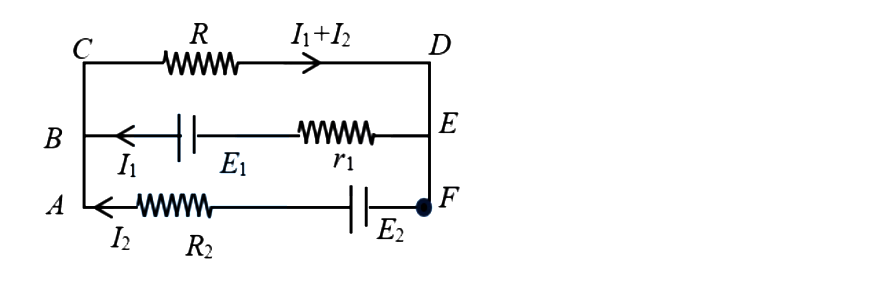 MHT CET 2022 Easy
 - In a biprism experiment, monochromatic light of wavelength ' \(\gamma\) ' is used. The distance between the two coherent sources ' \(d\) ' is kept constant. If the distance between slit and eyepiece ' \(D\) ' is varied as \(\mathrm{D}_1, \mathrm{D}_2, \mathrm{D}_3, \mathrm{D}_4\) and corresponding measured fringe widths are \(\mathrm{W}_1, \mathrm{~W}_2, \mathrm{~W}_3, \mathrm{~W}_4\) thenMHT CET 2024 Easy
- A mass 'm' is tied to one end of a spring and whirled in a horizontal circle with constant angular velocity. The elongation in the spring is \(1 \mathrm{~cm} .\) If the angular speed is doubled, the elongation in the spring is \(6 \mathrm{~cm}\). The original length of the spring isMHT CET 2020 Easy
- Two rods of different materials have lengths ' \(\ell_1\) ' and ' \(\ell_2\) ' whose coefficient of linear expansions are ' \(\alpha_1\) ' and ' \(\alpha_2\) ' respectively. If the difference between the two lengths is independent of temperature thenMHT CET 2025 Medium
- For a particle performing S.H.M., the displacement-time graph is as shown.
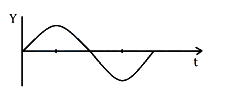
For that particle the force-time graph is correctly shown in graph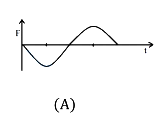
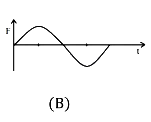
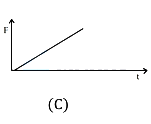
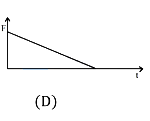 MHT CET 2020 Easy
More PYQs from MHT CET
- The area (in sq. units) of the region bounded by curves \(y=3 x+1, y=4 x+1\) and \(x=3\) isMHT CET 2023 Medium
- For a transistor, current gain \((\beta)=50\). To change the collector current by \(350 \mu \mathrm{~A}\), the base current should be changed byMHT CET 2024 Easy
- If \(\mathrm{y}=a^x \cdot \mathrm{~b}^{2 x-1}\), then \(\frac{\mathrm{d}^2 \mathrm{y}}{\mathrm{d} x^2}\) is equal toMHT CET 2025 Medium
- What is the oxidation state of S in \(\mathrm{SO}_4^{2-}\) ?MHT CET 2024 Easy
- Identify a mineral of zinc from following.MHT CET 2024 Easy
- The maximum value of subject to and isMHT CET 2018 Hard