


MHT CET · Physics · Capacitance
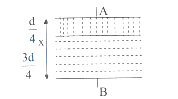
Two dielectric slabs having dielectric constant ' \(\mathrm{K}_1\) ' and ' \(\mathrm{K}_2\) ' of thickness ' \(\frac{\mathrm{d}}{4}\) and \(\frac{3 \mathrm{~d}}{4}\) are inserted between the plates as shown in figure. The net capacitance between \(A\) and \(B\) is \(\left[\varepsilon_0\right.\) is permittivity of free space]
- A \(\frac{2 \mathrm{~A} \varepsilon_0}{\mathrm{~d}}\left[\frac{\mathrm{K}_1 \mathrm{~K}_2}{3 \mathrm{~K}_1+\mathrm{K}_2}\right]\)
- B \(\frac{3 \mathrm{~A} \varepsilon_0}{\mathrm{~d}}\left[\frac{\mathrm{K}_1+\mathrm{K}_2}{\mathrm{~K}_1 \mathrm{~K}_2}\right]\)
- C \(\frac{3 \mathrm{A}\varepsilon_0}{2 \mathrm{~d}}\left[\frac{\mathrm{K}_1+\mathrm{K}_2}{\mathrm{~K}_1 \mathrm{~K}_2}\right]\)
- D \(\frac{4 A \varepsilon_0}{d}\left[\frac{K_1 K_2}{3 K_1+K_2}\right]\)
Answer & Solution
Correct Answer
(D) \(\frac{4 A \varepsilon_0}{d}\left[\frac{K_1 K_2}{3 K_1+K_2}\right]\)
Step-by-step Solution
Detailed explanation
Capacity of \(1^{\text {st }}\) Capacitor,
\(C_1=\frac{K_1 \varepsilon_0 A}{d / 4}=\frac{4 K_1 \varepsilon_0 A}{d}\)
Capacity of \(2^{\text {nd }}\) Capacitor,
\(\mathrm{C}_2=\frac{\mathrm{K}_2 \varepsilon_0 \mathrm{~A}}{3 \mathrm{~d} / 4}=\frac{4 \mathrm{~K}_2 \varepsilon_0 \mathrm{~A}}{3 \mathrm{~d}}\)
Equivalent capacitance \(\frac{1}{\mathrm{C}}=\frac{1}{\mathrm{C}_1}+\frac{1}{\mathrm{C}_2}\)
\(\begin{aligned}
\frac{1}{\mathrm{C}_1} & =\frac{\mathrm{d}}{4 \mathrm{~K}_1 \varepsilon_0 \mathrm{~A}} ; \frac{1}{\mathrm{C}_2}=\frac{3 \mathrm{~d}}{4 \mathrm{~K}_2 \varepsilon_0 \mathrm{~A}} \\
\frac{1}{\mathrm{C}} & =\frac{\mathrm{d}}{4 \mathrm{~K}_1 \varepsilon_0 \mathrm{~A}}+\frac{3 \mathrm{~d}}{4 \mathrm{~K}_2 \varepsilon_0 \mathrm{~A}} \\
\frac{1}{\mathrm{C}} & =\frac{\mathrm{d}}{4 \varepsilon_0 \mathrm{~A}}\left[\frac{1}{\mathrm{~K}_1}+\frac{3}{\mathrm{~K}_2}\right] \\
\frac{1}{\mathrm{C}} & =\frac{\mathrm{d}}{4 \varepsilon_0 \mathrm{~A}}\left[\frac{\mathrm{K}_2+3 \mathrm{~K}_1}{\mathrm{~K}_1 \mathrm{~K}_2}\right] \\
\therefore \quad \mathrm{C} & =\frac{4 \varepsilon_0 \mathrm{~A}}{\mathrm{~d}}\left[\frac{\mathrm{K}_1 \mathrm{~K}_2}{3 \mathrm{~K}_1+\mathrm{K}_2}\right]
\end{aligned}\)
\(C_1=\frac{K_1 \varepsilon_0 A}{d / 4}=\frac{4 K_1 \varepsilon_0 A}{d}\)
Capacity of \(2^{\text {nd }}\) Capacitor,
\(\mathrm{C}_2=\frac{\mathrm{K}_2 \varepsilon_0 \mathrm{~A}}{3 \mathrm{~d} / 4}=\frac{4 \mathrm{~K}_2 \varepsilon_0 \mathrm{~A}}{3 \mathrm{~d}}\)
Equivalent capacitance \(\frac{1}{\mathrm{C}}=\frac{1}{\mathrm{C}_1}+\frac{1}{\mathrm{C}_2}\)
\(\begin{aligned}
\frac{1}{\mathrm{C}_1} & =\frac{\mathrm{d}}{4 \mathrm{~K}_1 \varepsilon_0 \mathrm{~A}} ; \frac{1}{\mathrm{C}_2}=\frac{3 \mathrm{~d}}{4 \mathrm{~K}_2 \varepsilon_0 \mathrm{~A}} \\
\frac{1}{\mathrm{C}} & =\frac{\mathrm{d}}{4 \mathrm{~K}_1 \varepsilon_0 \mathrm{~A}}+\frac{3 \mathrm{~d}}{4 \mathrm{~K}_2 \varepsilon_0 \mathrm{~A}} \\
\frac{1}{\mathrm{C}} & =\frac{\mathrm{d}}{4 \varepsilon_0 \mathrm{~A}}\left[\frac{1}{\mathrm{~K}_1}+\frac{3}{\mathrm{~K}_2}\right] \\
\frac{1}{\mathrm{C}} & =\frac{\mathrm{d}}{4 \varepsilon_0 \mathrm{~A}}\left[\frac{\mathrm{K}_2+3 \mathrm{~K}_1}{\mathrm{~K}_1 \mathrm{~K}_2}\right] \\
\therefore \quad \mathrm{C} & =\frac{4 \varepsilon_0 \mathrm{~A}}{\mathrm{~d}}\left[\frac{\mathrm{K}_1 \mathrm{~K}_2}{3 \mathrm{~K}_1+\mathrm{K}_2}\right]
\end{aligned}\)
See the Complete Solution
Get step-by-step explanations for this and 2.5 Lakh+ more JEE, NEET & CET questions.
- Unlock all solutions
- Practice the full chapter
- Track accuracy across PYQs
4.8 rated on Google Play · 14,000+ reviews
More questions from Physics
- A charge 'Q' \(\mu\) C is placed at the centre of a cube. The flux through one face and two
opposite faces of the cube is respectivelyMHT CET 2020 Easy - The magnetic susceptibility of iron is 5499. The relative permeability of iron will beMHT CET 2025 Easy
- Two point charges +10 q and -4 q are located at \(\mathrm{x}=0\) and \(\mathrm{x}=\mathrm{L}\) respectively. What is the location of a point on the x -axis from the origin, which the net electric field due to these two point charges is zero? \((\mathrm{r}=\) required distance \()\)MHT CET 2024 Hard
- The average translational kinetic energy of \(N\) molecules in a gas is \(E_1\). The kinetic energy of the electron \((e)\) accelerated from rest through potential difference \(V\) volt is \(E_2\). The temperature at which \(E_1=E_2\) possible is ( \(R=\) gas constant, \(N=\) number of molecules)MHT CET 2022 Medium
- In an organ pipe closed at one end, the sum of the frequencies of first three overtones is 3930 Hz . The frequency of the fundamental mode of organ pipe isMHT CET 2025 Medium
- A pendulum is oscillating with frequency ' \(n\) ' on the surface of earth. If it is taken to a depth \(\frac{{ }^{\prime} \mathrm{R}^{\prime}}{3}\) below the surface of earth, new frequency of oscillation is ( \(R=\) radius of earth)MHT CET 2025 Medium
More PYQs from MHT CET
- Calculate the work done in kJ when 3 moles of an ideal gas at \(27^{\circ} \mathrm{C}\) expand isothermally and reversibly from 10 atm . to \(1 \mathrm{~atm}\left[\mathrm{R}=8.314 \mathrm{~J} \mathrm{~K}^{-1} \mathrm{~mol}^{-1}\right]\)MHT CET 2025 Medium
- If \(\mathrm{f}(x)=\sin ^{-1}\left(\frac{2 \cdot 3^x}{1+9^x}\right)\), then \(\mathrm{f}^{\prime}\left(\frac{1}{2}\right)\) equalsMHT CET 2024 Hard
- Which of the following is not present in DNA?MHT CET 2019 Easy
- Mitral valve and tricuspid valve are attached to the papillary muscles by __________ .MHT CET 2017 Hard
- If the . (cumulative distribution function) is given by then ________MHT CET 2019 Hard
- Alternating current of peak value ampere flows through the primary coil of the transformer. The coefficient of mutual inductance between primary and secondary coil is 1 henry. The peak emf induced in secondary coil is (Frequency of AC = 50 Hz)MHT CET 2016 Easy