


MHT CET · Physics · Motion In One Dimension
Two cars A and B start from a point at the same time in a straight line and their positions are represented by \(\mathrm{R}_{\mathrm{A}}(\mathrm{t})=\mathrm{at}+\mathrm{bt}^2\) and \(\mathrm{R}_{\mathrm{B}}(\mathrm{t})=x \mathrm{t}-\mathrm{t}^2\). At what time do the cars have same velocity?
- A \(\frac{x-a}{2(b+1)}\)
- B \(\frac{x+a}{2(b-1)}\)
- C \(\frac{x-a}{(b+1)}\)
- D \(\frac{x+a}{(b-1)}\)
Answer & Solution
Correct Answer
(A) \(\frac{x-a}{2(b+1)}\)
Step-by-step Solution
Detailed explanation
\(\therefore \quad\) Velocity of car A and B:
\(\begin{aligned}
\mathrm{V}_{\mathrm{A}} & =\frac{\mathrm{d}\left(\mathrm{R}_{\mathrm{A}}\right)}{\mathrm{dt}} \\
& =\mathrm{a}+2 \mathrm{bt} \\
\mathrm{V}_{\mathrm{B}} & =\frac{\mathrm{d}\left(\mathrm{R}_{\mathrm{B}}\right)}{\mathrm{dt}} \\
& =\mathrm{x}-2 \mathrm{t}
\end{aligned}\)
\(\therefore \quad\) So, time at which cars have same velocity is
\(\begin{array}{ll}
& V_A=V_B \\
& a+2 b t=x-2 t \\
\therefore \quad & t=\frac{x-a}{2(b+1)}
\end{array}\)
\(\begin{aligned}
\mathrm{V}_{\mathrm{A}} & =\frac{\mathrm{d}\left(\mathrm{R}_{\mathrm{A}}\right)}{\mathrm{dt}} \\
& =\mathrm{a}+2 \mathrm{bt} \\
\mathrm{V}_{\mathrm{B}} & =\frac{\mathrm{d}\left(\mathrm{R}_{\mathrm{B}}\right)}{\mathrm{dt}} \\
& =\mathrm{x}-2 \mathrm{t}
\end{aligned}\)
\(\therefore \quad\) So, time at which cars have same velocity is
\(\begin{array}{ll}
& V_A=V_B \\
& a+2 b t=x-2 t \\
\therefore \quad & t=\frac{x-a}{2(b+1)}
\end{array}\)
See the Complete Solution
Get step-by-step explanations for this and 2.5 Lakh+ more JEE, NEET & CET questions.
- Unlock all solutions
- Practice the full chapter
- Track accuracy across PYQs
4.8 rated on Google Play · 14,000+ reviews
More questions from Physics
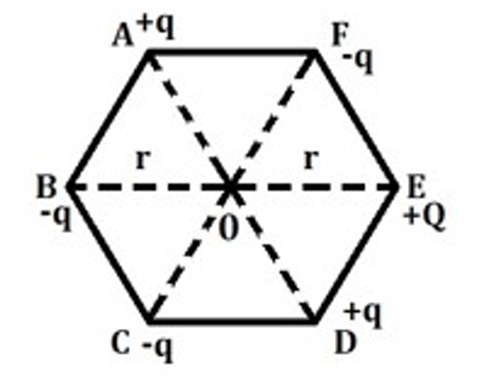
- The point charges \(+\mathrm{q},-\mathrm{q},-\mathrm{q},+\mathrm{q},+\mathrm{Q}\) and -q are placed at the vertices of a regular hexagon ABCDEF as shown in figure. The electric field at the centre of hexagon ' \(O\) ' due to the five charges at \(A, B, C, D\) and \(F\) is twice the electric field at centre ' \(O\) ' due to charge \(+Q\) at \(E\) alone. The value of Q is
 MHT CET 2025 Medium
 - The average force applied on the walls of a closed container depends as \(\mathrm{T}^{\mathrm{x}}\) where T is the temperature of an ideal gas. The value of x isMHT CET 2025 Medium
- The observer is moving with velocity \(v_0\) towards the stationary source of sound and then after crossing moves away from the source with velocity \(v_0\). Assume that the medium through which the sound waves travel is at rest. If \(v\) is the velocity of sound and \(n\) is the frequency emitted by the source then the difference between apparent frequencies heard by the observer isMHT CET 2017 Medium
- If the speed of an electron of hydrogen atom in the ground state is , then its speed in the third excited state will beMHT CET 2019 Easy
- The angle made by incident ray of light with the reflecting surface is calledMHT CET 2018 Easy
- Two copper wires of radii \(r_1\) and \(r_2\left(r_1>r_2\right)\) are subjected to the same tension and are plucked. The transverse waves willMHT CET 2022 Easy
More PYQs from MHT CET
- Which of the following compounds has difficulty in breaking the \(\mathrm{C}-\mathrm{Cl}\) bond?MHT CET 2024 Medium
- An element crystallises in fcc type of unit cell. The volume of one unit cell is \(24.99 \times 10^{-24} \mathrm{~cm}^{3}\) and density of the element \(7 \cdot 2 \mathrm{~g} \mathrm{~cm}^{-3} .\) Calculate the number of unit cells in \(36 \mathrm{~g}\) of pure sample of element?MHT CET 2020 Easy
- A liquid having coefficient of cubical expansion ' \(\gamma\) ' is kept in a copper vessel having coefficient of linear expansion \(\frac{\gamma}{3}\). If heat is supplied to the vessel, the original level of the liquid in the vessel willMHT CET 2025 Medium
- An ideal gas expands from \(1 \times 10^{-3} \mathrm{~m}^{3}\) to \(1 \times 10^{-2} \mathrm{~m}^{3}\) at \(300 \mathrm{~K}\) against a constant external pressure of \(1 \times 10^{5} \mathrm{~nm}^{-2}\), work done isMHT CET 2020 Easy
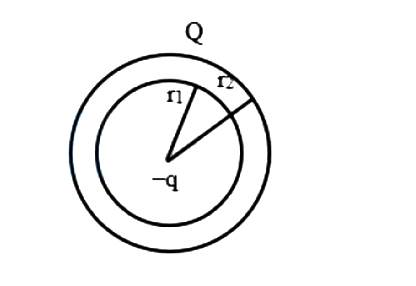
- A spherical conducting shell of inner radius ' \(r_1\) ' and outer radius ' \(r_2\) ' has a charge ' \(Q\) '. A charge \(-q\) is placed at the center of the shell. The surface charge density on the inner and outer surface of the shell will be
 MHT CET 2021 Easy
 - Identify product 'C' in following reaction
\(\mathrm{C}_{2} \mathrm{H}_{5} \mathrm{OH} \underset{\text { Pyridine }}{\stackrel{\mathrm{SOCl}_{2}}{\longrightarrow}} \mathrm{A} \stackrel{\mathrm{C}_{2} \mathrm{H}_{5} \mathrm{ONa}}{\longrightarrow} \mathrm{B} \underset{\Delta \text { , Pressure }}{\stackrel{\text { dil } \mathrm{H}_{2} \mathrm{SO}_{4}}{\longrightarrow}} \mathrm{C}\)MHT CET 2020 Medium