


MHT CET · Physics · Capacitance
Two capacitors of capacities \(2 \mu \mathrm{F}\) and \(4 \mu \mathrm{F}\) are connected in parallel. A third
capacitor of \(6 \mu \mathrm{F}\) capacity is connected in series with this combination. A battery
of \(12 \mathrm{~V}\) is connected across this combination. The charge on \(2 \mu \mathrm{F}\) capacitor is
- A \(12 \mu C\)
- B \(16 \mu C\)
- C \(14 \mu C\)
- D \(11 \mu C\)
Answer & Solution
Correct Answer
(A) \(12 \mu C\)
Step-by-step Solution
Detailed explanation
Two capacitors of capacities \(2 \mu \mathrm{F}\) and \(4 \mu \mathrm{F}\) are connected in parallel. A third capacitor of \(6 \mu \mathrm{F}\) capacity is connected in series with this combination. A battery of \(12 \mathrm{~V}\) is connected across this combination. The charge on \(2 \mu \mathrm{F}\) capacitor is \(12 \mu \mathrm{C}\).
Explanation:
The circuit diagram of given situation is as shown below
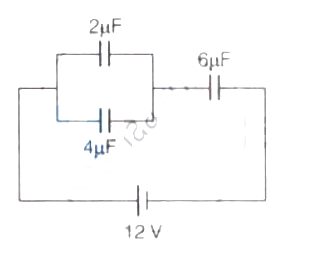
The equivalent capacitance of \(2 \mu \mathrm{F}\) and \(4 \mu \mathrm{F}\) capacitors connected in parallel Is \(C_{e q}=2+4=6 \mu \mathrm{F}\)
The circuit now becomes
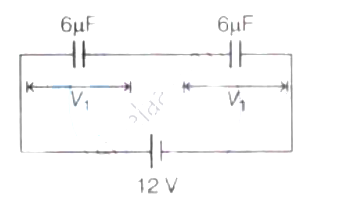
As, both the capacitors are of the same capacitance, so the potential of \(12 \mathrm{~V}\) is equally divided in them i.e., \(V_{1}=V_{2}=6 V\)
In parallel combination, the potential remains the same.
\(\therefore\) Charge on \(2 \mu \mathrm{F}, \mathrm{Q}=2 \times \mathrm{V}_{1}=2 \times 6=12 \mu \mathrm{C}\)
OR
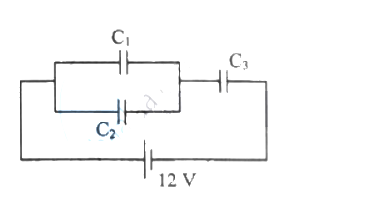
Let \(C_{1}=2 \mu F_{1} C_{2}=4 \mu F\) and \(C_{3}=6 \mu F\)
Equivalent of \(C_{1}\) and \(C_{2}=C_{4}=6 \mu F\)
Equivalent of \(C_{3}\) and \(C_{4}=C_{5}=3 \mu F\)
Charge on \(C_{5}=Q=C_{5} V=3 \times 12=36 \mu C\).
\(C_{3}\) and \(C_{4}\) are in series. Hence charge on them is also \(36 \mu C\).
The charge of \(36 \mu C\) is divided between \(C_{1}\) and \(C_{2}\) in proportion to their capacitance.
\(\frac{Q_{1}}{Q_{2}}=\frac{C_{1}}{C_{2}}\)
\(\therefore \frac{Q_{1}}{Q_{1}+Q_{2}}=\frac{C_{1}}{C_{1}+C_{2}}\)
\(\therefore \frac{Q_{1}}{Q}=\frac{C_{1}}{C_{1}+C_{2}}=\frac{2}{6}=\frac{1}{3}\)
\(\therefore Q_{1}=\frac{Q}{3}=\frac{36}{3}=12 \mu C\)
Explanation:
The circuit diagram of given situation is as shown below
The equivalent capacitance of \(2 \mu \mathrm{F}\) and \(4 \mu \mathrm{F}\) capacitors connected in parallel Is \(C_{e q}=2+4=6 \mu \mathrm{F}\)
The circuit now becomes
As, both the capacitors are of the same capacitance, so the potential of \(12 \mathrm{~V}\) is equally divided in them i.e., \(V_{1}=V_{2}=6 V\)
In parallel combination, the potential remains the same.
\(\therefore\) Charge on \(2 \mu \mathrm{F}, \mathrm{Q}=2 \times \mathrm{V}_{1}=2 \times 6=12 \mu \mathrm{C}\)
OR
Let \(C_{1}=2 \mu F_{1} C_{2}=4 \mu F\) and \(C_{3}=6 \mu F\)
Equivalent of \(C_{1}\) and \(C_{2}=C_{4}=6 \mu F\)
Equivalent of \(C_{3}\) and \(C_{4}=C_{5}=3 \mu F\)
Charge on \(C_{5}=Q=C_{5} V=3 \times 12=36 \mu C\).
\(C_{3}\) and \(C_{4}\) are in series. Hence charge on them is also \(36 \mu C\).
The charge of \(36 \mu C\) is divided between \(C_{1}\) and \(C_{2}\) in proportion to their capacitance.
\(\frac{Q_{1}}{Q_{2}}=\frac{C_{1}}{C_{2}}\)
\(\therefore \frac{Q_{1}}{Q_{1}+Q_{2}}=\frac{C_{1}}{C_{1}+C_{2}}\)
\(\therefore \frac{Q_{1}}{Q}=\frac{C_{1}}{C_{1}+C_{2}}=\frac{2}{6}=\frac{1}{3}\)
\(\therefore Q_{1}=\frac{Q}{3}=\frac{36}{3}=12 \mu C\)
See the Complete Solution
Get step-by-step explanations for this and 2.5 Lakh+ more JEE, NEET & CET questions.
- Unlock all solutions
- Practice the full chapter
- Track accuracy across PYQs
4.8 rated on Google Play · 14,000+ reviews
More questions from Physics
- 90 J of work is done to move an electric charge of magnitude 3 C from a place A , where potential is -10 V to another place B , where potential is ' \(\mathrm{V}_1\) ' volt. The value of \(\mathrm{V}_1\) isMHT CET 2024 Easy
- In S.H.M. the displacement of a particle at an instant is \(\mathrm{Y}=\mathrm{A} \cos 30^{\circ}\), where \(\mathrm{A}=40 \mathrm{~cm}\) and kinetic energy is 200 J . If force constant is \(1 \times 10^{\mathrm{x}} \mathrm{N} / \mathrm{m}\), then x will be \(\left(\cos 30^{\circ}=\sqrt{3} / 2\right)\)MHT CET 2024 Medium
- Convex lens of focal length \(1 / 3 \mathrm{~m}\) forms a real, inverted image twice in size of the object. The distance of the object from the lens isMHT CET 2025 Medium
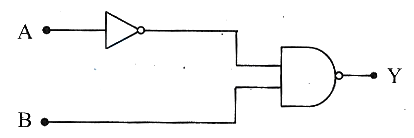
- For the following digital logic circuit, the correct truth-table is
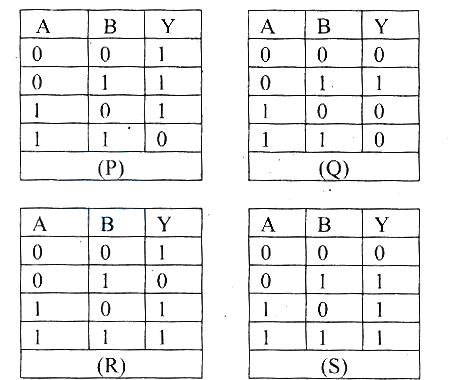 MHT CET 2024 Easy
 - The moment of inertia of a circular disc of radius \(2 \mathrm{~m}\) and mass \(1 \mathrm{~kg}\) about an axis \(\mathrm{XY}\) passing through its center of mass and perpendicular to the plane of the disc is \(2 \mathrm{~kg} \mathrm{~m}^2\). The moment of inertia about an axis parallel to the axis \(\mathrm{XY}\) and passing through the edge of the disc isMHT CET 2021 Medium
- The current drawn from the battery in the given network is (Internal resistance of battery is neglected)
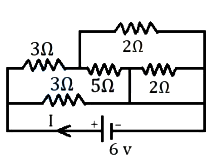 MHT CET 2020 Easy
More PYQs from MHT CET
- Which group of drugs is normally used as medicine?MHT CET 2020 Easy
- Which one of the following elements is an important binding agent in ribosomes during protein synthesis?MHT CET 2020 Hard
- A line having direction ratios \(1,-4,2\) intersects the lines \(\frac{x-7}{3}=\frac{y-1}{-1}=\frac{z+2}{1}\) and \(\frac{x}{2}=\frac{y-7}{3}=\frac{z}{1}\) at the points \(A\) and \(B\) resp., then co-ordinates of points A and B areMHT CET 2024 Medium
- If a ray of light in denser medium strikes a rarer medium at angle of incidence \(i\), the angles of reflection and refraction are \(r\) and \(r^{\prime}\) respectively. If the reflected and refracted rays are at right angles to each other, the critical angle for the given pair of media isMHT CET 2023 Medium
- Match the column I with column II and select the correct option.
Column I
(Pathogen)Column II
(Host)a. Bacillus papillae i. Gypsy moths b. Beauveria bassiana ii. Cabbage worms c. Nosema locustae iii. Aphids d. Nucleopolyhedroviral virus iv. Grasshoppers MHT CET 2022 Medium - If \(\vec{a}=\hat{i}+2 \hat{j}+3 \hat{k}, \vec{b}=-\hat{\imath}+2 \hat{\jmath}+\hat{k}, \vec{c}=3 \hat{i}+\hat{j}\) and \(\bar{a}+\lambda \bar{b}\) is perpendicular to \(\overline{\mathrm{c}}\), then \(\lambda=\)MHT CET 2021 Medium