


MHT CET · Physics · Current Electricity
To determine the internal resistance of a cell by using a potentiometer, the null point is at \(1 \mathrm{~m}\) when the cell is shunted by \(3 \Omega\) resistance and at a length \(1.5 \mathrm{~m}\) when cell is shunted by \(6 \Omega\) resistance. The internal resistance of the cell is.
- A \(8 \Omega\)
- B \(4 \Omega\)
- C \(6 \Omega\)
- D \(3 \Omega\)
Answer & Solution
Correct Answer
(C) \(6 \Omega\)
Step-by-step Solution
Detailed explanation
Consider the following diagram:
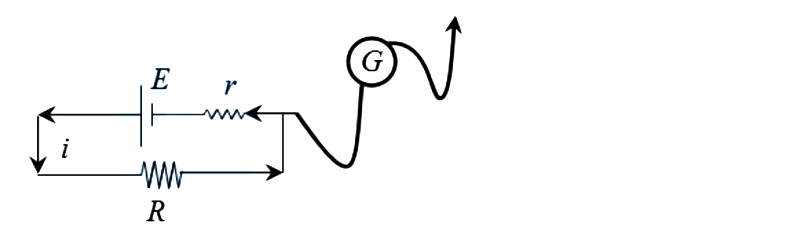
The potential drop across the external shunt resistance \(R\) is equal to the potential drop across the battery of emf \(E\) and internal resistance \(r\).
\(\begin{aligned} & \Delta V=E-i r=i R \\ & \Rightarrow i=\frac{E}{(R+r)} \\ & \therefore \Delta V=i R=\frac{E R}{(R+r)}\end{aligned}\)
\(\because \Delta V \propto L\), i.e., the balance length is directly proportional to the potential drop.
Therefore,
\(\frac{E R}{(R+r)} \propto L\)
In case of internal resistance measurement by potentiometer, considering two balance lengths \(\left(L_1, L_2\right)\) corresponding to shunt resistors \(\left(R_1, R_2\right)\) respectively,
\(\Rightarrow \frac{V_1}{V_2}=\frac{L_1}{L_2}=\frac{\left\{E R_1 /\left(R_1+r\right)\right\}}{\left\{E R_2 /\left(R_2+r\right)\right\}}=\frac{R_1\left(R_2+r\right)}{R_2\left(R_1+r\right)}\).
Here, \(L_1=1 \mathrm{~m}, L_2=1.5 \mathrm{~m},
\)
\(\Rightarrow \frac{1}{1.5}=\frac{3(6+r)}{6(3+r)}\) \(
6+2r =9+1.5r
\)
\(\Rightarrow r=6 \Omega\)
The potential drop across the external shunt resistance \(R\) is equal to the potential drop across the battery of emf \(E\) and internal resistance \(r\).
\(\begin{aligned} & \Delta V=E-i r=i R \\ & \Rightarrow i=\frac{E}{(R+r)} \\ & \therefore \Delta V=i R=\frac{E R}{(R+r)}\end{aligned}\)
\(\because \Delta V \propto L\), i.e., the balance length is directly proportional to the potential drop.
Therefore,
\(\frac{E R}{(R+r)} \propto L\)
In case of internal resistance measurement by potentiometer, considering two balance lengths \(\left(L_1, L_2\right)\) corresponding to shunt resistors \(\left(R_1, R_2\right)\) respectively,
\(\Rightarrow \frac{V_1}{V_2}=\frac{L_1}{L_2}=\frac{\left\{E R_1 /\left(R_1+r\right)\right\}}{\left\{E R_2 /\left(R_2+r\right)\right\}}=\frac{R_1\left(R_2+r\right)}{R_2\left(R_1+r\right)}\).
Here, \(L_1=1 \mathrm{~m}, L_2=1.5 \mathrm{~m},
\)
\(\Rightarrow \frac{1}{1.5}=\frac{3(6+r)}{6(3+r)}\) \(
6+2r =9+1.5r
\)
\(\Rightarrow r=6 \Omega\)
See the Complete Solution
Get step-by-step explanations for this and 2.5 Lakh+ more JEE, NEET & CET questions.
- Unlock all solutions
- Practice the full chapter
- Track accuracy across PYQs
4.8 rated on Google Play · 14,000+ reviews
More questions from Physics
- In \(L-C-R\) circuit power factor at resonance isMHT CET 2011 Easy
- To a bird in air, a fish in water appears to be at \(30 \mathrm{~cm}\) from the surface. If refractive index of water with respect to air is \(\frac{4}{3}\), the real distance of bird from the surface isMHT CET 2022 Hard
- The self-inductance \(L\) of a solenoid of length \(\lambda\) and area of crosssection \(A\) with a fixed number of turns \(N\) increases asMHT CET 2022 Easy
- A particle having a charge 50 e is revolving in a circular path of radius 0.4 m with 1 r.p.s. The magnetic field produced at the centre of the circle is \(\left(\mu_0=4 \pi \times 10^{-7}\right.\) SI units and \(\left.\mathrm{e}=1 \cdot 6 \times 10^{-19} \mathrm{c}\right)\)MHT CET 2024 Easy
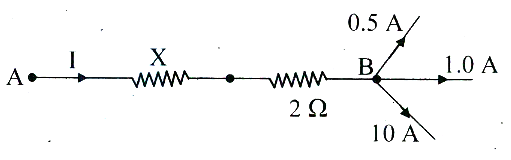
- In the following circuit, a power of 50 watt is absorbed in the section \(A B\) of the circuit. The value of resistance ' \(x\) ' is
 MHT CET 2024 Hard
 - The strength of magnetic field at a perpendicular distance ' \(x\) ' near a long straight conductor carrying current ' \(I\) ' is ' \(B\) '. The magnetic. field at a distance \(\frac{\mathrm{X}}{3}\) from straight conductor will beMHT CET 2024 Medium
More PYQs from MHT CET
- The termination of process of oogenesis is indicated by formation of __________ .MHT CET 2018 Medium
- If \(\sqrt{x}+\sqrt{y}=\sqrt{x y}\), then \(\frac{d y}{d x}=\)MHT CET 2020 Medium
- A reaction of phenol with chloroform in presence of sodium hydroxide to form salicylaldehyde is known asMHT CET 2020 Easy
- A straight conductor of length is moving with a speed of perpendicular to the magnetic field of intensity of . The induced emf across the conductor will beMHT CET 2017 Easy
- Which of the following inert gases is used for magnetic resonance imaging?MHT CET 2025 Easy
- The angle between particle velocity and wave velocity in a transverse wave isMHT CET 2008 Medium