


MHT CET · Physics · Oscillations
Three, point masses each of mass ' \(\mathrm{m}\) ' are kept at the corners of an equilateral triangle of side ' \(L\) '. The system rotates about the center of the triangle without any change in the separation of masses during rotation. The period of rotation is directly proportional to
- A L
- B \(\mathrm{L}^{1 / 2}\)
- C \(\mathrm{L}^{3 / 2}\)
- D \(\mathrm{L}^{-2}\)
Answer & Solution
Correct Answer
(C) \(\mathrm{L}^{3 / 2}\)
Step-by-step Solution
Detailed explanation
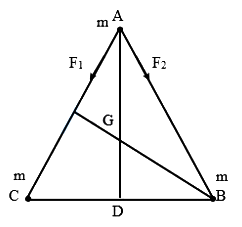
Consider mass \(\mathrm{m}\) at \(\mathrm{A}\).
The forces exerted on it by the other two masses are given by
\(\mathrm{F}_1=\mathrm{G} \frac{\mathrm{m}^2}{\mathrm{~L}^2}=\mathrm{F}_2\)
The angel between the two forces is \(60^{\circ}\). Hence the resultant force
The angel between the two forces is \(60^{\circ}\).
Hence the resultant force
\(\begin{aligned} & \mathrm{F}=\sqrt{\mathrm{F}_1^2+\mathrm{F}_1^2+2 \mathrm{~F}_1^2 \cos 60^{\circ}}=\sqrt{3} \mathrm{~F}_1 \\ & \mathrm{~F}=\sqrt{3} \cdot \mathrm{G} \frac{\mathrm{m}^2}{\mathrm{~L}^2}\end{aligned}\)
radius \(r=\frac{L}{\sqrt{3}}\)
For uniform circular motion, the gravitational force provides the centripetal force.
\(\begin{aligned} & \therefore \mathrm{mr} \omega^2=\mathrm{F} \\ & \therefore \mathrm{m} \frac{\mathrm{L}}{\sqrt{3}} \cdot \omega^2=\sqrt{3} \mathrm{G} \frac{\mathrm{m}^2}{\mathrm{~L}^2} \\ & \therefore \omega^2=3 \mathrm{G} \frac{\mathrm{m}}{\mathrm{L}^3}\end{aligned}\)
\(\begin{aligned} & \therefore \omega=\left(3 G \frac{\mathrm{m}}{\mathrm{L}^3}\right)^{1 / 2} \\ & \therefore \frac{2 \pi}{\mathrm{T}}=\left(\frac{3 \mathrm{Gm}}{\mathrm{L}^3}\right)^{1 / 2}\end{aligned}\)
\(\therefore \mathrm{T}=2 \pi\left(\frac{\mathrm{L}^3}{3Gm}\right)^{1 / 2}\)
\(\therefore \mathrm{T} \propto \mathrm{L}^{3 / 2}\)
See the Complete Solution
Get step-by-step explanations for this and 2.5 Lakh+ more JEE, NEET & CET questions.
- Unlock all solutions
- Practice the full chapter
- Track accuracy across PYQs
4.8 rated on Google Play · 14,000+ reviews
More questions from Physics
- In a diode, when there is a saturation current, the plate resistance will beMHT CET 2007 Easy
- An ideal gas in a container of volume 500 c.c. is at a pressure of \(2 \times 10^{+5} \mathrm{~N} / \mathrm{m}^2\). The average kinetic energy of each molecule is \(6 \times 10^{-21} \mathrm{~J}\). The number of gas molecules in the container isMHT CET 2023 Medium
- The electric field intensity near a conducting surface having uniform surface charge density ' \(\sigma\) ' is given by ( \(\epsilon_0=\) permittivity of free space)MHT CET 2025 Easy
- A spring has length \(l\) and force constant \(K\). If is cut into two springs of length \(l_1\) and \(l_2\) such that, \(l_1=n l_2(n\) is integer). The force constant of the spring of length \(l_2\) isMHT CET 2022 Medium
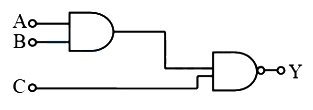
- For the following combination of logic gates, when all the three inputs \(A\), \(B\) and \(C\) are first 'high' and then 'low', the output \(Y\) will be respectively.
 MHT CET 2022 Easy
 - An open organ pipe and a closed organ pipe have the frequency of their first overtone identical. The ratio of length of open pipe to that of closed pipe isMHT CET 2020 Easy
More PYQs from MHT CET
- If \(x+y=k\) is normal to \(y^{2}=12 x\), then \(k\) isMHT CET 2011 Easy
- \(\tan 3 \mathrm{~A} \cdot \tan 2 \mathrm{~A} \cdot \tan \mathrm{A}=\)MHT CET 2021 Easy
- Let the curve be represented by \(x=2(\cos \mathrm{t}+\mathrm{t} \sin \mathrm{t}), y=2(\sin \mathrm{t}-\mathrm{t} \cos \mathrm{t})\). Then normal at any point ' \(t\) ' of the curve is at a distance of _____________ units from the origin.MHT CET 2023 Medium
- Which of the following is \(\underline{N O T}\) a character of ideal drug?MHT CET 2020 Easy
- When three inductors of same inductance 'L' are connected in series and 'I' is the current passing through the circuit. The energy stored in the circuit isMHT CET 2025 Easy
- Which of the following is Stephen reaction?MHT CET 2024 Easy