


MHT CET · Physics · Magnetic Effects of Current
Three long straight and parallel wires carrying currents are arranged as shown
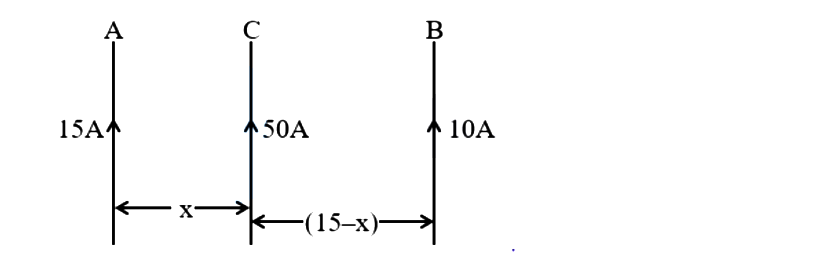
The wire \(\mathrm{C}\) which carries a current of \(50 \mathrm{~A}\) is so placed that it experiences no force. The distance of wire \(\mathrm{C}\) from wire \(\mathrm{A}\) is
- A \(3 \mathrm{~cm}\)
- B \(5 \mathrm{~cm}\)
- C \(9 \mathrm{~cm}\)
- D \(7 \mathrm{~cm}\)
Answer & Solution
Correct Answer
(C) \(9 \mathrm{~cm}\)
Step-by-step Solution
Detailed explanation
The correct option is (C).
Concept: Using Ampear's circuital law the magnetic field due to a current carrying wire at a distance \(r\) is given by, \(B=\frac{\mu_0 I}{2 \pi r}\) where, \(\mathrm{I}\) is the current through the wire.
If the magnetic field due to the wire A cancels out the magnetic field due to the wire \(\mathrm{B}\) at the wire \(\mathrm{C}\), then
\(\frac{\mu_0 I_A}{2 \pi x}=\frac{\mu_0 I_B}{2 \pi(15-x)}\)
\(\frac{(15-x)}{x}=\frac{I_B}{I_A}\)
Therefore, for \(\mathrm{I}_{\mathrm{B}}=10 \mathrm{~A}\) and \(\mathrm{I}_{\mathrm{A}}=15 \mathrm{~A}\), we get \(\mathrm{x}=9 \mathrm{~cm}\).
Concept: Using Ampear's circuital law the magnetic field due to a current carrying wire at a distance \(r\) is given by, \(B=\frac{\mu_0 I}{2 \pi r}\) where, \(\mathrm{I}\) is the current through the wire.
If the magnetic field due to the wire A cancels out the magnetic field due to the wire \(\mathrm{B}\) at the wire \(\mathrm{C}\), then
\(\frac{\mu_0 I_A}{2 \pi x}=\frac{\mu_0 I_B}{2 \pi(15-x)}\)
\(\frac{(15-x)}{x}=\frac{I_B}{I_A}\)
Therefore, for \(\mathrm{I}_{\mathrm{B}}=10 \mathrm{~A}\) and \(\mathrm{I}_{\mathrm{A}}=15 \mathrm{~A}\), we get \(\mathrm{x}=9 \mathrm{~cm}\).
See the Complete Solution
Get step-by-step explanations for this and 2.5 Lakh+ more JEE, NEET & CET questions.
- Unlock all solutions
- Practice the full chapter
- Track accuracy across PYQs
4.8 rated on Google Play · 14,000+ reviews
More questions from Physics
- A satellite moves in a stable circular orbit round the earth if (where \(\mathrm{V}_{\mathrm{H}}, \mathrm{V}_{\mathrm{c}}\) and \(\mathrm{V}_{\mathrm{e}}\) are the horizontal velocity, critical velocity and escape velocity respectively)MHT CET 2023 Easy
- Electromagnetic waves of wavelength ranging from \(100 Å\) A to \(400 Å\) comes underMHT CET 2012 Easy
- A vector \(\overrightarrow{\mathrm{A}}\) when added to the sum of the vectors \((\hat{\imath}-2 \hat{\jmath}+2 \hat{k})\) and \((-2 \hat{\imath}+\hat{\jmath}-\hat{k})\) gives a unit vector along \(\mathrm{y}\) -axis. The magnitude of the vector \(\overrightarrow{\mathrm{A}}\) isMHT CET 2020 Easy
- A charged particle of charge ' \(q\) ' is accelerated by a potential difference ' \(V\) ' enters a region of uniform magnetic field ' \(B\) ' at right angles to the direction of field. The charged particle completes semicircle of radius ' \(r\) ' inside magnetic field. The mass of the charged particle isMHT CET 2024 Medium
- The damping force of an oscillator is directly proportional to the velocity. The unit of constant of proportionality isMHT CET 2020 Easy
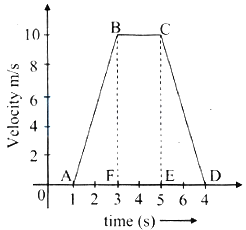
- For the velocity-time graph shown in the figure below, the distance covered by the body in last two second of its motion is ' \(\mathrm{S}_1\) '. What is the ratio of ' \(S_1\) ' to the total distance covered by it
 MHT CET 2024 Medium
More PYQs from MHT CET
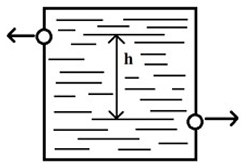
- There are two identical small holes on the opposite side of a tank containing full of a liquid. The tank is open at the top. The difference in height between the two holes is ' \(h\) '. As the liquid comes out of the two holes, the tank will experience a net horizontal force proportional to
 MHT CET 2025 Medium
 - Earth is assumed to be a charged conducting sphere having volume V and surface area \(A\). The capacitance of the earth in free space is ( \(\epsilon_0=\) permittivity of free space)MHT CET 2025 Medium
- Let \(a, b, c\) and be non-zero real numbers, if the point of intersection of the lines \(4 a x+2 a y+c=0\) and \(5 b x+2 b y+d=0\) lies in the \(4^{\text {th }}\) quadrant and is equidistant from the two axes, thenMHT CET 2022 Easy
- Identify the product ' \(A\) ' in the following reaction,
Anisole \(\xrightarrow[398 \mathrm{~K}]{\mathrm{HI}} \mathrm{A}+\) IodomethaneMHT CET 2025 Easy - Which of the following alkenes does NOT exhibit cis-trans isomerism ?MHT CET 2025 Medium
- The integrating factor of the differential equation \(\frac{d y}{d x}(x \log x)+y=2 \log x\) is given byMHT CET 2011 Easy