


MHT CET · Physics · Mathematics in Physics
The resultant of two vectors \(\overrightarrow{\mathrm{P}}\) and \(\overrightarrow{\mathrm{Q}}\) is \(\overrightarrow{\mathrm{R}}\). When the direction of \(\overrightarrow{\mathrm{Q}}\) is reversed, the
resultant is given by \(\overrightarrow{\mathrm{S}}\). Which one of the following is true for vectors \(\overrightarrow{\mathrm{R}}\) and \(\overrightarrow{\mathrm{S}}\) ?
- A \(\mathrm{R}^{2}-\mathrm{S}^{2}=\left(\mathrm{P}^{2}+\mathrm{Q}^{2}\right)\)
- B \(\mathrm{R}^{2}-\mathrm{S}^{2}=2(\overrightarrow{\mathrm{P}} \cdot \overrightarrow{\mathrm{Q}})\)
- C \(\mathrm{R}^{2}+\mathrm{S}^{2}=4(\overrightarrow{\mathrm{P}} \cdot \overrightarrow{\mathrm{Q}})\)
- D \(\mathrm{R}^{2}+\mathrm{S}^{2}=2\left(\mathrm{P}^{2}+\mathrm{Q}^{2}\right)\)
Answer & Solution
Correct Answer
(D) \(\mathrm{R}^{2}+\mathrm{S}^{2}=2\left(\mathrm{P}^{2}+\mathrm{Q}^{2}\right)\)
Step-by-step Solution
Detailed explanation
(B)
Given,
\(P+Q=R\)
After reversing direction of \(R\), we gel
\(\begin{array}{l}
r=-P-Q \\
S=-P-Q
\end{array}\)
So let angle between \(P\) and \(Q\) be \(Q\)
So resurtants.
\(\begin{array}{l}
R^{2}=p^{2}+Q^{2}+2 P Q \cos \theta...(1) \\
s^{2}=p^{2}+Q^{2}-2 P Q \cos \theta \quad...(2) \
\end{array}\)
Adthing equation (1) and (2)
\(R^{2}+S^{2}=2\left(P^{2}+Q^{2}\right)\)
So, the corvect answer is \(R^{2}+s^{2}=2\left(p^{2}+Q^{2}\right)\)
Given,
\(P+Q=R\)
After reversing direction of \(R\), we gel
\(\begin{array}{l}
r=-P-Q \\
S=-P-Q
\end{array}\)
So let angle between \(P\) and \(Q\) be \(Q\)
So resurtants.
\(\begin{array}{l}
R^{2}=p^{2}+Q^{2}+2 P Q \cos \theta...(1) \\
s^{2}=p^{2}+Q^{2}-2 P Q \cos \theta \quad...(2) \
\end{array}\)
Adthing equation (1) and (2)
\(R^{2}+S^{2}=2\left(P^{2}+Q^{2}\right)\)
So, the corvect answer is \(R^{2}+s^{2}=2\left(p^{2}+Q^{2}\right)\)
See the Complete Solution
Get step-by-step explanations for this and 2.5 Lakh+ more JEE, NEET & CET questions.
- Unlock all solutions
- Practice the full chapter
- Track accuracy across PYQs
4.8 rated on Google Play · 14,000+ reviews
More questions from Physics
- The ratio of the total energy of the \(2^{\text {nd }}\) orbit electron for the hydrogen atom \(1 \mathrm{H}^1\) to that of helium ion \(\left(\mathrm{He}^{+}\right) 2 \mathrm{He}^4\) isMHT CET 2025 Medium
- The potential barrier in \(\mathrm{p}-\mathrm{n}\) junction diode is due toMHT CET 2024 Easy
- An ideal diatomic gas is heated at constant pressure. What is the fraction of total energy applied, which increases the internal energy for the gas?MHT CET 2024 Easy
- A p-n junction diode as a rectifier convertsMHT CET 2024 Easy
- Two trains, each \(30 \mathrm{~m}\) long are travelling in opposite directions with velocities \(5 \mathrm{~m} / \mathrm{s}\) and \(10 \mathrm{~m} / \mathrm{s}\). They will cross afterMHT CET 2023 Easy
- A progressive wave is represented by . On this wave, how far away are the two points having a phase difference of ?MHT CET 2016 Medium
More PYQs from MHT CET
- Find the value of \(-197^{\circ} \mathrm{C}\) temperature in Kelvin.MHT CET 2021 Easy
- The surface tension of a soap solution is ' \(\mathrm{T}\) '. Work done in blowing a soap bubble of diameter \(2 \mathrm{~d}\) isMHT CET 2022 Easy
- In the following circuit, a power of 50 watt is absorbed in the section \(A B\) of the circuit. The value of resistance ' \(x\) ' is
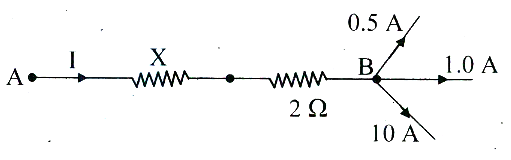 MHT CET 2024 Hard
 - The value of \(\int_1^4 \log [x] \mathrm{d} x\) where \([x]\) is the greatest integer function less than or equal to \(x\) is equal toMHT CET 2025 Medium
- A variable plane passes through the fixed point \((3,2,1)\) and meets \(X, Y\) and \(Z\) axes at points \(A\), B and C respectively. A plane is drawn parallel to YZ - plane through A , a second plane is drawn parallel to ZX -plan through B, a third plane is drawn parallel to XY - plane through C . Then locus of the point of intersection of these three planes, isMHT CET 2024 Hard
- In a triangle ABC with usual notations if \(\angle A=30^{\circ}\), then the value of \(\left(1+\frac{a}{c}+\frac{b}{c}\right)\left(1+\frac{c}{b}-\frac{a}{b}\right)=\)MHT CET 2025 Medium