


MHT CET · Physics · Gravitation
The ratio of energy required to raise a satellite of mass 'm' to a height ' \(\mathrm{h}\) ' above the earth's surface to that required to put it into the orbit at same height is \([\mathrm{R}=\) radius of the earth \(]\)
- A \(\frac{\mathrm{h}}{\mathrm{R}}\)
- B \(\frac{4 \mathrm{~h}}{\mathrm{R}}\)
- C \(\frac{3 \mathrm{~h}}{\mathrm{R}}\)
- D \(\frac{2 \mathrm{~h}}{\mathrm{R}}\)
Answer & Solution
Correct Answer
(D) \(\frac{2 \mathrm{~h}}{\mathrm{R}}\)
Step-by-step Solution
Detailed explanation
(D)
Energy required to raise the satellite to a height \(h\) from surface of earth is given by
\(\begin{aligned}
U &=-\frac{G M m}{(R+h)}-\left(-\frac{G M m}{R}\right) \\
&=\frac{G M m}{R}-\frac{G M m}{(R+h)}=G M m\left[\frac{1}{R}-\frac{1}{R+h}\right] \\
&=G M m\left[\frac{R+h-R}{R(R+h)}\right]=G M m \frac{h}{R(R+h)}
\end{aligned}\)
KE of the satellite is given by
\(\begin{aligned}
\mathrm{K} &=\frac{1}{2} \mathrm{mV}_{0}^{2}=\frac{1}{2} \mathrm{~m} \frac{\mathrm{GM}}{(\mathrm{R}+\mathrm{h})} \\
\therefore \quad \frac{\mathrm{U}}{\mathrm{K}} &=\frac{\mathrm{GMmh}}{\mathrm{R}(\mathrm{R}+\mathrm{h})} \times \frac{(\mathrm{R}+\mathrm{h}) 2}{\mathrm{mGM}}=\frac{2 \mathrm{~h}}{\mathrm{R}}
\end{aligned}\)
Energy required to raise the satellite to a height \(h\) from surface of earth is given by
\(\begin{aligned}
U &=-\frac{G M m}{(R+h)}-\left(-\frac{G M m}{R}\right) \\
&=\frac{G M m}{R}-\frac{G M m}{(R+h)}=G M m\left[\frac{1}{R}-\frac{1}{R+h}\right] \\
&=G M m\left[\frac{R+h-R}{R(R+h)}\right]=G M m \frac{h}{R(R+h)}
\end{aligned}\)
KE of the satellite is given by
\(\begin{aligned}
\mathrm{K} &=\frac{1}{2} \mathrm{mV}_{0}^{2}=\frac{1}{2} \mathrm{~m} \frac{\mathrm{GM}}{(\mathrm{R}+\mathrm{h})} \\
\therefore \quad \frac{\mathrm{U}}{\mathrm{K}} &=\frac{\mathrm{GMmh}}{\mathrm{R}(\mathrm{R}+\mathrm{h})} \times \frac{(\mathrm{R}+\mathrm{h}) 2}{\mathrm{mGM}}=\frac{2 \mathrm{~h}}{\mathrm{R}}
\end{aligned}\)
See the Complete Solution
Get step-by-step explanations for this and 2.5 Lakh+ more JEE, NEET & CET questions.
- Unlock all solutions
- Practice the full chapter
- Track accuracy across PYQs
4.8 rated on Google Play · 14,000+ reviews
More questions from Physics
- For a perfectly black body, the graph is plotted between the frequency of radiation with maximum intensity \(\left(v_{\mathrm{m}}\right)\) and the absolute temperature ' \(\mathrm{T}\) '. Out of the following which is the correct graph?
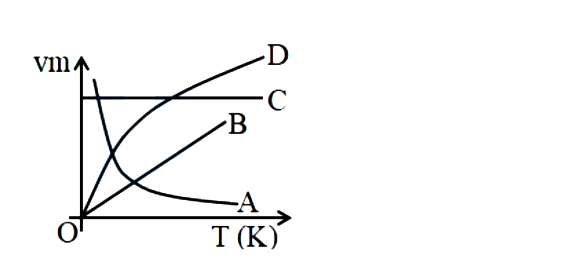 MHT CET 2022 Easy
 - Four charges \(2 \mu \mathrm{C},-3 \mu \mathrm{C}, 4 \mu \mathrm{C},-4 \mu \mathrm{C}\) and \(-1 \mu \mathrm{C}\) are enclosed by the Gaussian surface of radius 2 m . Net outward flux through the Gaussian surface is (in \(\mu \mathrm{V}-\mathrm{m}\) ) \(\left[\epsilon_0=\right.\) permittivity of free space \(]\)MHT CET 2025 Easy
- In an adiabatic process for an ideal gas, the relation between the universal gas constant ' \(R\) ' and specific heat at constant volume ' \(\mathrm{C}_{\mathrm{v}}\) ' is \(R=0 \cdot 4 C_v\). The pressure ' \(P\) ' of the gas is proportional to the temperature ' T ', of the gas as \(\mathrm{T}^k\). The value of constant ' K ' isMHT CET 2024 Hard
- Which of the following phenomenon exhibits particle's nature of light ?MHT CET 2007 Easy
- The magnetic moment of electron due to orbital motion is proportional to ( = principal quantum numbers)MHT CET 2017 Medium
- When intensity of incident light increasesMHT CET 2007 Medium
More PYQs from MHT CET
- When wavefronts pass from denser medium to rarer medium, the width of the wavefrontMHT CET 2024 Easy
- Which among the following complexes does NOT exhibit different geometrical isomers?
\(\text { [ } \mathrm{M}=\text { metal ion and } \mathrm{A}, \mathrm{B}, \mathrm{C}=\text { ligands }]\)MHT CET 2022 Hard - Three bodies P, Q and R have masses ' \(\mathrm{m}\) ' \(\mathrm{kg}\), ' \(2 \mathrm{~m}\) ' \(\mathrm{kg}\) and ' \(3 \mathrm{~m}\) ' \(\mathrm{kg}\) respectively. If all the bodies have equal kinetic energy, then greater momentum will be for body/bodies.MHT CET 2021 Easy
- The value of is ________MHT CET 2019 Hard
- A coil having 9 turns carrying current produces magnetic field \(\mathrm{B}_1\) at the centre. Now that coil is rewounded into 3 turns carrying same current. Then magnetic field at the centre \(B_2\) isMHT CET 2025 Medium
- Identify the type of unit cell containing single particle.MHT CET 2022 Medium