


MHT CET · Physics · Electrostatics
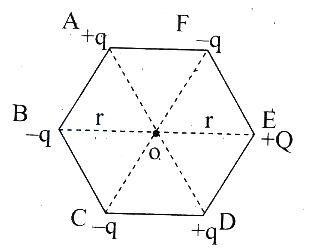
The point charges \(+q,-q,-q,+q,+Q\) and \(-q\) are placed at the vertices of a regular hexagon ABCDEF as shown in figure. The electric field at the centre of hexagon ' \(O\) ' due to the five charges at \(\mathrm{A}, \mathrm{B}, \mathrm{C}, \mathrm{D}\) and F is thrice the electric field at centre ' O ' due to charge +Q at E alone. The value of Q is
- A \(\frac{+q}{3}\)
- B \(\frac{\mathrm{qq}}{5}\)
- C \(\frac{+q}{6}\)
- D \(+6 q\).
Answer & Solution
Correct Answer
(A) \(\frac{+q}{3}\)
Step-by-step Solution
Detailed explanation
Electric field at ' \(O\) ' due to charge ' \(Q\) ' is given by, \(E=\frac{k Q}{r^2}\)
Electric field at ' \(O\) ' due to charges \(+q\) at \(A\) and \(D\) are equal and opposite and hence they will cancel each other. Similarly electric field at ' O ' due to charges -q at F and C will also cancel each other.
Electric field at ' O ' due to charge -q at B is given by,
\(E^{\prime}=\frac{k q}{r^2}\)
Now, \(\mathrm{E}^{\prime}=3 \mathrm{E}\)
\(\therefore \quad \frac{\mathrm{kq}}{\mathrm{r}^2}=\frac{3 \mathrm{kQ}}{\mathrm{r}^2} \Rightarrow \mathrm{Q}=\frac{\mathrm{q}}{3}\)
Electric field at ' \(O\) ' due to charges \(+q\) at \(A\) and \(D\) are equal and opposite and hence they will cancel each other. Similarly electric field at ' O ' due to charges -q at F and C will also cancel each other.
Electric field at ' O ' due to charge -q at B is given by,
\(E^{\prime}=\frac{k q}{r^2}\)
Now, \(\mathrm{E}^{\prime}=3 \mathrm{E}\)
\(\therefore \quad \frac{\mathrm{kq}}{\mathrm{r}^2}=\frac{3 \mathrm{kQ}}{\mathrm{r}^2} \Rightarrow \mathrm{Q}=\frac{\mathrm{q}}{3}\)
See the Complete Solution
Get step-by-step explanations for this and 2.5 Lakh+ more JEE, NEET & CET questions.
- Unlock all solutions
- Practice the full chapter
- Track accuracy across PYQs
4.8 rated on Google Play · 14,000+ reviews
More questions from Physics
- The work done in blowing a soap bubble of radius \(R\) is \(W_1\) at room temperature. Now the soap solution is heated. From the heated solution another soap bubble of radius \(2 R\) is blown and the work done is \(W_2\). ThenMHT CET 2022 Hard
- A pendulum bob has a speed \(4 \mathrm{~m} / \mathrm{s}\) at its lowest position. The pendulum is 1 m long. When the length of the string makes an angle of \(60^{\circ}\) with the vertical, the speed of the bob at that position is (acceleration due to gravity, \(g=10 \mathrm{~m} / \mathrm{s}^2, \cos 60^{\circ}=0 \cdot 5\) )MHT CET 2025 Medium
- When the dielectric is placed in an external electric field, the electric field inside the dielectric isMHT CET 2024 Easy
- An ideal transformer is used to set up an alternating e.m.f. of \(220 \mathrm{~V}\) to \(4.4 \mathrm{kV}\) to transmit \(6.6 \mathrm{~kW}\) of power. The primary coil has 100 turns. What is current rating of secondary?MHT CET 2022 Easy
- A string A has twice the length, twice the diameter, twice the tension and twice the density of another string B. The overtone of A which will, have the same fundamental frequency as that of B isMHT CET 2024 Medium
- In common emitter transistor amplifier, load resistance is \(6.5 \mathrm{k} \Omega\) and an input resistance is \(1.3 \mathrm{k} \Omega\). If the current gain is 78 , the voltage gain isMHT CET 2024 Medium
More PYQs from MHT CET
- The rate of decay of certain substance is directly proportional to the amount present at that instant. Initially, there are 27 gms of certain substance and 3 hours later it is found that \(8 \mathrm{gms}\) are left, then the amount left after one more hour isMHT CET 2020 Easy
- Identify Finkelstein reaction from the following.MHT CET 2022 Easy
- How many metamers are possible for molecular formula \(\mathrm{C}_{4} \mathrm{H}_{11} \mathrm{~N} ?\)MHT CET 2011 Medium
- An obstacle is moving towards the source with velocity 'v'. The sound is reflected from the obstacle. If ' \(\mathrm{c}^{\prime}\) is the speed of sound and \({ }\lambda^{\prime}\) ' is the wavelength, then the
wavelength of the reflected wave \(\left(\lambda_{r}\right)\) isMHT CET 2020 Medium - Which from following elements is NOT regarded as transition element?MHT CET 2025 Easy
- A beam of light of intensity \(I_0\) falls on a system of three polaroids which are arranged in succession such that the pass (transmission) axis is turned through \(60^{\circ}\) with respect to preceding one. The fraction of the incident light intensity that passes through the system is
\(\left(\cos 60^{\circ}=1 / 2\right)\)MHT CET 2025 Medium