


MHT CET · Physics · Dual Nature of Matter
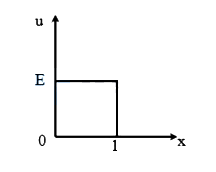
The P.E. ' \(U\) ' of a moving particle of mass ' \(m\) ' varies with ' \(\mathrm{x}\) ' is shown in the figure. The de-Broglie wavelength of the particle in the regions \(0 \leq x \leq 1\) and \(x>1\) are \(\lambda_1\) and \(\lambda_2\) respectively. If the total energy of the particle is ' \(\mathrm{nE}\) ', then the ratio \(\lambda_1 / \lambda_2\) is
- A \(\sqrt{\frac{n^2}{n-1}}\)
- B \(\sqrt{\frac{n-1}{n}}\)
- C \(\sqrt{\frac{n}{n-1}}\)
- D \(\sqrt{\frac{n(n-1)}{n}}\)
Answer & Solution
Correct Answer
(C) \(\sqrt{\frac{n}{n-1}}\)
Step-by-step Solution
Detailed explanation
In the region \(0 \leq x \leq 1\), the potential energy of the particle is \(E\). Total energy is \(\mathrm{nE}\).
Hence, kinetic energy, \(\mathrm{K}=\mathrm{nE}-\mathrm{E}=(\mathrm{n}-1) \mathrm{E}\)
Its momentum, \(\mathrm{p}_1=\sqrt{2 \mathrm{mK}}=\sqrt{2 \mathrm{~m}(\mathrm{n}-1) \mathrm{E}}\)
\(
\therefore \lambda_1=\frac{\mathrm{h}}{\mathrm{p}_1}=\frac{\mathrm{h}}{\sqrt{2 \mathrm{~m}(\mathrm{n}-1) \mathrm{E}}}
\)
In the region \(\mathrm{x}>1, \mathrm{PE}\) is zero
Hence, total is kinetic energy.
\(
\begin{aligned}
& \therefore \mathrm{K}=\mathrm{nE} \\
& \therefore \lambda_2=\frac{\mathrm{h}}{\mathrm{p}_2}=\frac{\mathrm{h}}{\sqrt{2 \mathrm{mnE}}} \\
& \therefore \frac{\lambda_1}{\lambda_2}=\sqrt{\frac{\mathrm{n}}{\mathrm{n}-1}}
\end{aligned}
\)
Hence, kinetic energy, \(\mathrm{K}=\mathrm{nE}-\mathrm{E}=(\mathrm{n}-1) \mathrm{E}\)
Its momentum, \(\mathrm{p}_1=\sqrt{2 \mathrm{mK}}=\sqrt{2 \mathrm{~m}(\mathrm{n}-1) \mathrm{E}}\)
\(
\therefore \lambda_1=\frac{\mathrm{h}}{\mathrm{p}_1}=\frac{\mathrm{h}}{\sqrt{2 \mathrm{~m}(\mathrm{n}-1) \mathrm{E}}}
\)
In the region \(\mathrm{x}>1, \mathrm{PE}\) is zero
Hence, total is kinetic energy.
\(
\begin{aligned}
& \therefore \mathrm{K}=\mathrm{nE} \\
& \therefore \lambda_2=\frac{\mathrm{h}}{\mathrm{p}_2}=\frac{\mathrm{h}}{\sqrt{2 \mathrm{mnE}}} \\
& \therefore \frac{\lambda_1}{\lambda_2}=\sqrt{\frac{\mathrm{n}}{\mathrm{n}-1}}
\end{aligned}
\)
See the Complete Solution
Get step-by-step explanations for this and 2.5 Lakh+ more JEE, NEET & CET questions.
- Unlock all solutions
- Practice the full chapter
- Track accuracy across PYQs
4.8 rated on Google Play · 14,000+ reviews
More questions from Physics
- Two wires 'A' and 'B' of equal lengths are connected in left and right gaps, of meter bridge, respectively. The null point is obtained at \(40 \mathrm{~cm}\) from left end. Diameters of the wires 'A' and 'B' are in the ratio \(3: 1\), the ratio of specific resistance of 'A' to that
of 'B' isMHT CET 2020 Medium - The magnitude of total energy and angular momentum of an electron in the \(\mathrm{n}^{\mathrm{th}}\) orbit of a Bohr atom is denoted by \(E_{n}\) and \(L_{n}\) respectively. ThenMHT CET 2020 Easy
- Using Bohr's model, the orbital period of electron in hydrogen atom in \(\mathrm{n}^{\text {th }}\) orbit is \(\left(\epsilon_{0}=\right.\) permittivity of free space, \(\mathrm{h}=\) Planck's constant, \(\mathrm{m}=\) mass of electron,
\(\mathrm{e}=\) electronic charge \()\)MHT CET 2020 Medium - If two inputs of a NAND gate are shorted, the resulting gate isMHT CET 2023 Easy
- The variation of intensity of magnetisation (I) and the applied magnetic field
intensity (H) for three magnetic materials ' \(\mathrm{X}^{\prime}\), \({ }^{\prime} \mathrm{Y}^{\prime}\) and ' \(\mathrm{Z}\) ' are shown in the graph as
OX, OY and OZ respectivley. The materials ' \(\mathrm{X}^{\prime},{ }^{\prime} \mathrm{Y}^{\prime}\) and ' \(\mathrm{Z}\) ' respectively are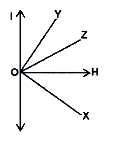 MHT CET 2020 Easy
 - Force is applied to a body of mass \(2 \mathrm{~kg}\) at rest on a frictionless horizontal surface as shown in the force against time \((\mathrm{F}-\mathrm{t})\) graph. The speed of the body after 1 second is
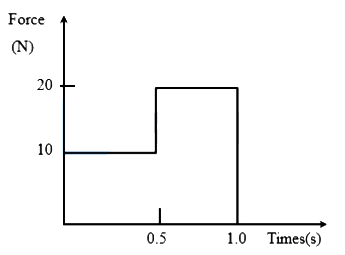 MHT CET 2021 Hard
More PYQs from MHT CET
- From a disc of radius \(R\), a concentric dircular portion of radius \(r\) is cut out so as to leave an annular disc of mass \(M\). The moment of inertia
of this annular disc about the axis perpendicular to its plane and passing through its centre of gravity isMHT CET 2009 Easy - The equation of circle passing through the points \((1,-2)\) and \((4,-3)\) and whose centre lies on the line \(3 x+2 y=7\) isMHT CET 2022 Easy
- Identify \(\mathrm{Z}\) in the following series of reactions:
 MHT CET 2020 Hard
 - When a capacitor is connected in series LR circuit, the alternating current flowing in the circuit.MHT CET 2022 Medium
- Brown ring test is used for the detection of which radical?MHT CET 2016 Easy
- What is the name of reaction involving replacement of diazonium group by chloride using cuprous (I) salt?MHT CET 2020 Easy