


MHT CET · Physics · Oscillations
The motion of the particle is given by the equation \(x=A \sin \omega t+B \cos \omega t\).
The motion of the particle is
- A simple harmonic with amplitude \((A+B)\)
- B simple harmonic with amplitude \((A-B)\)
- C simple harmonic with amplitude \(\left(A^2+B^2\right)^{\frac{1}{2}}\)
- D not simple harmonic
Answer & Solution
Correct Answer
(C) simple harmonic with amplitude \(\left(A^2+B^2\right)^{\frac{1}{2}}\)
Step-by-step Solution
Detailed explanation
Let \(A = R \cos \phi\) and \(B = R \sin \phi\). \(x = R \cos \phi \sin \omega t + R \sin \phi \cos \omega t = R \sin(\omega t + \phi)\)
See the Complete Solution
Get step-by-step explanations for this and 2.5 Lakh+ more JEE, NEET & CET questions.
- Unlock all solutions
- Practice the full chapter
- Track accuracy across PYQs
4.8 rated on Google Play · 14,000+ reviews
More questions from Physics
- In a diffraction pattern due to single slit of width 'a', the first minimum is observed at an angle of \(30^{\circ}\) when the light of wavelength \(5400 Å\) is incident on the slit. The first secondary maximum is observed at an angle of \(\left(\sin 30^{\circ}=\frac{1}{2}\right)\)MHT CET 2023 Medium
- An element \(\overrightarrow{\Delta \ell}=\Delta \mathrm{x} \hat{\mathrm{i}}\) is placed at the origin and carries a current of 10A. The magnitude of magnetic field on the Y axis at a distance of 0.5 m if \(\Delta \mathrm{x}=1 \mathrm{~cm}\) is \(\left(\frac{\mu_0}{4 \pi}=10^{-7}\right.\) SI unit \()\left(\sin 90^{\circ}=1\right)\)MHT CET 2025 Easy
- If \(\alpha\) is angular acceleration, \(\omega\) is angular velocity and \(a\) is the centripetal acceleration then, which of the following is true?MHT CET 2009 Easy
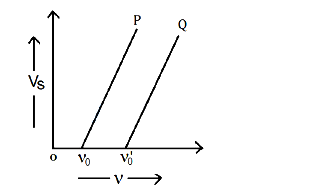
- The graph of stopping potential \(\left(\mathrm{V}_{s}\right)\) against frequency \((v)\) of incident radiation is plotted for two different metals 'P' and 'Q' as shown in the graph. \(\phi_{\mathrm{p}}\) and \(\phi_{\mathrm{q}}\) are work functions of \(\mathrm{P}\) and \(\mathrm{Q}\) respectively, then
 MHT CET 2020 Easy
 - Two waves \(Y_1=0.25 \sin 316 t\) and \(\mathrm{Y}_2=0.25 \sin 310 \mathrm{t}\) are propagating along the same direction. The number of beats produced per second areMHT CET 2024 Hard
- The average force applied on the wall of a closed container depends as \(\mathrm{T}^{\mathrm{X}}\) where T is the temperature of an ideal gas. The value of \(x\) isMHT CET 2024 Easy
More PYQs from MHT CET
- Which one of the following is NOT true about vegetative propagation?MHT CET 2018 Easy
- MHT CET 2018 Easy
- A stray magnetic field does ' \(\underline{\text { NOT' }}\) affect the deflection of moving coil galvanometer becauseMHT CET 2020 Easy
- Calamine isMHT CET 2008 Hard
- Which isomer of \(\mathrm{C}_4 \mathrm{H}_9 \mathrm{OH}\) has lower boiling point?MHT CET 2024 Easy
- Which among the following elements develops noble gas configuration in +1 state?MHT CET 2022 Easy