


MHT CET · Physics · Oscillations
The maximum velocity of a particle performing S.H.M. is ' \(V\) '. If the periodic time is made \(\left(\frac{1}{3}\right)^{\mathrm{rt}}\) and the amplitude is doubled, then the new maximum velocity of the particle will be
- A \({\frac {V}{6}}\)
- B \({\frac {3V}{2}}\)
- C \(3\ V\)
- D \(6\ V\)
Answer & Solution
Correct Answer
(D) \(6\ V\)
Step-by-step Solution
Detailed explanation
Given \(\mathrm{T}^{\prime}=\frac{1}{3} \mathrm{~T}\) and \(\mathrm{A}^{\prime}=2 \mathrm{~A}\)
\(\therefore \quad \omega^{\prime}=\frac{2 \pi}{\mathrm{T}^{\prime}}=\frac{2 \pi}{\left(\frac{1}{3} \mathrm{~T}\right)}=\frac{6 \pi}{\mathrm{T}}=3 \omega\)
\(\therefore \quad\) The new maximum velocity
\(\begin{aligned}
\mathrm{V}^{\prime} & =\mathrm{A}^{\prime} \omega^{\prime} \\
& =(2 \mathrm{~A}) \times(3 \omega) \\
& =6 \mathrm{~A} \omega \\
& =6 \mathrm{~V}
\end{aligned}\)
\(\therefore \quad \omega^{\prime}=\frac{2 \pi}{\mathrm{T}^{\prime}}=\frac{2 \pi}{\left(\frac{1}{3} \mathrm{~T}\right)}=\frac{6 \pi}{\mathrm{T}}=3 \omega\)
\(\therefore \quad\) The new maximum velocity
\(\begin{aligned}
\mathrm{V}^{\prime} & =\mathrm{A}^{\prime} \omega^{\prime} \\
& =(2 \mathrm{~A}) \times(3 \omega) \\
& =6 \mathrm{~A} \omega \\
& =6 \mathrm{~V}
\end{aligned}\)
See the Complete Solution
Get step-by-step explanations for this and 2.5 Lakh+ more JEE, NEET & CET questions.
- Unlock all solutions
- Practice the full chapter
- Track accuracy across PYQs
4.8 rated on Google Play · 14,000+ reviews
More questions from Physics
- A gas at normal temperature is suddenly compressed to one-fourth of its original volume. If \(\frac{\mathrm{C}_{\mathrm{p}}}{\mathrm{C}_{\mathrm{v}}}=\gamma=1.5\), then the increase in its temperature isMHT CET 2023 Easy
- Pure Silicon crystal at \(300 \mathrm{~K}\) has equal electron and hole concentration of \(1.5 \times 10^{16} \mathrm{~m}^{-3}\). Doping by indium increases \(n_h=4.5 \times 10^{22} \mathrm{~m}^{-3}\). The \(n_e\) in the doped silicon is:MHT CET 2022 Easy
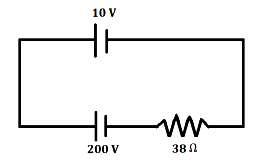
- In the given circuit, current flowing through it is
 MHT CET 2020 Easy
 - A lead bullet moving with velocity ' \(v\) ' strikes a wall and stops. If \(50 \%\) of its energy is converted into heat, then the increase in temperature is ( \(\mathrm{s}=\) specific heat of lead)MHT CET 2024 Hard
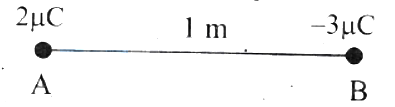
- Charges of \(2 \mu \mathrm{C}\) and \(-3 \mu \mathrm{C}\) are placed at two points A and B separated by 1 m . The distance of the point from A , where net potential is zero, is
 MHT CET 2024 Easy
 - A black rectangular surface of area ' \(A\) ' emits energy ' \(E\) ' per second at \(27^{\circ} \mathrm{C}\). If length and breadth is reduced to \((1 / 3)^{\text {rd }}\) of its initial value and temperature is raised to \(327^{\circ} \mathrm{C}\) then energy emitted per second becomesMHT CET 2021 Easy
More PYQs from MHT CET
- What is the pOH of millimolar solution of \(\mathrm{Ca}(\mathrm{OH})_2\) ?MHT CET 2024 Hard
- A particle of mass \(m\) is rotating in a plane in circularpath of radius \(r\). Its angular momentum is \(L\). The centripetal force acting on the particle isMHT CET 2009 Medium
- Negation of the statement ' Horses have wings if and only if crows have tails. ' isMHT CET 2024 Easy
- Which from following statements is true for tetrahydrofuran?MHT CET 2021 Easy
- If \(A=\left[\begin{array}{cc}\mathrm{k} & 2 \\ -2 & -\mathrm{k}\end{array}\right]\), then \(\mathrm{A}^{-1}\) does not exists if \(\mathrm{k}=\)MHT CET 2021 Easy
- In Young's double slit experiment, the light of wavelength ' \(\lambda\) ' is used. The intensity at a point on the screen is 'I' where the path difference is \(\frac{\lambda}{4}\). If ' \(\mathrm{I}_{\mathrm{o}}\) ' denotes the maximum intensity then the ratio of ' \(\mathrm{I}_{\mathrm{o}}\) ' to ' I ' is \(\left(\cos 45^{\circ}=1 / \sqrt{2}\right)\)MHT CET 2025 Medium