


MHT CET · Physics · Oscillations
The maximum velocity and maximum acceleration of a particle performing a linear S.H.M. is ' \(\alpha\) ' and ' \(\beta\) ' respectively. Then the path length of the particle is
- A \(\frac{\alpha^2}{\beta}\)
- B \(\frac{\beta \alpha^2}{2 \alpha^2}\)
- C \(\frac{2 \alpha^2}{\beta}\)
- D \(\frac{2 \beta}{\alpha^2}\)
Answer & Solution
Correct Answer
(C) \(\frac{2 \alpha^2}{\beta}\)
Step-by-step Solution
Detailed explanation
For S.H.M.,
Maximum velocity, \(\alpha=\mathrm{A} \omega\)
\(\omega=\frac{\alpha}{\mathrm{A}}\)...(i)
Maximum acceleration, \(\beta=A \omega^2\)
\(\begin{aligned}
& \beta=A\left(\frac{\alpha}{A}\right)^2=\frac{\alpha^2}{A} \\
& \Rightarrow A=\frac{\alpha^2}{\beta}
\end{aligned}\)
\(\therefore \quad\) Path length \(=2 \mathrm{~A}=\frac{2 \alpha^2}{\beta}\)
Maximum velocity, \(\alpha=\mathrm{A} \omega\)
\(\omega=\frac{\alpha}{\mathrm{A}}\)...(i)
Maximum acceleration, \(\beta=A \omega^2\)
\(\begin{aligned}
& \beta=A\left(\frac{\alpha}{A}\right)^2=\frac{\alpha^2}{A} \\
& \Rightarrow A=\frac{\alpha^2}{\beta}
\end{aligned}\)
\(\therefore \quad\) Path length \(=2 \mathrm{~A}=\frac{2 \alpha^2}{\beta}\)
See the Complete Solution
Get step-by-step explanations for this and 2.5 Lakh+ more JEE, NEET & CET questions.
- Unlock all solutions
- Practice the full chapter
- Track accuracy across PYQs
4.8 rated on Google Play · 14,000+ reviews
More questions from Physics
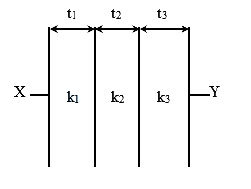
- Two parallel plates with dielectric placed between the plates are as shown in figure. The resultant capacity of capacitor will [A = area of plate. \(t_1, t_2\) and \(t_3\) are thickness of dielectric slabs, \(k_1\), \(\mathrm{k}_2\) and \(\mathrm{k}_3\) are dielectric constant.]
 MHT CET 2021 Hard
 - The resistances in the left and right gap of a metre bridge are \(40 \Omega\) and \(60 \Omega\) respectively. When the bridge is balanced, the distance of the null point from the centre of the wire towards left isMHT CET 2024 Easy
- A car of mass ' \(m\) ' moving with velocity ' \(u\) ' on a straight road in a straight line, doubles its velocity in time \(t\). the power delivered by the engine of a car for doubling the velocity isMHT CET 2021 Easy
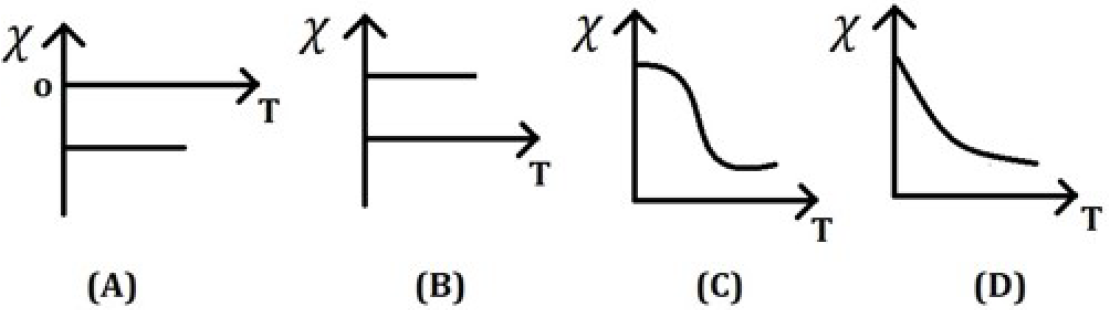
- The variation of magnetic susceptibility \((\chi)\) with temperature for a diamagnetic substance is shown correctly by graph
 MHT CET 2025 Easy
 - The ratio of the frequencies of two simple pendulums is \(4: 3\) at the same place. The ratio of their respective lengths isMHT CET 2025 Easy
- Two waves \(y_1=0.35 \sin (316 t)\) and \(y_2=0.35 \sin (310 t)\) are propagating along the same direction. The number of beats produced per second areMHT CET 2022 Easy
More PYQs from MHT CET
- The standard emf for cell,
\(\Theta_{\mathrm{Cd}_{(\mathrm{s})}}\left|\mathrm{Cd}^{+2}(1 \mathrm{M})\right|\left|\mathrm{Cu}^{+2}(1 \mathrm{M})\right| \mathrm{Cu}_{(\mathrm{s})}^{\oplus}\)
is 0.74 V . If concentration of \(\mathrm{Cd}_{(\mathrm{aq})}^{+2}\) and \(\mathrm{Cu}_{(\mathrm{aq})}^{+2}\) decreases by 10 times at 298 K . Calculate emf of cell.MHT CET 2025 Medium - Two lines \(\frac{x-3}{1}=\frac{y+1}{3}=\frac{z-6}{-1} \quad\) and \(\frac{x+5}{7}=\frac{y-2}{-6}=\frac{z-3}{4} \quad\) intersect at the point \(\mathrm{R}\). Then reflection of \(\mathrm{R}\) in the \(x y\)-plane has co-ordinatesMHT CET 2023 Medium
- In common emitter mode of transistor, the d.c. current gain is 20 , the emitter
current is \(7 \mathrm{~mA}\). The collector current isMHT CET 2020 Easy - A string is under tension of 180 N and mass per unit length \(2 \times 10^{-3} \mathrm{Kg} / \mathrm{m}\). It produces two consecutive resonant frequencies with a tuning fork, which are 375 Hz and 450 Hz . The mass of the string isMHT CET 2024 Medium
- A gas absorbs \(200 \mathrm{~J}\) heat and expands by \(500 \mathrm{~cm}^3\) against a constant external pressure \(2 \times 10^5 \mathrm{~N} \mathrm{~m}^{-2}\). What is the change in internal energy?MHT CET 2023 Medium
- Which among the following is NOT dicarboxylic acid?MHT CET 2023 Easy