


MHT CET · Physics · Mathematics in Physics
The magnitude of the sum of the two vectors \(\overrightarrow{\mathrm{A}}\) and \(\overrightarrow{\mathrm{B}}\) is equal to the magnitude of
the difference of two vectors \(\overrightarrow{\mathrm{A}}\) and \(\overrightarrow{\mathrm{B}}\). The angle between \(\overrightarrow{\mathrm{A}}\) and \(\overrightarrow{\mathrm{B}}\) is
- A \(30^{\circ}\)
- B \(45^{\circ}\)
- C \(90^{\circ}\)
- D \(180^{\circ}\)
Answer & Solution
Correct Answer
(C) \(90^{\circ}\)
Step-by-step Solution
Detailed explanation
Let the two vectors be \(\vec{A}\) and \(\vec{B}\) with magnitudes \(A\) and \(B\) respectively. Then magnitude of their sum is given by:
\(|\vec{A}+\vec{B}|=\sqrt{A^{2}+B^{2}+2 A B \cos \theta} \rightarrow(1)(\theta=\) angle between the vectors \()\)
Magnitude of their difference is given by:
\(|\overrightarrow{\mathrm{A}}-\overrightarrow{\mathrm{B}}|=\sqrt{\mathrm{A}^{2}+\mathrm{B}^{2}-2 \mathrm{AB} \cos \theta} \rightarrow(2)\)
As \(|\vec{A}+\vec{B}|=|\vec{A}-\vec{B}|\)
\(\Rightarrow \mathrm{A}^{2}+\mathrm{B}^{2}+2 \mathrm{AB} \cos \theta=\mathrm{A}^{2}+\mathrm{B}^{2}-2 \mathrm{AB} \cos \theta\)
\(\Rightarrow 4 \mathrm{AB} \cos \theta=0\) or \(\cos \theta=0\)
\(\Rightarrow \theta=90^{\circ}\).
\(|\vec{A}+\vec{B}|=\sqrt{A^{2}+B^{2}+2 A B \cos \theta} \rightarrow(1)(\theta=\) angle between the vectors \()\)
Magnitude of their difference is given by:
\(|\overrightarrow{\mathrm{A}}-\overrightarrow{\mathrm{B}}|=\sqrt{\mathrm{A}^{2}+\mathrm{B}^{2}-2 \mathrm{AB} \cos \theta} \rightarrow(2)\)
As \(|\vec{A}+\vec{B}|=|\vec{A}-\vec{B}|\)
\(\Rightarrow \mathrm{A}^{2}+\mathrm{B}^{2}+2 \mathrm{AB} \cos \theta=\mathrm{A}^{2}+\mathrm{B}^{2}-2 \mathrm{AB} \cos \theta\)
\(\Rightarrow 4 \mathrm{AB} \cos \theta=0\) or \(\cos \theta=0\)
\(\Rightarrow \theta=90^{\circ}\).
See the Complete Solution
Get step-by-step explanations for this and 2.5 Lakh+ more JEE, NEET & CET questions.
- Unlock all solutions
- Practice the full chapter
- Track accuracy across PYQs
4.8 rated on Google Play · 14,000+ reviews
More questions from Physics
- Consider a light planet revolving around a massive star in a circular orbit of radius ' \(r\) ' with time period ' \(T\) '. If the gravitational force of attraction between the planet and the star is proportional to \(r^{-\frac{7}{2}}\), then \(T^2\) is proportional toMHT CET 2023 Medium
- When an open pipe is closed from one end then the third overtone of the closed pipe is higher in frequency by than the second overtone of an open pipe. The fundamental frequency of the open-end pipe will beMHT CET 2016 Medium
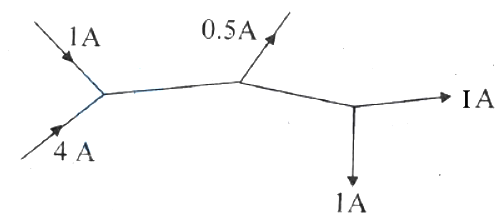
- The figure shows currents in a part of electric circuit. Then current \(I\) is
 MHT CET 2024 Easy
 - The coil of an a.c. generator has 100 turns, each of cross-sectional area \(2 \mathrm{~m}^2\). It is rotating at constant angular speed \(30 \mathrm{rad} / \mathrm{s}\), in a uniform magnetic field of \(2 \times 10^{-2} \mathrm{~T}\). If the total resistance of the circuit is \(600 \Omega\) then maximum power dissipated in the circuit isMHT CET 2023 Medium
- A frame made of metallic wire enclosing a surface area \(A\) is covered with a soap film. If the area of the frame of metallic wire is reduced by \(50 \%\), the energy of the soap film will be changed byMHT CET 2008 Easy
- Two wires \(A\) and \(B\) are stretched by the same load. The radius of wire \(A\) is double the radius of wire \(\mathrm{B}\). The stress on the wire \(\mathrm{B}\) as compared to the stress on the wire A isMHT CET 2020 Medium
More PYQs from MHT CET
- The value of \(\int_{0}^{\infty} \frac{x}{(1+x)\left(x^{2}+1\right)} d x\) isMHT CET 2012 Medium
- The major product obtained in the following reaction is Chlorobenzene + chlorine \(\underset{\mathrm{FeCl}_3}{\stackrel{\text { Anhydrous }}{\longrightarrow}}\) product (Major)MHT CET 2021 Medium
- Gross calorific value and physiological value of proteins are and kcal/g respectively.MHT CET 2020 Hard
- If the excess pressure inside a soap bubble of radius \(3 \mathrm{~mm}\) is equal to the pressure of a water column of height \(0.8 \mathrm{~cm}\), then the surface tension of the soap solution is ( \(\rho_{\text {water }}=1000 \mathrm{~kg} / \mathrm{m}^3, g=9.8 \mathrm{~m} / \mathrm{s}^2\) )MHT CET 2022 Medium
- The degree of the differential equation \(\frac{\mathrm{d}^2 \mathrm{y}}{\mathrm{d} x^2}+3\left(\frac{\mathrm{~d} y}{\mathrm{~d} x}\right)^2=x^2 \log \left(\frac{\mathrm{~d}^2 \mathrm{y}}{\mathrm{d} x^2}\right)\) isMHT CET 2025 Easy
- Match the plants given in Column-I with their type of endosperm in Column-II.
Choose the correct answer from options given below.Column I Column II i. Coconut a. Helobial ii. Balsam b. perisperm iii. Asphodelus c. nuclear iv. Black pepper d. Cellular MHT CET 2022 Medium