


MHT CET · Physics · Waves and Sound
The fundamental frequency of air column in pipe 'A' closed at one end is in unison with second overtone of an air column in pipe 'B' open at both ends. The ratio of length of air column in pipe 'A' to that of air column in pipe ' \(\mathrm{B}\) ' is
- A \(1: 6\)
- B \(3: 8\)
- C \(2: 3\)
- D \(3: 4\)
Answer & Solution
Correct Answer
(A) \(1: 6\)
Step-by-step Solution
Detailed explanation
Fundamental frequency of ta closed pipè, \(\mathrm{n}_1=\frac{\mathrm{v}}{4 \mathrm{~L}_1}\)
Frequency of the second overtone, \(\mathrm{n}_2=\frac{3 \mathrm{v}}{2 \mathrm{~L}_2}\)
Given \(\mathrm{n}_1=\mathrm{n}_2\)
\(\Rightarrow \frac{\mathrm{v}}{4 \mathrm{~L}_1}=\frac{3 \mathrm{v}}{2 \mathrm{~L}_2}\)
\(\therefore \quad \frac{\mathrm{L}_1}{\mathrm{~L}_2}=\frac{1}{6}\)
Frequency of the second overtone, \(\mathrm{n}_2=\frac{3 \mathrm{v}}{2 \mathrm{~L}_2}\)
Given \(\mathrm{n}_1=\mathrm{n}_2\)
\(\Rightarrow \frac{\mathrm{v}}{4 \mathrm{~L}_1}=\frac{3 \mathrm{v}}{2 \mathrm{~L}_2}\)
\(\therefore \quad \frac{\mathrm{L}_1}{\mathrm{~L}_2}=\frac{1}{6}\)
See the Complete Solution
Get step-by-step explanations for this and 2.5 Lakh+ more JEE, NEET & CET questions.
- Unlock all solutions
- Practice the full chapter
- Track accuracy across PYQs
4.8 rated on Google Play · 14,000+ reviews
More questions from Physics
- In single slit diffraction experiment, when the distance of separation between the slit and screen is doubled, the angular separation between fringesMHT CET 2020 Easy
- A body performing uniform circular motion of radius ' \(R\) ' has frequency ' \(n\) '. Its centripetal acceleration per unit radius is proportional to \((n)^x\). The value of \(x\) isMHT CET 2024 Medium
- The average force applied on the wall of a closed container depends as \(\mathrm{T}^{\mathrm{X}}\) where T is the temperature of an ideal gas. The value of \(x\) isMHT CET 2024 Easy
- A signal of frequency \(3 \mathrm{kHz}\) is amplitude modulated on a carrier wave of frequency \(2 \cdot 5 \mathrm{MHz}\). The upper and lower sideband frequencies in the resultant signal areMHT CET 2020 Easy
- A metal rod having coefficient of linear expansion \(2 \times 10^{-5} /{ }^{\circ} \mathrm{C}\) is 0.75 m long at \(45^{\circ} \mathrm{C}\). When the temperature rises to \(65^{\circ} \mathrm{C}\), the increase in length of the rod will beMHT CET 2024 Easy
- A string of length ' \(L\) ' fixed at one end carries a mass ' \(m\) ' at the other end. The string makes \(\frac{3}{\pi}\) r.p.s. around the vertical axis through fixed end. The tension in the string isMHT CET 2022 Medium
More PYQs from MHT CET
- The equation of the plane passing through the line of intersection of the planes \(x+y+z=1\) and \(3 x+4 y+5 z=2\) and perpendicular to the XY- plane isMHT CET 2025 Medium
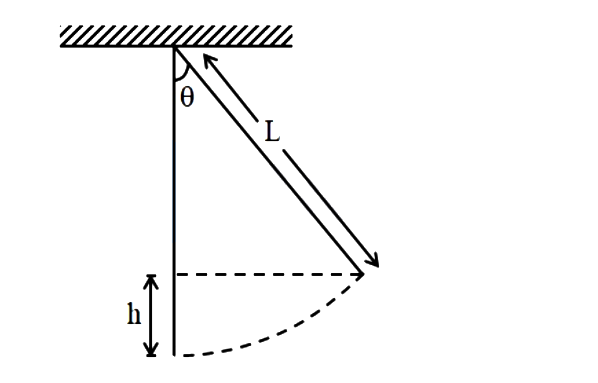
- A simple pendulum with bob of mas ' \(m\) ' and conducting wire of length ' \(L\) ' swings under gravity through an angle ' \(\theta\) '. The component of earth's magnetic field in the direction perpendicular to swing is ' \(\mathrm{B}\) '. Maximum e.m.f. induced across the pendulum is ( \(\mathrm{g}=\) acceleration due to gravity)
 MHT CET 2022 Hard
 - A ladder of length \(17 \mathrm{~m}\) rests with one end against a vertical wall and the other on the level ground. If the lower end slips away at the rate of \(1 \mathrm{~m} / \mathrm{sec}\)., then when it is \(8 \mathrm{~m}\) away from the wall, its upper end is coming down at the rate ofMHT CET 2023 Hard
- A disc of radius 0.4 meter and mass \(1 \mathrm{~kg}\) rotates about an axis passing through its center and perpendicular to its plane. The angular acceleration is \(10 \mathrm{rad} \mathrm{s}^{-2}\). The tangential force applied to the rim of the disc isMHT CET 2021 Hard
- Calculate the depression in freezing point of solution when \(4 \mathrm{~g}\) nonvolatile solute of molar mass \(126 \mathrm{~g} \mathrm{~mol}^{-1}\) dissolved in \(80 \mathrm{~mL}\) water. \(\left[\right.\) Cryoscopic constant of water \(\left.=1.86 \mathrm{~K} \mathrm{~kg} \mathrm{~mol}^{-1}\right]\)MHT CET 2023 Easy
- In an atom, electron of charge (-e) performs U.C.M. around a stationary positively charged nucleus, with period of revolution 'T'. If 'r' is the radius of the orbit of the electron and ' \(\mathrm{v}^{\prime}\) is the orbital velocity, then the circulating current (I) is proportional toMHT CET 2020 Easy