


MHT CET · Physics · Dual Nature of Matter
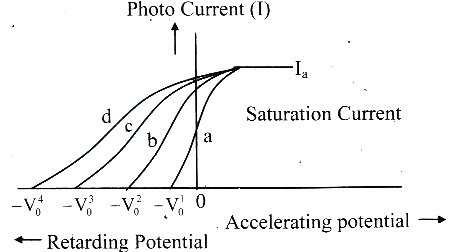
The figure shows the variation of photocurrent with anode potential for four different radiations. Let \(f_a, f_b, f_c\) and \(f_d\) be the frequencies for the curves \(a, b, c\) and \(d\) respectively
- A \(f_a \gt f_b \gt f_c \gt f_d\)
- B \(\mathrm{f}_{\mathrm{a}} \lt \mathrm{f}_{\mathrm{b}} \lt \mathrm{f}_{\mathrm{c}} \lt \mathrm{f}_{\mathrm{d}}\)
- C \(\mathrm{f}_{\mathrm{a}}\gt\mathrm{f}_{\mathrm{b}} \lt \mathrm{f}_{\mathrm{c}}=\mathrm{f}_{\mathrm{d}}\)
- D \(\mathrm{f}_{\mathrm{a}}=\mathrm{f}_{\mathrm{b}} \gt \mathrm{f}_{\mathrm{c}} \gt \mathrm{f}_{\mathrm{d}}\)
Answer & Solution
Correct Answer
(B) \(\mathrm{f}_{\mathrm{a}} \lt \mathrm{f}_{\mathrm{b}} \lt \mathrm{f}_{\mathrm{c}} \lt \mathrm{f}_{\mathrm{d}}\)
Step-by-step Solution
Detailed explanation
We know stopping potential is directly proportional to the frequency of the incoming radiation. This means curve ' \(a\) ' has the highest frequency and ' d ' the lowest.
\(\therefore \quad f_a \lt f_b \lt f_c \lt f_d\)
\(\therefore \quad f_a \lt f_b \lt f_c \lt f_d\)
See the Complete Solution
Get step-by-step explanations for this and 2.5 Lakh+ more JEE, NEET & CET questions.
- Unlock all solutions
- Practice the full chapter
- Track accuracy across PYQs
4.8 rated on Google Play · 14,000+ reviews
More questions from Physics
- Under isothermal conditions, two soap bubbles of radii ' \(r_{1}\) ' and ' \(r_{2}\) ' coalesce to form a big drop. The radius of the big drop isMHT CET 2020 Medium
- A stone of mass is tied to a string long and is rotated at a constant speed of in a vertical circle. The ratio of the tension at the top and the bottom is [Take ]MHT CET 2019 Medium
- For a stationary wave, \(Y=10 \sin \left(\frac{\pi x}{15}\right) \cos (48 \pi t) \mathrm{cm}\), the distance between a node and the successive antinode isMHT CET 2022 Easy
- A resistor of \(50 \Omega\), inductor of self inductance \(\left(\frac{3}{\pi^2}\right) \mathrm{H}\) and a capacitor of unknown capacity are connected in series to an a.c. source of 100 V and 50 Hz . When the voltage and current are in phase, the value of capacitance is (nearly)MHT CET 2024 Medium
- A square frame of each side ' \(L\) ' is dipped in a soap solution and taken out. The force acting on the film formed is \((\mathrm{T}=\) surface tension of soap solution)MHT CET 2022 Easy
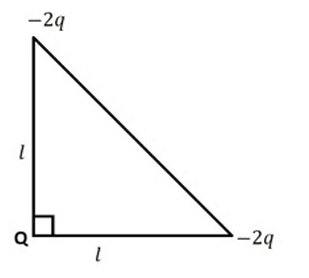
- Three charges Q, (-2q) and (-2q) are placed at the vertices of an isosceles right angled triangle as shown in figure. The net electrostatic potential energy is zero if Q is equal to
 MHT CET 2025 Medium
More PYQs from MHT CET
- If intensity of incident radiation in a photocell is increased, the stopping potentialMHT CET 2020 Easy
- For a particle performing S.H.M., the displacement-time graph is as shown.
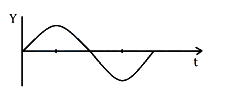
For that particle the force-time graph is correctly shown in graph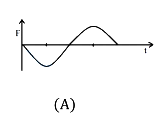
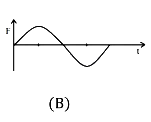
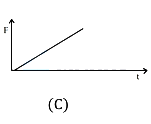
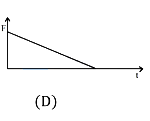 MHT CET 2020 Easy
 - An ice ball melts at the rate which is proportional to the amount of ice at that instant. Half of the quantity of ice melts in 15 minutes. \(x_0\) is the initial quantity of ice. If after 30 minutes the amount of ice left is \(k x_0\), then the value of \(k\) isMHT CET 2024 Easy
- \(\int_{0}^{1} x(1-x)^{5} d x=\)MHT CET 2020 Medium
- Transfer of antibodies from mother to infant through colostrum after birth provides ________ to the baby.MHT CET 2025 Hard
- Which from following compounds is obtained when toluene is treated with \(\mathrm{CrO}_2 \mathrm{Cl}_2\) in presence of \(\mathrm{CS}_2\) followed by acid hydrolysis?MHT CET 2023 Easy