


MHT CET · Physics · Gravitation
The depth below the earth's surface at which the acceleration due to gravity ' \(g\) ' becomes \(\frac{\mathrm{g}}{\mathrm{n}}\) is \((\mathrm{R}=\) radius of the earth, \(\mathrm{n}\) is an integer, \(\mathrm{n}>1)\)
- A \(\frac{\mathrm{R}(\mathrm{n}+1)}{\mathrm{n}}\)
- B \(\frac{R(n-1)}{n}\)
- C \(\frac{\mathrm{Rn}}{(\mathrm{n}+1)}\)
- D \(\frac{\mathrm{R}}{\mathrm{n}}\)
Answer & Solution
Correct Answer
(B) \(\frac{R(n-1)}{n}\)
Step-by-step Solution
Detailed explanation
Acceleration due to gravity at surface,
\(g=\left(\frac{G M}{R^2}\right)\)
where, \(\mathrm{G}\) is the universal gravitational constant, \(\mathrm{R}\) is the radius of earth.
At a depth \(\mathrm{h}\) below the surface, considering force balance:
\(\begin{aligned}
& \frac{G\left\{M\left(\frac{R-h}{R}\right)^3\right\} m}{(R-h)^2}=m g^{\prime} \\
& \Rightarrow g^{\prime}=\left(\frac{G M}{R^2}\right) \frac{(R-h)}{R}=g\left(\frac{R-h}{R}\right)=\frac{g}{n} \\
& \Rightarrow \frac{R-h}{R}=\frac{1}{n} \\
& \Rightarrow \frac{-h}{R}=\frac{1-n}{n}
\end{aligned}\)
\(\Rightarrow \mathrm{h}=\frac{(\mathrm{n}-1) \mathrm{R}}{\mathrm{n}}\)
\(g=\left(\frac{G M}{R^2}\right)\)
where, \(\mathrm{G}\) is the universal gravitational constant, \(\mathrm{R}\) is the radius of earth.
At a depth \(\mathrm{h}\) below the surface, considering force balance:
\(\begin{aligned}
& \frac{G\left\{M\left(\frac{R-h}{R}\right)^3\right\} m}{(R-h)^2}=m g^{\prime} \\
& \Rightarrow g^{\prime}=\left(\frac{G M}{R^2}\right) \frac{(R-h)}{R}=g\left(\frac{R-h}{R}\right)=\frac{g}{n} \\
& \Rightarrow \frac{R-h}{R}=\frac{1}{n} \\
& \Rightarrow \frac{-h}{R}=\frac{1-n}{n}
\end{aligned}\)
\(\Rightarrow \mathrm{h}=\frac{(\mathrm{n}-1) \mathrm{R}}{\mathrm{n}}\)
See the Complete Solution
Get step-by-step explanations for this and 2.5 Lakh+ more JEE, NEET & CET questions.
- Unlock all solutions
- Practice the full chapter
- Track accuracy across PYQs
4.8 rated on Google Play · 14,000+ reviews
More questions from Physics
- In the circuit shown in the figure, \(\mathrm{P} \neq \mathrm{R}\). The reading of the galvanometer remains the same with switch 'S' open or closed. Then
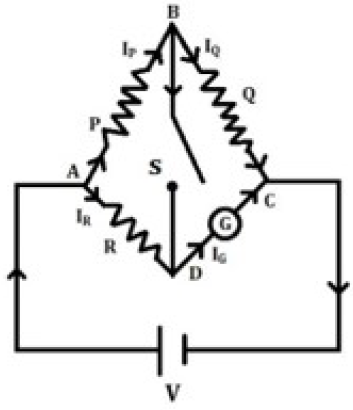 MHT CET 2025 Medium
 - A rectangular block of surface area A emits energy E per second at \(27^{\circ} \mathrm{C}\). If length and breadth is reduced to half of initial value and temperature is raised to \(327^{\circ} \mathrm{C}\) then energy emitted per second becomesMHT CET 2025 Medium
- A coil is wound on a core of rectangular crosssection. If all the linear dimensions of the core are increased by a factor 2 and number of turns per unit length of coil remains same, the self inductance increases by a factor of (Assume, permeability is same)MHT CET 2024 Easy
- A solid sphere rolls without slipping on an inclined plane at an angle \(\theta\). The ratio of total kinetic energy to its rotational kinetic energy isMHT CET 2023 Medium
- The output of OR gate is ' 1 'MHT CET 2022 Easy
- A long, rectangular conducting loop of width \(l\) mass \(m\) and resistance \(R\) is placed partly in a perpendicular magnetic field \(B\). It is pushed downwards with velocity \(v\) so that it may continue to fall freely. The velocity \(v\) is \((g=\) acceleration due to gravity)
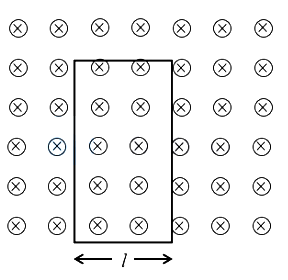 MHT CET 2022 Hard
More PYQs from MHT CET
- Calculate the molality of solution of non volatile solute having depression in freezing point 0.93 K and cryoscopic constant of solvent \(1.86 \mathrm{~K} \mathrm{~kg} \mathrm{~mol}^{-1}\).MHT CET 2024 Medium
- The heat energy that must be supplied to 14 gram of nitrogen at room temperature to raise its temperature by \(48^{\circ} \mathrm{C}\) at constant pressure is (Molecular weight of nitrogen \(=28, R=\) gas constant, \(C_p=\frac{7}{2} R\) for diatomic gas)MHT CET 2025 Easy
- \(\int_{0}^{\frac{\pi}{2}} \frac{\sin ^{\frac{2}{3}} x}{\sin ^{\frac{2}{3}} x+\cos ^{\frac{2}{3}} x} d x=\)MHT CET 2020 Easy
- Identify the reagent R used in following reaction?
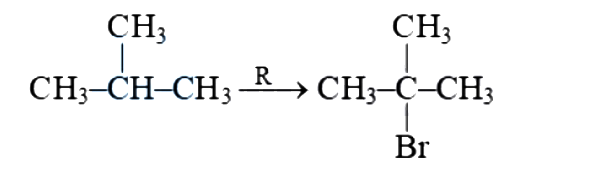 MHT CET 2021 Easy
 - An electron in the ground state of hydrogen atom is revolving in a circular orbit of
radius \(\mathrm{R}\). The orbital magnetic moment of the electron is
\((\mathrm{m}=\) mass of electron, \(\mathrm{h}=\) Planck's constant, \(\mathrm{e}=\) electronic charge \()\)MHT CET 2020 Easy - Identify the test from following so that aldehyde when boiled with ammoniacal silver nitrate solution deposts silver.MHT CET 2024 Medium