


MHT CET · Physics · Thermal Properties of Matter
The coefficient of linear expansion of brass and steel rods are \(\alpha_1\) and \(\alpha_2\) respectively. Lengths of brass and steel rods are \(l_1\) and \(l_2\) respectively. If \(\left(l_2-l_1\right)\) is maintained same at all temperatures, which one of the following relations is correct?
- A \(\alpha_1 l_2=\alpha_2 l_1\)
- B \(\alpha_1^2 l_2=\alpha_2^2 l_1\)
- C \(\alpha_{12} l_2^2=\alpha_2 l_1^2\)
- D \(l_1 \alpha_1=l_2 \alpha_2\)
Answer & Solution
Correct Answer
(D) \(l_1 \alpha_1=l_2 \alpha_2\)
Step-by-step Solution
Detailed explanation
The correct option is (D).
Concept: Length of a metalic rod at a given temperature is given by,
\(l=l_0(1+\alpha \Delta T)\)
where, \(l_0\) is the initial length, \(\alpha\) the coefficient of linear expansion and \(\Delta T\) the temperature change.
At any given temperature the lengths of the brass and steel rods can be written as, \(l_b=l_1\left(1+\alpha_1 \Delta T\right)\) and \(l_s=l_2\left(1+\alpha_2 \Delta T\right)\) respectively.
Therefore, at difference of length is given by,
\(\begin{aligned} & l_b-l_s=l_1\left(1+\alpha_1 \Delta T\right)-l_2\left(1+\alpha_2 \Delta T\right) \\ & \Rightarrow l_b-l_s=\left(l_1-l_2\right)+\left(\alpha_1 l_1-l_2 \alpha_2\right) \Delta T\end{aligned}\)
Since, \(l_b-l_{\mathrm{s}}=l_1-l_2\) as the difference of length remains constant.
Therefore, \(\left(\alpha_1 l_1-l_2 \alpha_2\right)=0\)
So, \(\alpha_1 l_1=l_2 \alpha_2\) is the answer.
Since, \(l_b-l_s=l_1-l_2\) as the difference of length remains constant.
Therefore, \(\left(\alpha_1 l_1-l_2 \alpha_2\right)=0\) So, \(\alpha_1 l_1=l_2 \alpha_2\) is the answer.
Concept: Length of a metalic rod at a given temperature is given by,
\(l=l_0(1+\alpha \Delta T)\)
where, \(l_0\) is the initial length, \(\alpha\) the coefficient of linear expansion and \(\Delta T\) the temperature change.
At any given temperature the lengths of the brass and steel rods can be written as, \(l_b=l_1\left(1+\alpha_1 \Delta T\right)\) and \(l_s=l_2\left(1+\alpha_2 \Delta T\right)\) respectively.
Therefore, at difference of length is given by,
\(\begin{aligned} & l_b-l_s=l_1\left(1+\alpha_1 \Delta T\right)-l_2\left(1+\alpha_2 \Delta T\right) \\ & \Rightarrow l_b-l_s=\left(l_1-l_2\right)+\left(\alpha_1 l_1-l_2 \alpha_2\right) \Delta T\end{aligned}\)
Since, \(l_b-l_{\mathrm{s}}=l_1-l_2\) as the difference of length remains constant.
Therefore, \(\left(\alpha_1 l_1-l_2 \alpha_2\right)=0\)
So, \(\alpha_1 l_1=l_2 \alpha_2\) is the answer.
Since, \(l_b-l_s=l_1-l_2\) as the difference of length remains constant.
Therefore, \(\left(\alpha_1 l_1-l_2 \alpha_2\right)=0\) So, \(\alpha_1 l_1=l_2 \alpha_2\) is the answer.
See the Complete Solution
Get step-by-step explanations for this and 2.5 Lakh+ more JEE, NEET & CET questions.
- Unlock all solutions
- Practice the full chapter
- Track accuracy across PYQs
4.8 rated on Google Play · 14,000+ reviews
More questions from Physics
- One end of a capillary tube is dipped in water, the rise of water column is ' \(h\) '. The upward force of 98 dyne due to surface tension is balanced by the force due to the weight of the water column. The inner circumference of the capillary is (surface tension of water \(=7 \times 10^{-2} \mathrm{Nm}^{-1}\) )MHT CET 2025 Hard
- When a resistance of \(100 \Omega\) is connected in series with a galvanometer of resistance \(R\), its range is
V. To double its range, a resistance of \(1000 \Omega\) is connected in series. Find \(R\).MHT CET 2010 Medium - The end correction for the vibrations of air column in a tube of circular cross-section will be more if the tube isMHT CET 2024 Easy
- A student is throwing balls vertically upwards such that he throws the \(2^{\text {nd }}\) ball when the \(1^{\text {st }}\) ball reaches maximum height. If he throws balls at an interval of 3 second, the maximum height of the balls is \(\left(\mathrm{g}=10 \frac{\mathrm{m}}{\mathrm{s}^2}\right)\)MHT CET 2021 Easy
- In the given circuit, if \(\frac{\mathrm{dI}}{\mathrm{dt}}=-1 \mathrm{~A} / \mathrm{s}\) then the value of \(\left(V_A-V_B\right)\) at this instance will be
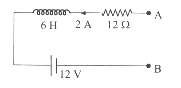 MHT CET 2023 Medium
 - Refractive index of the medium is ' \(\mu\) ' and wavelength is \(\lambda\), then which of th wing proportionality relation is correct?MHT CET 2020 Easy
More PYQs from MHT CET
- The orthocentre and centroid of triangle are \(A(-3,5)\) and \(B(3,3)\) respectively. If \(C\) is the circumcenter of this triangle, then the radius of the circle having line segment \(A C\) as a diameter, is units.MHT CET 2022 Medium
- What is the product obtained when \(\mathrm{Br}_{2}\) water reacts with glucose?MHT CET 2020 Easy
- \(\overrightarrow{\mathbf{a}} \times[\overrightarrow{\mathbf{a}} \times(\overrightarrow{\mathbf{a}} \times \overrightarrow{\mathbf{b}})]\) is equal toMHT CET 2008 Medium
- Which from following reactions is exothermic?MHT CET 2025 Medium
- An electron (mass \(\mathrm{m}\) ) is accelerated through a potential difference of ' \(\mathrm{V}\) ' and then it enters in a magnetic field of induction ' \(\mathrm{B}\) ' normal to the lines. The radius of the circular path is (e = electronic charge \()\)MHT CET 2023 Medium
- Calculate osmotic pressure exerted by a solution containing \(0.822 \mathrm{~g}\) of solute in \(300 \mathrm{~mL}\) of water at \(300 \mathrm{~K}\).
(Molar mass of solute \(=340 \mathrm{~mol}^{-1}, \mathrm{R}=0.0821 \mathrm{~L} \mathrm{~atm} \mathrm{~mol}^{-1} \mathrm{~K}^{-1}\) )MHT CET 2021 Medium