


MHT CET · Physics · Ray Optics
Rays from a point source of light situated at height \(h\) below the liquid surface having refractive index \(\mu\), forms a circular patch of light of radius \(r\) on the surface. The area of the patch is
- A \(\frac{\pi}{h\left(\mu^2-1\right)}\)
- B \(\frac{\pi h}{\left(\mu^2-1\right)}\)
- C \(\frac{\pi h^2}{\left(\mu^2-1\right)}\)
- D \(\frac{\pi h^2}{\sqrt{\left(\mu^2-1\right)}}\)
Answer & Solution
Correct Answer
(C) \(\frac{\pi h^2}{\left(\mu^2-1\right)}\)
Step-by-step Solution
Detailed explanation
Consider the figure as shown below:
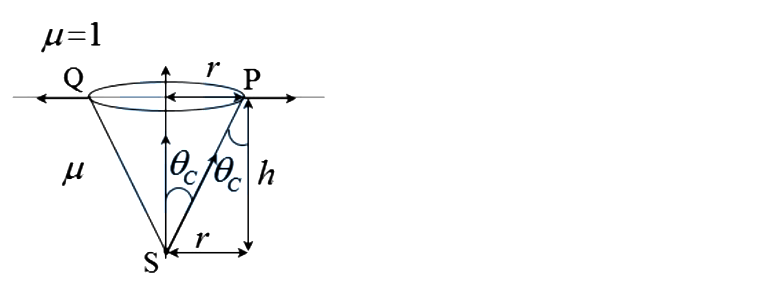
Area of the light patch \(=\pi r^2\)
We know the patch forms due to total internal reflection. Light rays from source \(S\) are incident at the edge of the circular path at critical angle \(\theta_{\mathrm{C}}\) (as shown at points \(\mathrm{P}\) and \(\mathrm{Q}\) ), the refracted ray exits at angle \(\frac{\pi}{2}\) w.r.t. the normal.
Using Snell's Law
\(
\begin{aligned}
& \therefore \mu\left(\sin \theta_C\right)=1\left(\sin \left(\frac{\pi}{2}\right)\right) \\
& \Rightarrow \sin \theta_C=\frac{1}{\mu}=\frac{r}{\sqrt{h^2+r^2}} \\
& \Rightarrow r^2=\frac{\left(h^2+r^2\right)}{\mu^2} \\
& \Rightarrow r^2=\frac{h^2}{\left(\mu^2-1\right)}
\end{aligned}
\)
\(\therefore\) Area of the patch \(=\left(\frac{\pi h^2}{\mu^2-1}\right)\)
Area of the light patch \(=\pi r^2\)
We know the patch forms due to total internal reflection. Light rays from source \(S\) are incident at the edge of the circular path at critical angle \(\theta_{\mathrm{C}}\) (as shown at points \(\mathrm{P}\) and \(\mathrm{Q}\) ), the refracted ray exits at angle \(\frac{\pi}{2}\) w.r.t. the normal.
Using Snell's Law
\(
\begin{aligned}
& \therefore \mu\left(\sin \theta_C\right)=1\left(\sin \left(\frac{\pi}{2}\right)\right) \\
& \Rightarrow \sin \theta_C=\frac{1}{\mu}=\frac{r}{\sqrt{h^2+r^2}} \\
& \Rightarrow r^2=\frac{\left(h^2+r^2\right)}{\mu^2} \\
& \Rightarrow r^2=\frac{h^2}{\left(\mu^2-1\right)}
\end{aligned}
\)
\(\therefore\) Area of the patch \(=\left(\frac{\pi h^2}{\mu^2-1}\right)\)
See the Complete Solution
Get step-by-step explanations for this and 2.5 Lakh+ more JEE, NEET & CET questions.
- Unlock all solutions
- Practice the full chapter
- Track accuracy across PYQs
4.8 rated on Google Play · 14,000+ reviews
More questions from Physics
- A particle is revolving in anticlockwise sense along the circumference of a circle of radius 'r' with linear velocity 'v', then the angle between ' \(\mathrm{v}^{\prime}\) and angular velocity '\(\omega^{\prime}\) will beMHT CET 2020 Easy
- Let \(\gamma_1\) be the ratio of molar specific heat at constant pressure and molar specific heat at constant volume of a monoatomic gas and \(\gamma_2\) be the similar ratio of diatomic gas. Considering the diatomic gas molecule as a rigid rotator, the ratio \(\frac{\gamma_2}{\gamma_1}\) isMHT CET 2023 Medium
- If a ray of light in denser medium strikes a rarer medium at angle of incidence \(i\), the angles of reflection and refraction are \(r\) and \(r^{\prime}\) respectively. If the reflected and refracted rays are at right angles to each other, the critical angle for the given pair of media isMHT CET 2023 Medium
- A coil is wound on a core of rectangular cross-section. If all the linear dimensions of core are increased by a factor 3 and number of turns per unit length of coil remains same, the self-inductance increases by a factorMHT CET 2025 Medium
- A pipe open at one end has length \(0.8 \mathrm{~m}\). At the open end of the tube a string \(0.5 \mathrm{~m}\) long is vibrating in its \(1^{\text {st }}\) overtone and resonates with fundamental frequency of pipe. If tension in the string is \(50 \mathrm{~N}\), the mass of string is (speed of sound \(=320 \mathrm{~m} / \mathrm{s}\) )MHT CET 2020 Medium
- What should be the velocity of earth due to rotation about its own axis so that the weight at equator becomes \(\left(\frac{3}{5}\right)^{\text {th }}\) of initial value? (Radius of earth on equator \(=6400 \mathrm{~km}, \mathrm{~g}=10 \frac{\mathrm{m}}{\mathrm{s}^{2}}, \cos 0^{\circ}=1\) )MHT CET 2020 Medium
More PYQs from MHT CET
- What is the value of critical temperature of water?MHT CET 2021 Medium
- \(\int_1^2 \frac{\mathrm{d} x}{\left(x^2-2 x+4\right)^{\frac{3}{2}}}=\frac{\mathrm{k}}{\mathrm{k}+5}\), then \(\mathrm{k}\) has the valueMHT CET 2023 Hard
- A projectile is thrown with an initial velocity \((\hat{a}+b \hat{j}) \mathrm{m} / \mathrm{s}\), where \(\hat{i}\) and \(\hat{j}\) are unit vectors along horizontal and vertical directions respectively. If the range of the projectile is twice the maximum height reached by it, thenMHT CET 2021 Medium
- If \(y=\sec \left(\tan ^{-1} x\right)\), then \(\frac{\mathrm{d} y}{\mathrm{~d} x}\) at \(x=1\) is equal toMHT CET 2024 Easy
- A body is projected vertically from earth's surface with \(\left(\frac{1}{3}\right)^{\text {rd }}\) of escape velocity. The maximum height reached by the body is ( \(\mathrm{R}=\) radius of earth)MHT CET 2025 Medium
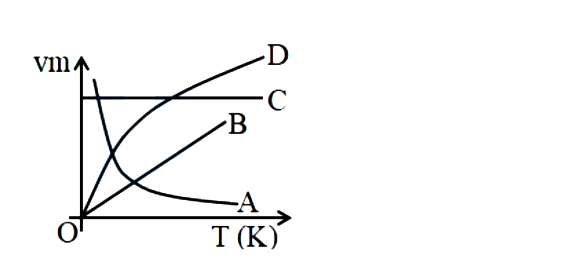
- For a perfectly black body, the graph is plotted between the frequency of radiation with maximum intensity \(\left(v_{\mathrm{m}}\right)\) and the absolute temperature ' \(\mathrm{T}\) '. Out of the following which is the correct graph?
 MHT CET 2022 Easy