


MHT CET · Physics · Dual Nature of Matter
Photoelectrons are emitted when photons of energy \(4.2 \mathrm{eV}\) are incident on a photosensitive metallic sphere of radius \(10 \mathrm{~cm}\) and work function \(2.4 \mathrm{eV}\). The number of photoelectrons emitted before the emission is stopped is
\(
\left[\frac{1}{4 \pi \epsilon_0}=9 \times 10^9 \text { SI unit; } \mathrm{e}=1.6 \times 10^{-19} \mathrm{C}\right]
\)
- A \(1.25 \times 10^6\)
- B \(1.25 \times 10^8\)
- C \(1.25 \times 10^2\)
- D \(1.25 \times 10^4\)
Answer & Solution
Correct Answer
(B) \(1.25 \times 10^8\)
Step-by-step Solution
Detailed explanation
\(
\mathrm{h} v=4.2 \mathrm{eV}, \phi=2.4 \mathrm{eV},(\mathrm{KE})_{\max }=4.2-2.4\) \(=1.8 \mathrm{eV}
\)
The electrons will not be able to escape from the surface when its potential becomes \(1.8 \mathrm{~V}\).
\(
\begin{aligned}
& \mathrm{V}=\frac{1}{4 \pi \epsilon_0} \frac{\mathrm{q}}{\mathrm{r}} \\
& 1.8=9 \times 10^9 \times \frac{\mathrm{q}}{0.1} \\
& \mathrm{q}=2 \times 10^{-11} \mathrm{C}
\end{aligned}
\)
The number of photoelectrons emitted before the emission is stopped is,
\(
\mathrm{n}=\frac{\mathrm{q}}{\mathrm{e}}=\frac{2 \times 10^{-11}}{1.6 \times 10^{-19}}=1.25 \times 10^8
\)
\mathrm{h} v=4.2 \mathrm{eV}, \phi=2.4 \mathrm{eV},(\mathrm{KE})_{\max }=4.2-2.4\) \(=1.8 \mathrm{eV}
\)
The electrons will not be able to escape from the surface when its potential becomes \(1.8 \mathrm{~V}\).
\(
\begin{aligned}
& \mathrm{V}=\frac{1}{4 \pi \epsilon_0} \frac{\mathrm{q}}{\mathrm{r}} \\
& 1.8=9 \times 10^9 \times \frac{\mathrm{q}}{0.1} \\
& \mathrm{q}=2 \times 10^{-11} \mathrm{C}
\end{aligned}
\)
The number of photoelectrons emitted before the emission is stopped is,
\(
\mathrm{n}=\frac{\mathrm{q}}{\mathrm{e}}=\frac{2 \times 10^{-11}}{1.6 \times 10^{-19}}=1.25 \times 10^8
\)
See the Complete Solution
Get step-by-step explanations for this and 2.5 Lakh+ more JEE, NEET & CET questions.
- Unlock all solutions
- Practice the full chapter
- Track accuracy across PYQs
4.8 rated on Google Play · 14,000+ reviews
More questions from Physics
- A particle executing S.H.M. has velocities ' \(\mathrm{V}_1\) ' and ' \(\mathrm{V}_2\) ' at distances ' \(x_1\) ' and ' \(x_2\) ' respectively, from the mean position. Its frequency isMHT CET 2024 Medium
- The frequency of AC mains in India isMHT CET 2012 Medium
- A uniform metal wire has length 'L', mass 'M' and density ' \(\mathrm{Q}\) '. It is under tension 'T"
and ' \(v^{\prime}\) is the speed of transverse wave along the wire. The area of cross-section of
the wire isMHT CET 2020 Medium - Two identical coaxial circular loops carry current 'i' each circulating in the clockwise direction. If the loops are approaching each other, thenMHT CET 2025 Medium
- Choose the correct statement. In semiconductors, valance band and conduction bandMHT CET 2021 Medium
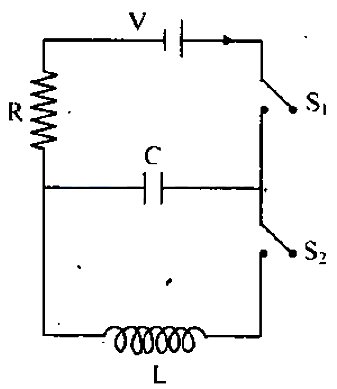
- In the given circuit, when \(\mathrm{S}_1\) is closed, the capacitor gets fully charged. Now \(\mathrm{S}_1\) is open and \(\mathrm{S}_2\) is closed. Then
 MHT CET 2024 Hard
More PYQs from MHT CET
- In energy band diagram of insulators, a band gap and the conduction band is respectivelyMHT CET 2020 Easy
- Two capillary tubes of the same diameter are kept vertically in two different liquids whose densities are in the ratio \(4: 3\). The rise of liquid in two capillaries is ' \(h_1\) ' and ' \(h h_2\) ' respectively. If the surface tensions of liquids are in the ratio \(6: 5\), the ratio of heights \(\left(\frac{h_1}{h_2}\right)\) is
(Assume that their angles of contact are same)MHT CET 2023 Medium - The end correction for the vibrations of air column in a tube of circular cross-section will be more if the tube isMHT CET 2024 Easy
- What is the number of lone pair of electrons involved in IF molecule?MHT CET 2024 Easy
- If a function \(f: R \rightarrow R\) is defined by \(f(x)=\frac{4 x}{5}+3\), then \(f^{-1}(x)=\)MHT CET 2020 Easy
- \(16 \mathrm{~g}\) of oxygen gas expands isothermally and reversibly at \(300 \mathrm{~K}\) from \(10 \mathrm{dm}^{3}\) to \(100 \mathrm{dm}^{3}\). The work done is (in \(J\) )MHT CET 2009 Medium