


MHT CET · Physics · Dual Nature of Matter
Kinetic energy of a proton is equal to energy \(E\) of a photon. Let ' \(\lambda_1\) ' be the de-Broglie wavelength of proton and ' \(\lambda_2\) ' be the wavelength of photon. If \(\left(\frac{\lambda_1}{\lambda_2}\right) \propto \mathrm{E}^{\mathrm{n}}\) then the value of ' \(n\) ' is
- A 1
- B 2
- C 5
- D 0.5
Answer & Solution
Correct Answer
(D) 0.5
Step-by-step Solution
Detailed explanation
If \(E\) is the kinetic energy of the proton, then \(E=\frac{p^2}{2 m}\)
where p is the momentum and m is the mass of proton
\(\therefore \quad \mathrm{p}=\sqrt{2 \mathrm{mE}}\)
\(\therefore \quad \lambda_1=\frac{\mathrm{h}}{\mathrm{p}}=\frac{\mathrm{h}}{\sqrt{2 \mathrm{mE}}}\)
Similarly, for a photon, \(E=\frac{h c}{\lambda_2}\)
\(\begin{aligned} & \therefore \quad \dot{\lambda}_2=\frac{h c}{E} \\ & \therefore \quad \frac{\lambda_1}{\lambda_2}=\frac{h}{\sqrt{2 m E}} \times \frac{E}{h c}=\frac{1}{c} \sqrt{\frac{E}{2 m}} \\ & \therefore \quad \\ & \therefore \quad \frac{\lambda_1}{\lambda_2} \propto E^{1 / 2} \Rightarrow n=0.5\end{aligned}\)
where p is the momentum and m is the mass of proton
\(\therefore \quad \mathrm{p}=\sqrt{2 \mathrm{mE}}\)
\(\therefore \quad \lambda_1=\frac{\mathrm{h}}{\mathrm{p}}=\frac{\mathrm{h}}{\sqrt{2 \mathrm{mE}}}\)
Similarly, for a photon, \(E=\frac{h c}{\lambda_2}\)
\(\begin{aligned} & \therefore \quad \dot{\lambda}_2=\frac{h c}{E} \\ & \therefore \quad \frac{\lambda_1}{\lambda_2}=\frac{h}{\sqrt{2 m E}} \times \frac{E}{h c}=\frac{1}{c} \sqrt{\frac{E}{2 m}} \\ & \therefore \quad \\ & \therefore \quad \frac{\lambda_1}{\lambda_2} \propto E^{1 / 2} \Rightarrow n=0.5\end{aligned}\)
See the Complete Solution
Get step-by-step explanations for this and 2.5 Lakh+ more JEE, NEET & CET questions.
- Unlock all solutions
- Practice the full chapter
- Track accuracy across PYQs
4.8 rated on Google Play · 14,000+ reviews
More questions from Physics
- The current in resistor in the following circuit is
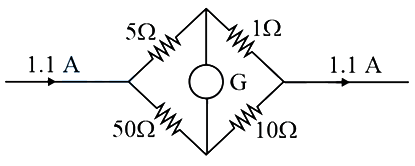 MHT CET 2019 Medium
 - When a photon enters glass from air, which one of the following quantities does not change?MHT CET 2021 Easy
- At resonance, the value of current in a series L-C-R- (Symbols have their usual meanings.)MHT CET 2022 Easy
- A ball rises to surface at a constant velocity in liquid whose density is 3 times greater than that of the material of the ball. The ratio of force of friction acting on the rising ball to its weight isMHT CET 2024 Hard
- A vehicle is moving with a constant speed of \(10 \mathrm{~m} / \mathrm{s}\) in a circular horizontal track of radius 20 m . A bob is suspended from the roof of a vehicle by a massless string. The angle made by the string with the vertical will be (acceleration due to gravity, \(g=10 \mathrm{~m} / \mathrm{s}^2\) )MHT CET 2025 Medium
- Water rises in a capillary tube of radius ' \(r\) ' upto height ' \(h\) ' The mass of water in the capillary is ' \(m\) ' The mass of water will rise in a capillary of radius will \(\frac{r}{4}\) beMHT CET 2022 Medium
More PYQs from MHT CET
- If \(A=\left[\begin{array}{lll}0 & 1 & 2 \\ 1 & 2 & 3 \\ 3 & 1 & 1\end{array}\right]\), then \(A^{-1}=\)MHT CET 2021 Easy
- What is the difference in molar mass of Undecane and Dodecane?MHT CET 2025 Easy
- The wavelength of light for the least energetic photons emitted in the Lyman series of the hydrogen spectrum is nearly [Take \(\mathrm{hc}=1240 \mathrm{eV}-\mathrm{nm}\), change in energy of the levels \(=10.2 \mathrm{eV}]\)MHT CET 2023 Medium
- The common principal solution of the equations \(\sin \theta=-\frac{1}{2}\) and \(\tan \theta=\frac{1}{\sqrt{3}}\) isMHT CET 2025 Easy
- Which of the following molecules consist minimum lone pair of electrons in the valence shell of central atom?MHT CET 2025 Easy
- A \(1 \mu \mathrm{~F}\) capacitor is charged to 50 V and is then discharged through 10 mH inductor of negligible resistance. The maximum current in the inductor isMHT CET 2024 Easy