


MHT CET · Physics · Electromagnetic Induction
Inductance of solenoid ' \(L\) ' having diameter ' \(d\) '. Let \(n\) be the number of turns per unit length. The inductance per length near the middle of a solenoid is (Asume that current passes through the turns, \(\mu_0=\) Permeability of vacuum)
- A \(\frac{\mu_0 \pi n d^2}{4}\)
- B \(\frac{\mu_0 \pi n^2 d}{2}\)
- C \(\frac{\mu_0 \pi n^2 d^2}{2}\)
- D \(\frac{\mu_0 \pi n^2 d^2}{4}\)
Answer & Solution
Correct Answer
(D) \(\frac{\mu_0 \pi n^2 d^2}{4}\)
Step-by-step Solution
Detailed explanation
Concept: Using the definition of the flux associated through the surface we can obtain the inductance per unit length near the center of the solenoid.
We define selfinductance \(\mathrm{L}\) as:
\(\phi=\mathrm{Li}\)
where, \(\phi\) is the associated flux and \(\mathrm{i}\) is the current through the solenoid.
\(\phi=\mathrm{B} \cdot \mathrm{A}\)
where, \(B=\left(\mu_0\right.\) in \(), A=2 \pi \frac{d^2}{4}\) is the area.
\(\begin{aligned} & \therefore \mathrm{Li}=\left(\mu_0 \mathrm{in}\right)\left(\mathrm{n} \pi \frac{\mathrm{d}^2}{4}\right) \\ & \therefore \mathrm{L}=\frac{\mu_0 \pi \mathrm{n}^2 \mathrm{~d}^2}{4}\end{aligned}\)
We define selfinductance \(\mathrm{L}\) as:
\(\phi=\mathrm{Li}\)
where, \(\phi\) is the associated flux and \(\mathrm{i}\) is the current through the solenoid.
\(\phi=\mathrm{B} \cdot \mathrm{A}\)
where, \(B=\left(\mu_0\right.\) in \(), A=2 \pi \frac{d^2}{4}\) is the area.
\(\begin{aligned} & \therefore \mathrm{Li}=\left(\mu_0 \mathrm{in}\right)\left(\mathrm{n} \pi \frac{\mathrm{d}^2}{4}\right) \\ & \therefore \mathrm{L}=\frac{\mu_0 \pi \mathrm{n}^2 \mathrm{~d}^2}{4}\end{aligned}\)
See the Complete Solution
Get step-by-step explanations for this and 2.5 Lakh+ more JEE, NEET & CET questions.
- Unlock all solutions
- Practice the full chapter
- Track accuracy across PYQs
4.8 rated on Google Play · 14,000+ reviews
More questions from Physics
- Only \(4 \%\) of the total current in the circuit passed through a galvanometer. If the resistance of the galvanometer is \(\mathrm{G}\), then the shunt resistance connected to the galvanometer isMHT CET 2023 Hard
- Which one of the following symbols represents a photodiode?
(A)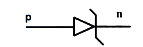
(B)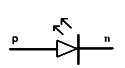
(C)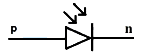
(D)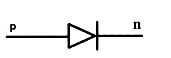 MHT CET 2020 Easy
 - In a series circuit The impedance of the circuitisMHT CET 2019 Easy
- Assuming human pupil to have radius of 0.25 cm and comfortable viewing distance of 25 cm , the minimum separation between the two objects that human eye can resolve at 500 nm wavelength is nearlyMHT CET 2025 Medium
- The maximum wavelength of radiation emitted by a star is 289.8 nm. Then intensity of radiation for the star is (Given : Stefan’s constant = , Wien’s constant,MHT CET 2019 Medium
- A string of length ' \(L\) ' fixed at one end carries a body of mass ' \(m\) ' at the other end. The mass is revolved in a circle in the horizontal plane about a vertical axis passing through the fixed end of the string. The string makes angle ' \(\theta\) ' with the vertical. The angular frequency of the body is ' \(\omega\) '. The tension in the string isMHT CET 2023 Medium
More PYQs from MHT CET
- The differential equation of all straight lines passing through the point \((1,-1)\) isMHT CET 2025 Medium
- What is the oxidation number of As in \(\mathrm{H}_{3} \mathrm{AsO}_{3}\) ?MHT CET 2020 Easy
- Identify the lanthanoid that exhibits zero effective magnetic moment in +3 state.MHT CET 2025 Medium
- If \(\mathrm{I}_0\) is the intensity of the principal maximum in the single slit diffraction pattern, then what will be the intensity when the slit width is doubled?MHT CET 2023 Medium
- Three numbers are chosen at random from numbers 1 to 20 . The probability that they are consecutive isMHT CET 2025 Medium
- The integrating factor of the differential equation \(x \frac{\mathrm{dy}}{\mathrm{d} x}+\mathrm{y} \log x=x \mathrm{e}^x \cdot x^{\frac{-1}{2}} \log x(x>0)\) isMHT CET 2025 Medium