


MHT CET · Physics · Wave Optics
In Young's double slit experiment, the two slits are \(d\) distance apart. Interference pattern is observed on the screen at a distance \(D\) from the slits. Fist dark fringe is observed on the screen directly opposite to one of the slits. The wavelength of the light is.
- A \(\frac{D^2}{2 d}\)
- B \(\frac{d^2}{D}\)
- C \(\frac{d^2}{2 D}\)
- D \(\frac{D^2}{d}\)
Answer & Solution
Correct Answer
(B) \(\frac{d^2}{D}\)
Step-by-step Solution
Detailed explanation
Consider the following diagram:
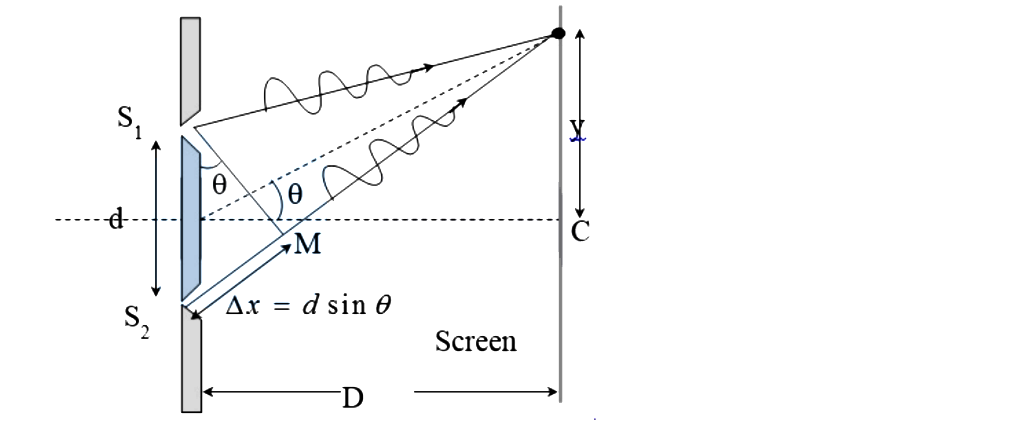
The dark fringe is produced at a point just opposite to the slit \(S_1\), i.e.,
\(y_1=\frac{d}{2}\)
For dark fringe, path difference is odd multiple of half of the wavelength:
\(\Delta x=(2 n-1) \frac{\lambda}{2}\)
From the figure, relation between fringe location and path difference can be obtained as:
\(\tan \theta=\frac{y}{D} \approx \sin \theta=\frac{\Delta x}{d} \)
\( \therefore y=\frac{\Delta x D}{a}=(2 n-1)\left(\frac{\lambda}{2}\right) \cdot\left(\frac{D}{a}\right)\)\(=(2 n-1) \frac{\lambda D}{2 d}\)
where \(n=1,2,3, \ldots \ldots \ldots\)
\(\begin{aligned} & \Rightarrow \frac{d}{2}=(2 n-1) \frac{\lambda D}{2 d} \\ & \Rightarrow \lambda=\frac{d^2}{(2 n-1) D}\end{aligned}\)
For \(n=1\),
\(\Rightarrow \lambda=\frac{d^2}{D}\)
The dark fringe is produced at a point just opposite to the slit \(S_1\), i.e.,
\(y_1=\frac{d}{2}\)
For dark fringe, path difference is odd multiple of half of the wavelength:
\(\Delta x=(2 n-1) \frac{\lambda}{2}\)
From the figure, relation between fringe location and path difference can be obtained as:
\(\tan \theta=\frac{y}{D} \approx \sin \theta=\frac{\Delta x}{d} \)
\( \therefore y=\frac{\Delta x D}{a}=(2 n-1)\left(\frac{\lambda}{2}\right) \cdot\left(\frac{D}{a}\right)\)\(=(2 n-1) \frac{\lambda D}{2 d}\)
where \(n=1,2,3, \ldots \ldots \ldots\)
\(\begin{aligned} & \Rightarrow \frac{d}{2}=(2 n-1) \frac{\lambda D}{2 d} \\ & \Rightarrow \lambda=\frac{d^2}{(2 n-1) D}\end{aligned}\)
For \(n=1\),
\(\Rightarrow \lambda=\frac{d^2}{D}\)
See the Complete Solution
Get step-by-step explanations for this and 2.5 Lakh+ more JEE, NEET & CET questions.
- Unlock all solutions
- Practice the full chapter
- Track accuracy across PYQs
4.8 rated on Google Play · 14,000+ reviews
More questions from Physics
- The coefficient of thermal conductivity of a rod depends on itsMHT CET 2022 Easy
- A metal sphere of radius ‘ ’ and density ‘ ’ is dropped in a liquid of density ‘ ’ moves with terminal velocity ‘ ’. Another metal sphere of same radius and density ‘ ’ is dropped in the same liquid, its terminal velocity will beMHT CET 2019 Medium
- Out of the fundamental forces in nature, maximum and minimum range is respectively forMHT CET 2020 Easy
- Which one of the following logic gates is called as Universal gate?MHT CET 2022 Easy
- An electric dipole having dipole moment \(\mathrm{P}=\mathrm{q} \times 2 \ell\) is placed in a uniform electric field ' \(E\) '. The dipole moment is along the direction of the field. The force acting on it and its potential energy are respectivelyMHT CET 2021 Easy
- In common emitter transistor amplifier, the output voltage and input voltage have a phase difference ofMHT CET 2022 Easy
More PYQs from MHT CET
- In a capactive circuit, the reactance of capacitor at frequency 'f' is ' \(\mathrm{X}_{\mathrm{c}}{ }^{\prime}\). What will be
its reactance at frequency \(4 \mathrm{f} ?\)MHT CET 2020 Easy - Identify the outer electronic configuration of first element of first transition series.MHT CET 2022 Easy
- A current carrying loop is placed in a uniform magnetic field. The torque acting on the loop does not depend uponMHT CET 2021 Easy
- The size of the real image produced by a convex lens of focal length \(\mathrm{F}\) is ' \(\mathrm{m}\) ' times the size of the object. The image distance from the lens isMHT CET 2023 Medium
- With respect to derivatives of germinal layers in human beings, complete the analogy.
Ectoderm: Sweat glands:: Endoderm: _________ .MHT CET 2021 Hard - Which of the following polymers is used to obtain shopping bags?MHT CET 2021 Easy