


MHT CET · Physics · Wave Optics
In Young's double slit experiment, the intensity at a point where the path difference is \(\frac{\lambda}{4}\) [ \(\lambda\) is wavelength of light used] is ' \(I\) '. If ' \(\mathrm{I}_0\) ' is the maximum intensity, then \(\frac{\mathrm{I}}{\mathrm{I}_0}\) is equal to
- A \(3: 2\)
- B \(2: 3\)
- C \(3: 4\)
- D \(1: 2\)
Answer & Solution
Correct Answer
(D) \(1: 2\)
Step-by-step Solution
Detailed explanation
If I' is the intensity of each wave, then resultant intensity is given by
\(
\mathrm{I}=4 \mathrm{I} \cos ^2 \frac{\phi}{2}
\)
I will have maximum value when \(\cos ^2 \frac{\phi}{2}=1\)
\(\therefore\) maximum intensity, \(\mathrm{I}_0=4 \mathrm{I}\)
When path difference is \(\frac{\lambda}{4}\), the phase difference, \(\phi=\frac{\pi}{2}\)
The resultant intensity, \(I=4 I^{\prime} \cos ^2 \frac{\pi}{4}=4 I^{\prime} \times \frac{1}{2}=2 I^{\prime}\)
\(
\therefore \frac{\mathrm{I}}{\mathrm{I}_0}=\frac{1}{2}
\)
\(
\mathrm{I}=4 \mathrm{I} \cos ^2 \frac{\phi}{2}
\)
I will have maximum value when \(\cos ^2 \frac{\phi}{2}=1\)
\(\therefore\) maximum intensity, \(\mathrm{I}_0=4 \mathrm{I}\)
When path difference is \(\frac{\lambda}{4}\), the phase difference, \(\phi=\frac{\pi}{2}\)
The resultant intensity, \(I=4 I^{\prime} \cos ^2 \frac{\pi}{4}=4 I^{\prime} \times \frac{1}{2}=2 I^{\prime}\)
\(
\therefore \frac{\mathrm{I}}{\mathrm{I}_0}=\frac{1}{2}
\)
See the Complete Solution
Get step-by-step explanations for this and 2.5 Lakh+ more JEE, NEET & CET questions.
- Unlock all solutions
- Practice the full chapter
- Track accuracy across PYQs
4.8 rated on Google Play · 14,000+ reviews
More questions from Physics
- When a metallic surface is illuminated with radiation of wavelength ' \(\lambda\) ', the stopping potential is ' \(\mathrm{V}\) '. If the same surface is illuminated with radiation of wavelength ' \(2 \lambda\) ', the stopping potential is ' \(\left(\frac{\mathrm{v}}{4}\right)\),. The threshold wavelength for the metallic surface isMHT CET 2023 Medium
- An electron makes a full rotation in a circle of radius \(0.8 \mathrm{~m}\) in one second. The magnetic field at the centre of the circle is
\(
\left(\mu_0=4 \pi \times 10^{-7} \text { SI units }\right)
\)MHT CET 2023 Medium - A bar of iron having magnetic moment \(2 \cdot 4 \mathrm{Am}^2\) weighs 66 g . If the density of the material of the bar is \(7700 \mathrm{~kg} / \mathrm{m}^3\), the intensity of magnetisation in \(\mathrm{Am}^{-1}\) isMHT CET 2025 Medium
- The acceleration (a) - time (T) graph for the body starting from rest is given below. The maximum speed of the body is
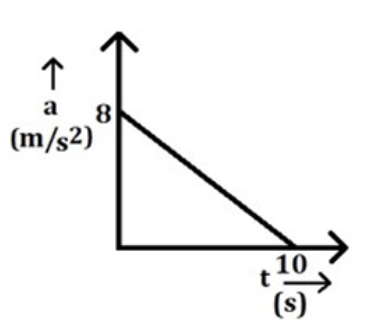 MHT CET 2025 Medium
 - Two spheres of equal masses, one of which is a thin spherical shell and the other solid sphere, have the same moment of inertia about their respective diameters. The ratio of their radii isMHT CET 2024 Hard
- The pure inductors each of inductance \(6 \mathrm{H}\) are connected as shown in the figure. Their equivalent inductance between the points ' \(\mathrm{P}\) ' and ' \(\mathrm{Q}\) ' is
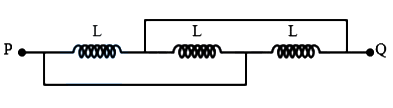 MHT CET 2021 Hard
More PYQs from MHT CET
- If \(P\) is a point on the segment \(A B\) of length \(12 \mathrm{~cm}\), then the position of \(P\) for \(A P^{2}+B P^{2}\) to be minimum is such thatMHT CET 2020 Medium
- Calculate the density of metal having volume of unit cell \(64 \times 10^{-24} \mathrm{~cm}^3\) and molar mass of metal \(192 \mathrm{~g} \mathrm{~mol}^{-1}\) containing 4 particles in unit cell.MHT CET 2022 Easy
- A block of mass ' \(\mathrm{m}\) ' attached to one end of the vertical spring produces extension \(\mathrm{x}^{\prime}\). If the block is pulled and released, the periodic time of oscillation isMHT CET 2020 Easy
- Edge length of unit cell of BCC structure is \(352 \mathrm{pm}\). What is radius of the atoms?MHT CET 2021 Medium
- Five solid spheres each of mass \(m\) and radius \(r\) are rotating about an axis \(A\) as shown in figure. Hence the moment of inertia of the system about the axis of rotation A-A' as shown in figure. Hence the moment of inertia of the system about the axis of rotation A-A' is
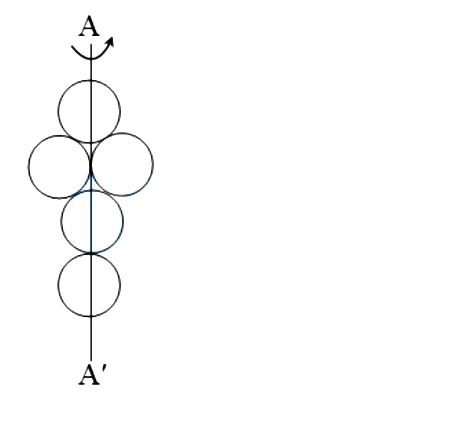 MHT CET 2022 Medium
 - One end of a capillary tube is dipped in water, the rise of water column is ' \(h\) '. The upward force of 98 dyne due to surface tension is balanced by the force due to the weight of the water column. The inner circumference of the capillary is (surface tension of water \(=7 \times 10^{-2} \mathrm{Nm}^{-1}\) )MHT CET 2025 Hard