


MHT CET · Physics · Wave Optics
In Young's double slit experiment, the intensity at a point where path difference is \(\frac{\lambda}{6}\) ( \(\lambda\) being the wavelength of light used) is I'. If ' \(I_0\) ' denotes the maximum intensity, then \(\frac{I}{I_0}\) is equal to
- A \(\frac{\sqrt{3}}{2}\)
- B \(\frac{3}{4}\)
- C \(\frac{1}{\sqrt{2}}\)
- D \(\frac{1}{2}\)
Answer & Solution
Correct Answer
(B) \(\frac{3}{4}\)
Step-by-step Solution
Detailed explanation
If \(\mathrm{I}\) ' is the intensity of each wave, then the resultant intensity at a point is given by
\(
\mathrm{I}=4 \mathrm{I}^{\prime} \cos ^2 \frac{\phi}{2}
\)
For maximum intensity, phase difference \(\phi=0\)
\(
\therefore \mathrm{I}_0=4 \mathrm{I}^{\prime} \cos ^2 0=4 \mathrm{I}^{\prime}
\)
At a point where path difference is \(\frac{\lambda}{6}\), hence phase difference is
\(
\begin{aligned}
& \frac{\pi}{3} . \\
& \therefore \mathrm{I}=4 \mathrm{I}^{\prime} \cos ^2 \frac{\pi}{6}=3 \mathrm{I}^{\prime} \\
& \therefore \frac{\mathrm{I}}{\mathrm{I}_0}=\frac{3}{4}
\end{aligned}
\)
\(
\mathrm{I}=4 \mathrm{I}^{\prime} \cos ^2 \frac{\phi}{2}
\)
For maximum intensity, phase difference \(\phi=0\)
\(
\therefore \mathrm{I}_0=4 \mathrm{I}^{\prime} \cos ^2 0=4 \mathrm{I}^{\prime}
\)
At a point where path difference is \(\frac{\lambda}{6}\), hence phase difference is
\(
\begin{aligned}
& \frac{\pi}{3} . \\
& \therefore \mathrm{I}=4 \mathrm{I}^{\prime} \cos ^2 \frac{\pi}{6}=3 \mathrm{I}^{\prime} \\
& \therefore \frac{\mathrm{I}}{\mathrm{I}_0}=\frac{3}{4}
\end{aligned}
\)
See the Complete Solution
Get step-by-step explanations for this and 2.5 Lakh+ more JEE, NEET & CET questions.
- Unlock all solutions
- Practice the full chapter
- Track accuracy across PYQs
4.8 rated on Google Play · 14,000+ reviews
More questions from Physics
- A parallel plate capacitor has uniform electric field 'E' in the space between the
plates. If the distance between plates is 'd' and area of each plate is 'A', the energy
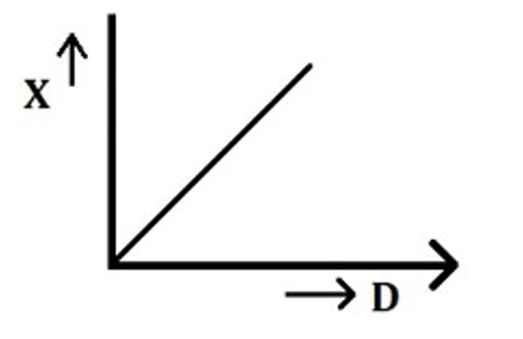
stored in the capacitor is \(\left(\epsilon_{0}=\right.\) permittivity of free space \()\)MHT CET 2020 Easy - Graph shows the variation of fringe width \((\mathrm{X})\) versus distance of the screen from the plane of the slits (D) in Young's double slit experiment. (keeping other parameters same, \(\mathrm{d}=\) distance between the slits). The wavelength of light used can be calculated as
 MHT CET 2025 Medium
 - For a particle performing S.H.M., when displacement is 'x', the potential energy and restoring force acting on it is denoted by 'E' and 'F' respectively. The relation between \(\mathrm{x}, \mathrm{E}\) and \(\mathrm{F}\) isMHT CET 2020 Easy
- ' \(n\) ' small drops of same size fall through air with constant velocity \(5 \mathrm{~cm} / \mathrm{s}\). They coalesce to form a big drop. The terminal velocity of the big drop isMHT CET 2021 Hard
- In capillary tube having area of cross-section ' \(\mathrm{A}\) ', water rises to a height ' \(h\) '. If cross sectional area is reduced to \(\frac{A}{9}\), the rise of water in the capillary tube isMHT CET 2022 Medium
- Magnetic field at the centre of a circular loop of area 'A' is ' \(B^{\prime}\) '. The magnetic moment of the loop will be \(\left(\mu_{0}=\right.\) permeability of free space)MHT CET 2020 Medium
More PYQs from MHT CET
- Flame cell are also called _A and they are found in animals like B.MHT CET 2021 Medium
- Separation of Acetone and Benzene from their mixture is carried out byMHT CET 2020 Easy
- A coil having effective area ' \(\mathrm{A}\) ' is held with its plane normal to a magnitude field of induction ' \(\mathrm{B}\) '. The magnetic induction is quickly reduced to \(25 \%\) of its initial value in 1 second. The e.m.f. induced in the coil (in volt) will beMHT CET 2023 Medium
- Acidic buffer solution is prepared by mixing proportionate quantity ofMHT CET 2024 Medium
- Zirconium is refined byMHT CET 2020 Easy
- The internal energy of a monoatomic ideal gas molecule isMHT CET 2023 Easy