


MHT CET · Physics · Wave Optics
In Young's double slit experiment, 'I' is the minimum intensity and ' \(\mathrm{I}_1\) ' is the intensity at a point where the path difference is \(\frac{\lambda}{4}\) where ' \(\lambda\) ' is the wavelength of light used. The ratio \(I / I_1\) is (Intensities of the two interfering waves are same) \(\left(\cos 0^{\circ}=1, \cos 90^{\circ}=0\right)\)
- A 5
- B 4
- C 3
- D 2
Answer & Solution
Correct Answer
(D) 2
Step-by-step Solution
Detailed explanation
- Concept: At \(\lambda / 4\) path difference, the phase difference is \(\pi / 2\) radians. The resultant intensity for two waves of equal amplitude interfering with a phase difference \(\phi\) is \(I=4 I_0 \cos ^2(\phi / 2)\).
- Calculation: \(\phi=\pi / 2\) leads to \(I=4 I_0 \cos ^2(\pi / 4)=4 I_0 \times(1 / \sqrt{2})^2=2 I_0\).
- Since \(I_1\) (dark fringe) is 0 , comparing intensities is not straightforward, but given that minimum intensity \(\left(I_1\right)\) typically represents a baseline or zero in the theoretical model, the scenario described doesn't make practical sense. It's a conceptual error as \(I_1\) cannot be zero in an actual setting where other fringes are being compared unless explicitly defined differently in a particular experimental setup.
Answer: The theoretical response is conceptually flawed because the minimum intensity in a typical Young's double slit setup (constructive and destructive interference model) is not zero, it's rather \(I_0\). Assuming \(I_1=I_0, I / I_1=2\).
- Calculation: \(\phi=\pi / 2\) leads to \(I=4 I_0 \cos ^2(\pi / 4)=4 I_0 \times(1 / \sqrt{2})^2=2 I_0\).
- Since \(I_1\) (dark fringe) is 0 , comparing intensities is not straightforward, but given that minimum intensity \(\left(I_1\right)\) typically represents a baseline or zero in the theoretical model, the scenario described doesn't make practical sense. It's a conceptual error as \(I_1\) cannot be zero in an actual setting where other fringes are being compared unless explicitly defined differently in a particular experimental setup.
Answer: The theoretical response is conceptually flawed because the minimum intensity in a typical Young's double slit setup (constructive and destructive interference model) is not zero, it's rather \(I_0\). Assuming \(I_1=I_0, I / I_1=2\).
See the Complete Solution
Get step-by-step explanations for this and 2.5 Lakh+ more JEE, NEET & CET questions.
- Unlock all solutions
- Practice the full chapter
- Track accuracy across PYQs
4.8 rated on Google Play · 14,000+ reviews
More questions from Physics
- The logic gate combination circuit shown in the figure performs the logic function of
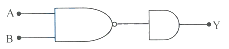 MHT CET 2023 Easy
 - A spherical surface of radius of curvature ' \(R\) ' separates air from glass of refractive index 1.5. The centre of curvature is in the glass. A point object \(P\) placed in air forms a real image \(Q\) in the glass. The line \(P Q\) cuts the surface at point ' \(O\) ' and \(\mathrm{PO}=\mathrm{OQ}=\mathrm{x}\). Hence the distance ' \(\mathrm{x}\) ' is equal toMHT CET 2023 Hard
- The potential energy of 'a long spring when it is stretched by 3 cm is ' \(U\) '. If the spring is stretched by 9 cm , potential energy stored in it will beMHT CET 2024 Easy
- At constant temperature, increasing the pressure of a gas by \(5 \%\) its volume will decrease byMHT CET 2023 Hard
- The root mean square velocity of molecules of a gas is \(200 \mathrm{~m} / \mathrm{s}\). What will be the
root mean square velocity of the molecules, if the molecular weight is doubled and
the absolute temperature is halved?MHT CET 2020 Easy - Reverse bias applied to a \(p-n\) junction diodeMHT CET 2022 Easy
More PYQs from MHT CET
- Moving coil galvanometers \(\mathrm{M}_{1}\) and \(\mathrm{M}_{2}\) have resistance, number of turns, area of coil and magnetic field as follows.
\(\mathrm{R}_{1}=10 \Omega, \mathrm{R}_{2}=14 \Omega, \mathrm{N}_{1}=30, \mathrm{~N}_{2}=42\)
\(\mathrm{A}_{1}=3 \cdot 6 \times 10^{-3} \mathrm{~m}^{2}, \mathrm{~A}_{2}=1 \cdot 8 \times 10^{-2} \mathrm{~m}^{2},\) \(\mathrm{~B}_{1}=0 \cdot 25 \mathrm{~T}, \mathrm{~B}_{2}=0 \cdot 50 \mathrm{~T}\)
(Spring constants are same for both materials)
The ratio of (i) current sensitivity and (ii) voltage sensitivity for galvanometer
\(\left(\mathrm{M}_{2}\right.\) to \(\left.\mathrm{M}_{1}\right)\) is respectivelyMHT CET 2020 Medium - A magnetic needle of magnetic moment \(6 \times 10^{-2} \mathrm{Am}^2\) and moment of inertia \(9.6 \times 10^{-5} \mathrm{~kg} \mathrm{~m}^2\) performs simple harmonic motion in a magnetic field of 0.01 T . Time taken to complete 10 oscillations is [Take \(\pi=3 \cdot 14\) ]MHT CET 2024 Easy
- The unit vector \((a \hat{\imath}+b \hat{j})\) is perpendicular to \((\hat{\imath}+\hat{\jmath})\). The value of \(^{\prime} b^{\prime}\) isMHT CET 2020 Medium
- " It is impossible to determine simultaneously the exact position and exact momentum of an electron. " This statement is calledMHT CET 2025 Easy
- The area of the region bounded by the curves \(y=\mathrm{e}^x, y=\log x\) and lines \(x=1, x=2\) isMHT CET 2023 Hard
- Homo sapiens are most closely related to _________ .MHT CET 2024 Hard