


MHT CET · Physics · Wave Optics
In Yong's double slit experiment, in interference pattern, a minimum is observed exactly in front of one slit. The distance between the two coherent source is ' \(\mathrm{d}\) ' and ' \(\mathrm{D}\) ' is the distance between the source and screen. The possible wavelength used are inversely proportional to
- A \(\mathrm{D}, 5 \mathrm{D}, 9 \mathrm{D} \ldots\)
- B \(\mathrm{D}, 3 \mathrm{D}, 5 \mathrm{D} \ldots\)
- C \(3\mathrm{D}, 4 \mathrm{D}, 5 \mathrm{D} \ldots\)
- D \(3\mathrm{D}, 7 \mathrm{D}, 10 \mathrm{D} \ldots\)
Answer & Solution
Correct Answer
(B) \(\mathrm{D}, 3 \mathrm{D}, 5 \mathrm{D} \ldots\)
Step-by-step Solution
Detailed explanation
If \(x\) is the fringe width, then three will be a minimum in front of the slit if
\(
\begin{aligned}
& \frac{\mathrm{d}}{2}=\frac{\mathrm{x}}{2}, \frac{3 \mathrm{x}}{2}, \frac{5 \mathrm{x}}{2}, \ldots \ldots \\
& \text { or } \mathrm{d}=\mathrm{x}, 3 \mathrm{x}, 5 \mathrm{x} \ldots . \\
& \therefore \mathrm{x}=\mathrm{d}, \frac{\mathrm{d}}{3}, \frac{\mathrm{d}}{5}, \ldots \ldots \\
& \because \lambda=\frac{\mathrm{xd}}{\mathrm{D}} \\
& \therefore \lambda=\frac{\mathrm{d}^2}{\mathrm{D}}, \frac{\mathrm{d}^2}{3 \mathrm{D}}, \frac{\mathrm{d}^2}{5 \mathrm{D}}
\end{aligned}
\)
\(\therefore \lambda\) is inversely proportional to \(\mathrm{D}, 3 \mathrm{D}, 5 \mathrm{D} \ldots\)
\(
\begin{aligned}
& \frac{\mathrm{d}}{2}=\frac{\mathrm{x}}{2}, \frac{3 \mathrm{x}}{2}, \frac{5 \mathrm{x}}{2}, \ldots \ldots \\
& \text { or } \mathrm{d}=\mathrm{x}, 3 \mathrm{x}, 5 \mathrm{x} \ldots . \\
& \therefore \mathrm{x}=\mathrm{d}, \frac{\mathrm{d}}{3}, \frac{\mathrm{d}}{5}, \ldots \ldots \\
& \because \lambda=\frac{\mathrm{xd}}{\mathrm{D}} \\
& \therefore \lambda=\frac{\mathrm{d}^2}{\mathrm{D}}, \frac{\mathrm{d}^2}{3 \mathrm{D}}, \frac{\mathrm{d}^2}{5 \mathrm{D}}
\end{aligned}
\)
\(\therefore \lambda\) is inversely proportional to \(\mathrm{D}, 3 \mathrm{D}, 5 \mathrm{D} \ldots\)
See the Complete Solution
Get step-by-step explanations for this and 2.5 Lakh+ more JEE, NEET & CET questions.
- Unlock all solutions
- Practice the full chapter
- Track accuracy across PYQs
4.8 rated on Google Play · 14,000+ reviews
More questions from Physics
- In case of p-n junction diode, the width of depletion region isMHT CET 2019 Easy
- The a.c. source is connected to series LCR circuit. If voltage across \(\mathrm{R}\) is \(40 \mathrm{~V}\), that across \(\mathrm{L}\) is \(80 \mathrm{~V}\) and that across \(\mathrm{C}\) is \(40 \mathrm{~V}\), then the e.m.f. 'e' of a.c. source isMHT CET 2023 Hard
- Three thin rods, each of mass ' \(M\) ' and length ' \(L\) ' are placed along \(X, Y\) and Z axes which are mutually perpendicular. One end of each rod is at origin. M. I. of the system about Z axis isMHT CET 2024 Medium
- The frequency of the output signal of an LC oscillator circuit is ' \(F\) ' \(\mathrm{Hz}\) with a capacitance of \(0.1 \mu \mathrm{F}\). If the value of the capacitor is increased to \(0.2 \mu \mathrm{F}\), then the frequency of the output signal will beMHT CET 2021 Medium
- Consider a particle of mass m suspended by a string at the equator. Let R and M denote radius and mass of the earth. If is the angular velocity of rotation of the earth about its own axis, then the tension on the string will beMHT CET 2019 Hard
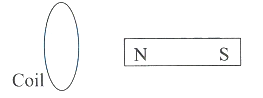
- The magnet is moved towards the coil with speed ' \(\mathrm{V}\) '. The induced e.m.f. in the coil is ' \(\mathrm{e}\) '. The magnet and the coil move away from one another each moving with speed ' \(\mathrm{V}\) '. The induced e.m.f. in the coil is
 MHT CET 2023 Medium
More PYQs from MHT CET
- If \(f(x)=\frac{a^x-a^{-x}}{a^x+a^{-x}}\), where a, \(x\) satisfy the necessary conditions, then \(f^{-1}(x)=\)MHT CET 2022 Medium
- The point, at which the maximum value of \(10 x+6 y\) subject to the constraints \(x+y \leq 12\), \(2 x+y \leq 20, x \geq 0, y \geq 0\) occurs, isMHT CET 2024 Hard
- \(\int \frac{\sin x \cdot \cos x}{\sin ^{4} x+\cos ^{4} x} d x=\)MHT CET 2020 Medium
- The inverse of \(p \rightarrow(q \rightarrow r)\) is logically equivalent toMHT CET 2024 Hard
- In Young's double slit experiment, the distance between the slits is \(3 \mathrm{~mm}\) and the slits are \(2 \mathrm{~m}\) away from the screen. Two interference patterns can be obtained on
the screen due to light of wavelength \(480 \mathrm{~nm}\) and \(600 \mathrm{~nm}\) respectively. The
separation on the screen between the \(5^{\text {th }}\) order bright fringes on the two
interference patterns isMHT CET 2020 Easy - Mark the CORRECT statement.MHT CET 2020 Easy