


MHT CET · Physics · Semiconductors
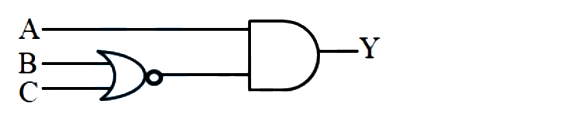
In the logic circuit diagram, A, B and C are the inputs, \(\mathrm{Y}\) is the output. The output \(\mathrm{Y}\) is ' \(\mathrm{HIGH}\) '
- A when \(\mathrm{A}=1, \mathrm{~B}=0, \mathrm{C}=1\)
- B for all the input ' \(\mathrm{HIGH}\) '
- C for all the inputs 'LOW'
- D when \(A=1, B=0, C=0\)
Answer & Solution
Correct Answer
(D) when \(A=1, B=0, C=0\)
Step-by-step Solution
Detailed explanation
The output Y is
\(
\begin{aligned}
& Y=\overline{(A+B)} \cdot C \\
& B=0, C=0 \text { and } A=1 \text { should give } Y=1 .
\end{aligned}
\)
\(
\begin{aligned}
& Y=\overline{(A+B)} \cdot C \\
& B=0, C=0 \text { and } A=1 \text { should give } Y=1 .
\end{aligned}
\)
See the Complete Solution
Get step-by-step explanations for this and 2.5 Lakh+ more JEE, NEET & CET questions.
- Unlock all solutions
- Practice the full chapter
- Track accuracy across PYQs
4.8 rated on Google Play · 14,000+ reviews
More questions from Physics
- An inductor of \(\left(\frac{100}{\pi}\right) \mathrm{mH}\), capacitor of capacitance \(\left(\frac{10^{-3}}{2 \pi}\right) \mathrm{F}\) and resistance of \(10 \Omega\) are connected in series with an AC voltage source of \(110 \mathrm{~V}, 50 \mathrm{~Hz}\) supply. The tangent of the phase angle ' \(\phi\) ' between voltage and current isMHT CET 2025 Medium
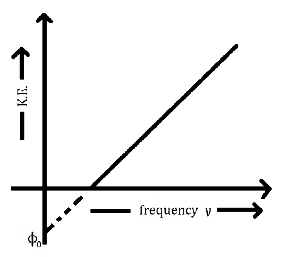
- The graph of kinetic energy against the frequency \((\mathrm{V})\) of incident light is as shown in the figure. The slope of the graph and intercept on \(X\) axis respectively are
 MHT CET 2020 Easy
 - A disc of radius \(0.4 \mathrm{~m}\) and mass \(1 \mathrm{~kg}\) rotates about an axis passing through its center and perpendicular to its plane. The angular acceleration of the disc is \(10 \mathrm{rad} / \mathrm{s}^2\). The tangential force applied to the rim of the disc isMHT CET 2021 Medium
- In the system of two particles of masses ' \(\mathrm{m}_1\) ' and ' \(\mathrm{m}_2\) ', the first particle is moved by a distance 'd' towards the centre of mass. To keep the centre of mass unchanged, the second particle will have to be moved by a distanceMHT CET 2024 Medium
- The magnetic field at the centre of a current carrying circular coil of an area ' \(A\) ' is ' \(B\) '. The magnetic moment of the coils is
[ \(\mu 0=\) permeability of free space.]MHT CET 2022 Hard - On an imaginary linear scale of temperature (called ' \(\mathrm{W}\) ' scale) the freezing and boiling points of water are \(39^{\circ} \mathrm{W}\) and \(239^{\circ} \mathrm{W}\) respectively. The temperature on the new scale corresponding to \(39^{\circ} \mathrm{C}\) temperature on Celsius scale will beMHT CET 2021 Hard
More PYQs from MHT CET
- Which of the following solutes dissolved in water, having same concentration exhibits highest value of colligative property?MHT CET 2022 Easy
- Which of the following statements is NOT true about Rutherford atomic model?MHT CET 2023 Easy
- Derivative of with respect to at is _______MHT CET 2016 Medium
- What is the conductivity of 0.05 M KCl solution if cell constant is \(1.32 \mathrm{~cm}^{-1}\) and resistance is 528 ohm?MHT CET 2024 Easy
- In hydrogen atoms, transition from the state \(n=6\) to \(n=1\) result in ultraviolet radiation.
Infrared radiation will be obtained in the transitionMHT CET 2022 Medium - 1.8 g water is vapourised by supplying 4 kJ heat at \(100^{\circ} \mathrm{C}\). What is the heat of vapourisation of water at same temperature?MHT CET 2025 Easy