


MHT CET · Physics · Center of Mass Momentum and Collision
In projectile motion two particles of masses \(\mathrm{m}_1\) and \(m_2\) have velocities \(\vec{V}_1\), and \(\vec{V}_2\) respectively at time \(\mathrm{t}=0\). Their velocities become \(\overrightarrow{\mathrm{V}_1{ }^{\prime}}\) and \(\overrightarrow{\mathrm{V}_2{ }^{\prime}}\) at time 2 t while still moving in air. The value of \(\left[\left(m_1 \overrightarrow{V_1{ }^{\prime}}+m_2 \overrightarrow{V_2{ }^{\prime}}\right)-\left(m_1 \overrightarrow{V_1}+m_2 \overrightarrow{V_2}\right)\right]\) is ( \(\mathrm{g}=\) acceleration due to gravity)
- A zero
- B \(\frac{1}{2}\left(\mathrm{~m}_1+\mathrm{m}_2\right) \mathrm{gt}\)
- C \(\left(\mathrm{m}_1+\mathrm{m}_2\right) \mathrm{gt}\)
- D \(2\left(m_1+m_2\right) g t\)
Answer & Solution
Correct Answer
(D) \(2\left(m_1+m_2\right) g t\)
Step-by-step Solution
Detailed explanation
\(\begin{aligned} & \mathrm{F}_{\mathrm{ext}}=\left(\mathrm{m}_1+\mathrm{m}_2\right) \mathrm{g} \\ & \frac{\Delta \mathrm{P}}{\Delta \mathrm{t}}=\frac{\left[\left(\mathrm{m}_1 \overrightarrow{\mathrm{~V}_1^{\prime}}+\mathrm{m}_2 \overrightarrow{\mathrm{~V}_2^{\prime}}\right)-\left(\mathrm{m}_1 \overrightarrow{\mathrm{~V}_1}+\mathrm{m}_2 \overrightarrow{\mathrm{~V}_2}\right)\right]}{2 \mathrm{t}-0}\end{aligned}\)
\(\because \quad \mathrm{F}_{\mathrm{ext}}=\frac{\Delta \mathrm{P}}{\Delta \mathrm{t}}\)
\(\therefore \quad\left(m_1+m_2\right) g=\frac{\left[\left(m_1 \overrightarrow{\mathrm{~V}_1^{\prime}}+\mathrm{m}_2 \overrightarrow{\mathrm{~V}_2^{\prime}}\right)-\left(\mathrm{m}_1 \overrightarrow{\mathrm{v}_1}+\mathrm{m}_2 \overrightarrow{\mathrm{~V}_2}\right)\right]}{2 \mathrm{t}}\)
\(\therefore \quad\left[\left(\mathrm{m}_1 \overrightarrow{\mathrm{~V}_1^{\prime}}+\mathrm{m}_2 \overrightarrow{\mathrm{~V}_2^{\prime}}\right)-\left(\mathrm{m}_1 \overrightarrow{\mathrm{~V}_1}+\mathrm{m}_2 \overrightarrow{\mathrm{~V}_2}\right)\right]\)
\(=2\left(m_1+m_2\right) g t\)
\(\because \quad \mathrm{F}_{\mathrm{ext}}=\frac{\Delta \mathrm{P}}{\Delta \mathrm{t}}\)
\(\therefore \quad\left(m_1+m_2\right) g=\frac{\left[\left(m_1 \overrightarrow{\mathrm{~V}_1^{\prime}}+\mathrm{m}_2 \overrightarrow{\mathrm{~V}_2^{\prime}}\right)-\left(\mathrm{m}_1 \overrightarrow{\mathrm{v}_1}+\mathrm{m}_2 \overrightarrow{\mathrm{~V}_2}\right)\right]}{2 \mathrm{t}}\)
\(\therefore \quad\left[\left(\mathrm{m}_1 \overrightarrow{\mathrm{~V}_1^{\prime}}+\mathrm{m}_2 \overrightarrow{\mathrm{~V}_2^{\prime}}\right)-\left(\mathrm{m}_1 \overrightarrow{\mathrm{~V}_1}+\mathrm{m}_2 \overrightarrow{\mathrm{~V}_2}\right)\right]\)
\(=2\left(m_1+m_2\right) g t\)
See the Complete Solution
Get step-by-step explanations for this and 2.5 Lakh+ more JEE, NEET & CET questions.
- Unlock all solutions
- Practice the full chapter
- Track accuracy across PYQs
4.8 rated on Google Play · 14,000+ reviews
More questions from Physics
- Force \(\mathrm{F}=\mathrm{P} \cos (\mathrm{Ax})+\mathrm{Q} \operatorname{Sin}(\mathrm{Bt})\) where \(\mathrm{x}\) and \(\mathrm{t}\) are displacement and time respectively. Which one of the following physical quantity has the dimensions of \(\left[\frac{\mathrm{B}}{\mathrm{A}}\right] ?\)MHT CET 2020 Easy
- KE per unit volume is \(E\). The pressure exerted by the gas is given byMHT CET 2010 Hard
- If and form a right angled triangle then out of the following which one is satisfied?MHT CET 2018 Medium
- For the following digital logic circuit, the correct truth-table is
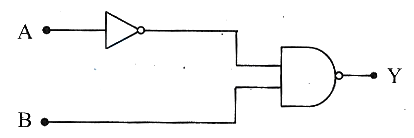
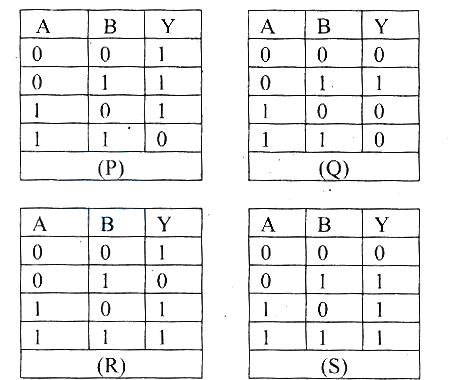 MHT CET 2024 Easy
 - The magnitude of the sum of the two vectors \(\overrightarrow{\mathrm{A}}\) and \(\overrightarrow{\mathrm{B}}\) is equal to the magnitude of
the difference of two vectors \(\overrightarrow{\mathrm{A}}\) and \(\overrightarrow{\mathrm{B}}\). The angle between \(\overrightarrow{\mathrm{A}}\) and \(\overrightarrow{\mathrm{B}}\) isMHT CET 2020 Easy - In two separate setups for Biprism experiment using same wavelength, fringes of equal width are obtained. If ratio of slit separation is \(2: 3\) then the ratio of the distance between the slit and screen in the two setups isMHT CET 2023 Medium
More PYQs from MHT CET
- A body performing simple harmonic motion has potential energy '\(\mathrm{P}_{1}\)' at displacement ' \(x_{1}\) '. Its potential energy is ' \(\mathrm{P}_{2}\) ' at displacement ' \(x_{2}\) '. The potential energy 'P' at displacement \(\left(x_{1}+x_{2}\right)\) isMHT CET 2020 Medium
- Equation of tangent to the parabola \(y^{2}=16 x\) at
\(P(3,6)\) isMHT CET 2009 Easy - What type of hybridisation is present in carbocation formed during the alkaline hydrolysis of 1- bromo -1- phenyl ethane?MHT CET 2019 Medium
- JG cells of Kidney secreteMHT CET 2019 Easy
- The protective sheath of radicle in a monocot seed is _______.MHT CET 2024 Easy
- Which hormone induces RNA synthesis?MHT CET 2022 Hard