


MHT CET · Physics · Current Electricity
In metre bridge experiment, the null point is obtained at \(20 \mathrm{~cm}\) from left end of the wire, when resistance \(X\) is balanced against another resistance \(Y(X < Y)\). To balance a resistance \(4 X\) against \(Y\), the new position of the null point from the same end will be
- A \(40 \mathrm{~cm}\)
- B \(80 \mathrm{~cm}\)
- C \(60 \mathrm{~cm}\)
- D \(50 \mathrm{~cm}\)
Answer & Solution
Correct Answer
(D) \(50 \mathrm{~cm}\)
Step-by-step Solution
Detailed explanation
The correct option is (D).
Concept: Meter bridge experiment is based on two facts:
(1) the resistance across a wire is directly proportional to its length
(2) balanced Wheatstone bridge has null deflection when the ratio of resistances is equal, and no current flows through the circuit.
The current through galvanometre is zero, when the ratio of resistances, i.e., \(\frac{P}{Q}=\frac{R}{S}\).
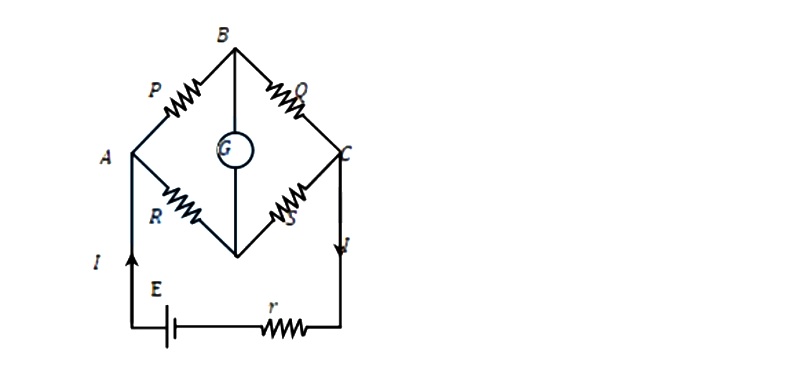
As given in the problem, \(P=X, Q=Y, R \propto 20 \mathrm{~cm}\) and \(S \propto 80 \mathrm{~cm}\).
Therefore,
\(\frac{X}{Y}=\frac{20}{80}=\frac{1}{4}\)
Similarly, to balance a resistance \(P=4 X\) against \(Q=Y\), let us assume a length \(l\) is required. Then, \(R=l\)
\(\frac{4 X}{Y}=\frac{l}{100-l}\)
On solving, we get \(l=50 \mathrm{~cm}\).
Concept: Meter bridge experiment is based on two facts:
(1) the resistance across a wire is directly proportional to its length
(2) balanced Wheatstone bridge has null deflection when the ratio of resistances is equal, and no current flows through the circuit.
The current through galvanometre is zero, when the ratio of resistances, i.e., \(\frac{P}{Q}=\frac{R}{S}\).
As given in the problem, \(P=X, Q=Y, R \propto 20 \mathrm{~cm}\) and \(S \propto 80 \mathrm{~cm}\).
Therefore,
\(\frac{X}{Y}=\frac{20}{80}=\frac{1}{4}\)
Similarly, to balance a resistance \(P=4 X\) against \(Q=Y\), let us assume a length \(l\) is required. Then, \(R=l\)
\(\frac{4 X}{Y}=\frac{l}{100-l}\)
On solving, we get \(l=50 \mathrm{~cm}\).
See the Complete Solution
Get step-by-step explanations for this and 2.5 Lakh+ more JEE, NEET & CET questions.
- Unlock all solutions
- Practice the full chapter
- Track accuracy across PYQs
4.8 rated on Google Play · 14,000+ reviews
More questions from Physics
- A coil of ' n ' turns and area ' A ' is suddenly removed from a magnetic field, a charge ' \(q\) ' flows through the coil. If resistance of the coil is ' \(R\) ' then the magnetic flux density is (in \(\mathrm{Wb} / \mathrm{m}^2\) )MHT CET 2025 Medium
- A solid cylinder of radius 'R' and mass 'M' rolls down an inclined plane of height 'h'. When it reaches the bottom of the plane, its rotational kinetic energy is \((\mathrm{g}=\) acceleration due to gravity)MHT CET 2020 Medium
- The temperature difference between two sides of metal plate, \(3 \mathrm{~cm}\) thick is \(15^{\circ} \mathrm{C}\). Heat is transmitted through plate at the rate of \(900 \mathrm{kcal}\) per minute per \(\mathrm{m}^2\) at steady state. The thermal conductivity of metal isMHT CET 2021 Hard
- The relative angular speed of hour hand and second hand of a clock is (in rad/s)MHT CET 2022 Medium
- When source of sound and observer both are moving towards each other, the observer will hearMHT CET 2025 Easy
- For a gas, \(\frac{\mathrm{R}}{\mathrm{C}_{\mathrm{v}}}=0.4\) where R is the universal gas constant and ' \(\mathrm{C}_{\mathrm{v}}\) ' is molar specific heat at constant volume. The gas is made up of molecules which areMHT CET 2024 Medium
More PYQs from MHT CET
- A photoelectric surface is illuminated successively by monochromatic light of 'wavelength ' \(\lambda\) ' and \(\left(\frac{\lambda}{2}\right)\). If the maximum kinetic energy of the emitted photoelectrons in the first case is one-fourth that in the second case, the work function of the surface of the material is ( \(\mathrm{c}=\) speed of light, \(\mathrm{h}=\) Planck's constant \()\)MHT CET 2024 Medium
- What is the difference between \(\Delta \mathrm{H}\) and \(\Delta \mathrm{U}\) for reaction given below at \(298 \mathrm{~K}\) ? \(\left(\mathrm{R}=8.314 \mathrm{JK}^{-1} \mathrm{~mol}^{-1}\right)\) \(2 \mathrm{C}_6 \mathrm{H}_{6(\ell)}+150_{2(\mathrm{~g})} \rightarrow 12 \mathrm{CO}_{2(\mathrm{~g})}+6 \mathrm{H}_2 \mathrm{O}_{(\ell)}\)MHT CET 2021 Medium
- A point mass ' \(m\) ' attached at one end of a massless, inextensible string of length ' \(\ell\) ' performs a vertical circular motion and the string rotates in vertical plane, as shown in the diagram. The increase in the centripetal acceleration of the point mass when it moves from point \(A\) to point C is
[ \(\mathrm{g}=\) acceleration due to gravity.]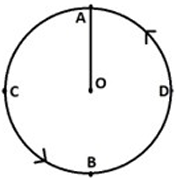 MHT CET 2025 Medium
 - Select the correct sequence of the \(\mathrm{F}_1\) generation.
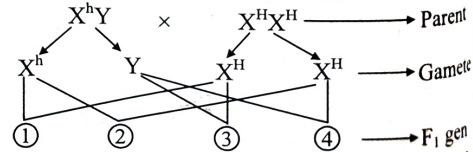 MHT CET 2017 Medium
 - Two strings ' X ' and ' Y ' of a guitar produces a beat frequency of 6 Hz . When the tension of the string ' \(Y\) ' is increased, the beat frequency is found to be 4 Hz . If the frequency of string ' X ' is 300 Hz , then the original frequency of string ' \(Y\) ' isMHT CET 2025 Medium
- The orbital frequency of an electron in the hydrogen atom is proportional toMHT CET 2010 Easy