


MHT CET · Physics · Current Electricity
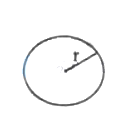
In an atom, electron of charge (-e) performs U.C.M. around a stationary positively charged nucleus, with period of revolution 'T'. If 'r' is the radius of the orbit of the electron and ' \(\mathrm{v}^{\prime}\) is the orbital velocity, then the circulating current (I) is proportional to
- A \(\mathrm{e}^{1} \mathrm{r}^{-1} \mathrm{v}^{-1}\)
- B \(\mathrm{e}^{1} \mathrm{r}^{1} \mathrm{~V}^{-1}\)
- C \(\mathrm{e}^{1} \mathrm{~V}^{1} \mathrm{r}^{-1}\)
- D \(\mathrm{v}^{1} \mathrm{r}^{1} \mathrm{e}^{-1}\)
Answer & Solution
Correct Answer
(C) \(\mathrm{e}^{1} \mathrm{~V}^{1} \mathrm{r}^{-1}\)
Step-by-step Solution
Detailed explanation
In an atom, electron of charge \((-e)\) perform U.C.M. around a stationary positively charged nucleus, with period of revolution \(\mathrm{'T'}\).
If \(' r^{\prime}\) is the radius of the orbit of the electron and ' \(v\) ' is the orbital velocity, then the circulating current \(\mathrm{(I)}\) is proportional to \(\underline{\mathbf{e}}^{\mathbf{1}}\) \(\underline{\mathbf{v}}^{\mathbf{1}}\) \(\underline{\mathbf{r}}^{\mathbf{-1}}\).
\(\frac{2 \pi r}{\mathrm{T}}=v\)
\(\mathrm{I}=\frac{\mathrm{e}}{\mathrm{T}}=\frac{\mathrm{ev}}{2 \pi \mathrm{r}}=\mathrm{e}^{1} \mathrm{v}^{1} \mathrm{r}^{-1} \frac{1}{2} \pi\)
\(\mathrm{I} \propto e^{1} v^{1} r^{-1}\)
If \(' r^{\prime}\) is the radius of the orbit of the electron and ' \(v\) ' is the orbital velocity, then the circulating current \(\mathrm{(I)}\) is proportional to \(\underline{\mathbf{e}}^{\mathbf{1}}\) \(\underline{\mathbf{v}}^{\mathbf{1}}\) \(\underline{\mathbf{r}}^{\mathbf{-1}}\).
\(\frac{2 \pi r}{\mathrm{T}}=v\)
\(\mathrm{I}=\frac{\mathrm{e}}{\mathrm{T}}=\frac{\mathrm{ev}}{2 \pi \mathrm{r}}=\mathrm{e}^{1} \mathrm{v}^{1} \mathrm{r}^{-1} \frac{1}{2} \pi\)
\(\mathrm{I} \propto e^{1} v^{1} r^{-1}\)
See the Complete Solution
Get step-by-step explanations for this and 2.5 Lakh+ more JEE, NEET & CET questions.
- Unlock all solutions
- Practice the full chapter
- Track accuracy across PYQs
4.8 rated on Google Play · 14,000+ reviews
More questions from Physics
- A transverse wave in a medium is given by \(y=A \sin 2(\omega t-k x)\). It is found that the magnitude of the maximum velocity of particles in the medium is equal to that of the wave velocity. What is the value of \(A\) ?MHT CET 2023 Medium
- During thermodynamic process, the increase in internal energy of a system is equal to the work done on the system. Which process does the system undergo?MHT CET 2025 Easy
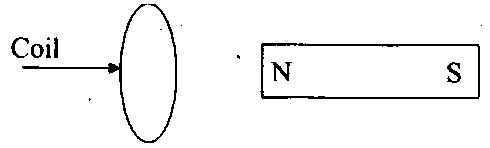
- The coil and magnet are moved in the same direction with same speed (V). The induced e.m.f. is
 MHT CET 2024 Medium
 - An electric dipole of dipole moment ' \(p\) ' is aligned parallel to a uniform electric field ' \(E\) '. The energy required to rotate the dipole by \(90^{\circ}\) is \(\left[\begin{array}{ll}\sin 0^{\circ}=0, & \sin 90^{\circ}=1 \\ \cos 0^{\circ}=1, & \cos 90^{\circ}=0\end{array}\right]\)MHT CET 2025 Easy
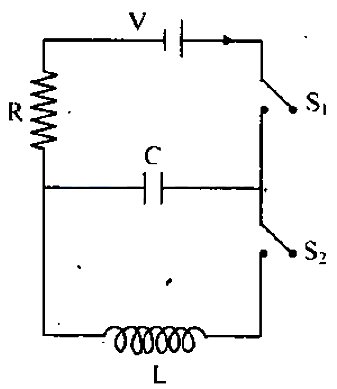
- In the given circuit, when \(\mathrm{S}_1\) is closed, the capacitor gets fully charged. Now \(\mathrm{S}_1\) is open and \(\mathrm{S}_2\) is closed. Then
 MHT CET 2024 Hard
 - With gradual increase in frequency of an a.c. supply, the impedance of an LCR series circuitMHT CET 2024 Easy
More PYQs from MHT CET
- A boat at anchor is rocked by waves whose crests are \(100 \mathrm{~m}\) apart and velocity is \(25 \mathrm{~m} / \mathrm{s}\). The boat bounces up once in everyMHT CET 2007 Easy
- Which major product is formed when excess of methane is treated with chlorine in presence of UV light?MHT CET 2025 Easy
- The rays of different colours fail to converge at a point after passing through a thick converging lens. This defect is calledMHT CET 2023 Easy
- First evidence for triplet genetic code was given by _________ .MHT CET 2022 Easy
- Identify the product ' B ' in the following sequence of ractions.
Methyl magnesium bromide \(\xrightarrow{\mathrm{CdCl}_2} \mathrm{~A} \xrightarrow{\mathrm{CH}_3 \mathrm{COCl}} \mathrm{B}\)MHT CET 2025 Medium - In a Fraunhofer diffraction at a single slit of width \(d\) and incident light of wavelength \(5500 \mathrm{~A}\), the firs minimum is observed at an angle \(30^{\circ}\). The first secondary maxima are observed at an angle \(\theta=\)MHT CET 2022 Hard