


MHT CET · Physics · Oscillations
If ' \(\mathrm{v}\) ' is velocity and ' \(a\) ' is acceleration of a particle executing linear simple harmonic motion. Which one of the following statements is correct?
- A when ' \(a\) ' is maximum, \(v\) is maximum
- B when ' \(a\) ' is maximum, \(v\) is zero
- C when ' \(a\) ' is zero, \(v\) is zero
- D ' \(a\) ' is zero for any value of ' \(v\) '
Answer & Solution
Correct Answer
(B) when ' \(a\) ' is maximum, \(v\) is zero
Step-by-step Solution
Detailed explanation
The correct option is (B).
Concept: For SHM, \(\mathrm{a}=-\left(\omega^2\right) \mathrm{x}\) is the necessary condition. A general solution for SHM can be written as,
\(x=A \sin (\omega t+\phi)\)
where, \(\mathrm{x}\) is the displacement from mean position, \(A\) is the amplitude, \(\omega\) is the angular frequency and \(\phi\) is the phase angle.
On taking the first derivative, velocity can be written as
\(
v=\frac{d x}{d t}=(A \omega) \cos (\omega t+f)=(A w)\) \(\sin \left(\omega t+\phi+\frac{\pi}{2}\right)
\)
And, taking derivative of velocity, acceleration can be written as:
\(
\mathrm{a}=\frac{\mathrm{dv}}{\mathrm{dt}}=-\left(\mathrm{A} \omega^2\right) \sin (\omega \mathrm{t}+\phi)=\left(\mathrm{A} \omega^2\right)\) \(\sin (\omega \mathrm{t}+\phi+\pi)
\)
Therefore, in SHM acceleration is ahead of velocity by a phase \(\frac{\pi}{2}\) Hence, Option (B) is the only correct option.
Concept: For SHM, \(\mathrm{a}=-\left(\omega^2\right) \mathrm{x}\) is the necessary condition. A general solution for SHM can be written as,
\(x=A \sin (\omega t+\phi)\)
where, \(\mathrm{x}\) is the displacement from mean position, \(A\) is the amplitude, \(\omega\) is the angular frequency and \(\phi\) is the phase angle.
On taking the first derivative, velocity can be written as
\(
v=\frac{d x}{d t}=(A \omega) \cos (\omega t+f)=(A w)\) \(\sin \left(\omega t+\phi+\frac{\pi}{2}\right)
\)
And, taking derivative of velocity, acceleration can be written as:
\(
\mathrm{a}=\frac{\mathrm{dv}}{\mathrm{dt}}=-\left(\mathrm{A} \omega^2\right) \sin (\omega \mathrm{t}+\phi)=\left(\mathrm{A} \omega^2\right)\) \(\sin (\omega \mathrm{t}+\phi+\pi)
\)
Therefore, in SHM acceleration is ahead of velocity by a phase \(\frac{\pi}{2}\) Hence, Option (B) is the only correct option.
See the Complete Solution
Get step-by-step explanations for this and 2.5 Lakh+ more JEE, NEET & CET questions.
- Unlock all solutions
- Practice the full chapter
- Track accuracy across PYQs
4.8 rated on Google Play · 14,000+ reviews
More questions from Physics
- Choose the correct statement. In semiconductors, valance band and conduction bandMHT CET 2021 Medium
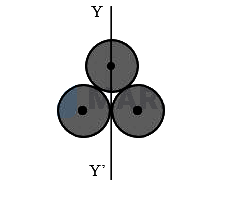
- Three solid spheres each of mass ' \(M\) ' and radius ' \(R\) ' are arranged as shown in the figure. The moment of inertia of the system about YY' will be
 MHT CET 2021 Medium
 - If the speed of an electron of hydrogen atom in the ground state is , then its speed in the third excited state will beMHT CET 2019 Easy
- The change in energy when a big dropis split in sma \(\| n\) droplets isMHT CET 2009 Hard
- Critical angle of light passing from glass to air is minimum for wavelength ofMHT CET 2024 Medium
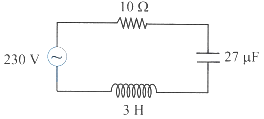
- In the circuit shown the ratio of quality factor and the bandwidth is
 MHT CET 2023 Hard
More PYQs from MHT CET
- In a process, a system performs \(238 \mathrm{~J}\) of work on it's surrounding by absorbing \(54 \mathrm{~J}\) of heat. What is the change in internal energy of system during this operation?MHT CET 2021 Medium
- If random variable thenMHT CET 2016 Medium
- The area of the region bounded by the parabola \(y^2=27 x\) and the line \(x=1\) is ______ sq.units.MHT CET 2025 Medium
- Which from following molecules has two lone pair of electrons in valence shell of its central atom?MHT CET 2024 Easy
- The conductivity of 0.005 M NaI solution at \(25^{\circ} \mathrm{C}\) is \(6.07 \times 10^{-4} \Omega^{-1} \mathrm{~cm}^{-1}\). Calculate its molar conductivityMHT CET 2024 Easy
- Which of the following sugar is present in nucleotide of RNA?MHT CET 2022 Hard