


MHT CET · Physics · Dual Nature of Matter
If the radius of the first Bohr orbit is ' \(r\) ' then the de-Broglie wavelength of the electron in the \(4^{\text {th }}\) orbit will be
- A \(4 \pi r\)
- B \(6 \pi r\)
- C \(8 \pi r\)
- D \(\frac{\pi \mathrm{r}}{4}\)
Answer & Solution
Correct Answer
(C) \(8 \pi r\)
Step-by-step Solution
Detailed explanation
According to Bohr's second postulate, \(\frac{\mathrm{nh}}{2 \pi}=\mathrm{mvr}_{\mathrm{n}}\)
\(\therefore\) de-Broglie wavelength, \(\lambda_{\mathrm{n}}=\frac{\mathrm{h}}{\mathrm{mv}}=\frac{2 \pi \mathrm{r}_{\mathrm{n}}}{\mathrm{n}}\)
Also, \(r_n \propto n^2\)
\(\therefore\) The de-Broglie wavelength of the electron in the \(4^{\text {th }}\) orbit is:
\(
\begin{aligned} \lambda_4 & =\frac{2 \pi r_4}{4}=\frac{2 \pi \times(16 r)}{4} \\
\therefore \lambda_4 & =8 \pi \mathrm{r}
\end{aligned}
\)
\(\therefore\) de-Broglie wavelength, \(\lambda_{\mathrm{n}}=\frac{\mathrm{h}}{\mathrm{mv}}=\frac{2 \pi \mathrm{r}_{\mathrm{n}}}{\mathrm{n}}\)
Also, \(r_n \propto n^2\)
\(\therefore\) The de-Broglie wavelength of the electron in the \(4^{\text {th }}\) orbit is:
\(
\begin{aligned} \lambda_4 & =\frac{2 \pi r_4}{4}=\frac{2 \pi \times(16 r)}{4} \\
\therefore \lambda_4 & =8 \pi \mathrm{r}
\end{aligned}
\)
See the Complete Solution
Get step-by-step explanations for this and 2.5 Lakh+ more JEE, NEET & CET questions.
- Unlock all solutions
- Practice the full chapter
- Track accuracy across PYQs
4.8 rated on Google Play · 14,000+ reviews
More questions from Physics
- A composite slab consists of two materials having coefficients of thermal conductivity K and 2 K , thickness x and 4 x respectively. The temperatures of two outer surfaces of a composite slab are \(T_2\) and \(T_1\) respectively ( \(\mathrm{T}_2>\mathrm{T}_1\) ). The rate of heat transfer through the slab in a steady state is \(\left[\frac{A\left(T_2-T_1\right) K}{x}\right] f\), where \(f\) is equal toMHT CET 2025 Medium
- Select the correct statement.MHT CET 2025 Medium
- The potential difference \(\left(V_A-V_B\right)\) between the points A and B in the given part of the circuit
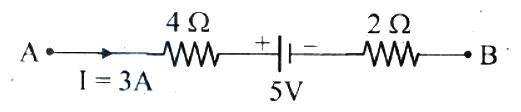 MHT CET 2024 Medium
 - Two identical blocks each of mass ' \(M\) ' attached to the ends of a massless inextensible string which passes over a pulley with a fixed axis as shown below. A small mass ' \(m\) ' is now placed on the block B. The acceleration with which the two blocks move together is
[ \(\mathrm{g}=\) gravitational acceleration]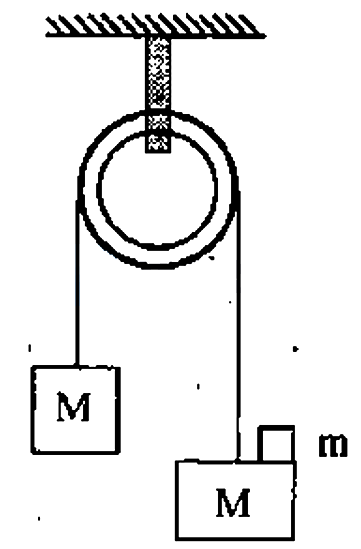 MHT CET 2024 Medium
 - An alternating e.m.f. is given by e \(=e_{0}\) sin wt. In what time the e.m.f. will have half its maximum value, if 'e' starts from zero? (T = Time period) \((\sin 30^{\circ}=\cos 60^{\circ}=0 \cdot 5, \quad \cos 30^{\circ}=\sin 60^{\circ}\) \(=\frac{\sqrt{3}}{2})\)MHT CET 2020 Hard
- The core used in transformers are laminated toMHT CET 2024 Easy
More PYQs from MHT CET
- Identify the correct sequence of events of pollen pistil interaction given below.
(a) pollen tube grows through the stigma, style and reaches the ovule.
(b) Pollen grain lands on the stigma.
(c) Pollen germinates to form pollen tube.
(d) Pollen tube carrying 2 male gametes enter the ovule.
Choose the correct option.MHT CET 2023 Easy - A simple pendulum of length \(2 \mathrm{~m}\) is given a horizontal push through angular displacement of \(60^{\circ}\). If the mass of bob is 200 gram, the angular velocity of the bob will be (Take Acceleration due to gravity \(=10 \mathrm{~m} / \mathrm{s}^2\) ) \(\left(\sin 30^{\circ}=\cos 60^{\circ}=0.5, \cos 30^{\circ}=\sin 60^{\circ}=\sqrt{3} / 2\right)\)MHT CET 2023 Hard
- The integral \(\int_{\frac{-1}{2}}^{\frac{1}{2}}\left([x]+\log _c\left(\frac{1+x}{1-x}\right)\right) \mathrm{d} x\), where \([x]\) represent greatest integer function, equalsMHT CET 2024 Medium
- The compound \(\mathrm{CH}_3-\mathrm{CH}=\mathrm{CH}-\mathrm{CH}_2-\mathrm{OH}\) is also called asMHT CET 2022 Easy
- With usual notations, if the angles \(A, B, C\) of a \(\triangle A B C\) are in A.P. and \(b: c=\sqrt{3}: \sqrt{2}\),
then \(\angle \mathrm{A}=\)MHT CET 2020 Easy - If \(E^{\circ}\left(\mathrm{Zn}_{(\mathrm{aq})}^{+2} \mid \mathrm{Zn}_{(\mathrm{s})}\right)=-0 \cdot 76 \mathrm{~V}\).
Calculate potential for \(\mathrm{Zn}_{(\mathrm{s})} \rightarrow \mathrm{Zn}_{(0.01 \mathrm{M})}^{+2}+2 \overline{\mathrm{e}}\) at 298 K ?MHT CET 2025 Medium