


MHT CET · Physics · Electromagnetic Induction
If ' \(N\) ' is the number of turns in a circular coil, the value of its self-inductance varies as
- A \(\mathrm{N}^1\)
- B \(\mathrm{N}^3\)
- C \(\mathrm{N}^2\)
- D \(\mathrm{N}^0\)
Answer & Solution
Correct Answer
(C) \(\mathrm{N}^2\)
Step-by-step Solution
Detailed explanation
The correct option is (C)
Concept: The flux associated with the loop is \(\phi=\mathrm{BA}\) and the coefficient of self-inductance \(\mathrm{L}\) is defined as \(\mathrm{L}=\frac{\phi}{\mathrm{I}}\), where the I is the current flowing through the coil.
The magnetic magnetic field \(B\) at the center of a coil carrying current \(\mathrm{i}\), with radius \(\mathrm{r}\) is given by,
\(B=\frac{\mu_0 I}{2 r}\)
So for a coil with \(\mathrm{n}\) no. of turns: \(\mathrm{B}_{\mathrm{N}}=\mathrm{N}\left(\frac{\mu_0 \mathrm{I}}{2 \mathrm{r}}\right)\)
The self flux associated with one coil is : \(\phi 1=\mathrm{B}_{\mathrm{N}} \mathrm{A}\)
Now, the self flux associated with coil of \(\mathrm{N}\) turns is: \(\phi \mathrm{N}=\mathrm{N} \phi_1\)
Therefore,
\(\phi N=N\left\{N\left(\frac{\mu_0 I}{2 r}\right) A\right\}_1\)
Now using the definition of self-inductance: \(L=\frac{\theta}{I}\), we get, \(\mathrm{L} \propto \mathrm{N}^2\)
So, self-inductance is proportional to square of number of turns in the coil.
Concept: The flux associated with the loop is \(\phi=\mathrm{BA}\) and the coefficient of self-inductance \(\mathrm{L}\) is defined as \(\mathrm{L}=\frac{\phi}{\mathrm{I}}\), where the I is the current flowing through the coil.
The magnetic magnetic field \(B\) at the center of a coil carrying current \(\mathrm{i}\), with radius \(\mathrm{r}\) is given by,
\(B=\frac{\mu_0 I}{2 r}\)
So for a coil with \(\mathrm{n}\) no. of turns: \(\mathrm{B}_{\mathrm{N}}=\mathrm{N}\left(\frac{\mu_0 \mathrm{I}}{2 \mathrm{r}}\right)\)
The self flux associated with one coil is : \(\phi 1=\mathrm{B}_{\mathrm{N}} \mathrm{A}\)
Now, the self flux associated with coil of \(\mathrm{N}\) turns is: \(\phi \mathrm{N}=\mathrm{N} \phi_1\)
Therefore,
\(\phi N=N\left\{N\left(\frac{\mu_0 I}{2 r}\right) A\right\}_1\)
Now using the definition of self-inductance: \(L=\frac{\theta}{I}\), we get, \(\mathrm{L} \propto \mathrm{N}^2\)
So, self-inductance is proportional to square of number of turns in the coil.
See the Complete Solution
Get step-by-step explanations for this and 2.5 Lakh+ more JEE, NEET & CET questions.
- Unlock all solutions
- Practice the full chapter
- Track accuracy across PYQs
4.8 rated on Google Play · 14,000+ reviews
More questions from Physics
- Two rods of same length and material are joined end to end. They transfer heat in 8 second. When they are joined in parallel they transfer same amount of heat in same conditions in timeMHT CET 2021 Medium
- A sphere of mass' \(m\) ' moving with velocity ' \(v\) 'collides head-on another sphere of same mass which is at rest. The ratio of final velocity of second sphere to the initial velocity of the first sphere is ( \(e\) is coefficient of restitution and collision is inelastic)MHT CET 2022 Medium
- Two coils \(\mathrm{P}\) and S have a mutual inductance of \(3 \times 10^{-3} \mathrm{H}\). If the current in the coil, P is \(I=20 \sin (50 \pi t) \mathrm{A}\), then the maximum value of the e.m.f. induced in coil \(\mathrm{S}\) isMHT CET 2022 Easy
- In the following circuit, current through \(A C B\) is if each resistance \(R=4 \Omega\) is
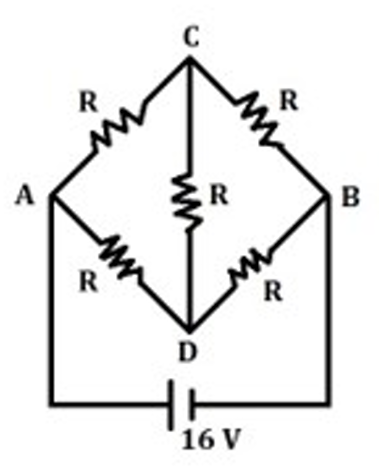 MHT CET 2025 Easy
 - A body of mass ' \(m\) ' performs linear S.H.M. given by equation \(\mathrm{x}=\mathrm{P} \sin \omega \mathrm{t}+\mathrm{Q} \sin \left(\omega \mathrm{t}+\frac{\pi}{2}\right)\). The total energy of the particle at any instant isMHT CET 2021 Medium
- A streamline flow of a liquid of density ' \(\rho\) ' is passing through a horizontal pipe of cross-sectional area \(A_1\) and \(A_2\) at two ends. If the pressure of liquid is ' P ' at a point where flow speed is ' \(v\) ', then pressure at another point where the flow of speed becomes 3 v isMHT CET 2024 Medium
More PYQs from MHT CET
- If \(A\) and \(B\) are independent events such that odds in favour of \(A\) is \(2: 3\) and odds
against \(B\) is \(4: 5\), then \(P(A \cap B)=\)MHT CET 2020 Medium - Which one of the following is unlike other nuclei in the embryo sac of angiosperms regarding ploidy?MHT CET 2021 Medium
- Which from following is a CORRECT decreasing order of ionization enthalpies of different elements?MHT CET 2023 Easy
- The frequency of a tuning fork is \(220 \mathrm{~Hz}\) and the velocity of sound in air is \(330 \mathrm{~m} / \mathrm{s}\). When the tuning fork completes 80 vibrations, the distance travelled isMHT CET 2021 Medium
- Nitrates of soil are also leached deep into the Earth by ______________ .MHT CET 2024 Easy
- If \(X \sim B\left(8, \frac{1}{2}\right)\), then \(P(|x-4| \leq 2)=\)MHT CET 2020 Medium