


MHT CET · Physics · Atomic Physics
If an electron in hydrogen atom jumps from \(3^{\text {rd }}\) orbit to \(2^{\text {nd }}\) orbit, it emits a photon of wavelength ' \(\lambda\) '. When it jumps from \(4^{\text {th }}\) orbit to \(3^{\text {rd }}\) orbit, the corresponding wavelength of the photon will be
- A \(\frac{20}{13} \lambda\)
- B \(\frac{20}{7} \lambda\)
- C \(\frac{9}{16} \lambda\)
- D \(\frac{16}{25} \lambda\)
Answer & Solution
Correct Answer
(B) \(\frac{20}{7} \lambda\)
Step-by-step Solution
Detailed explanation
Rydberg's relation is given by
\(\frac{1}{\lambda}=\mathrm{R}_{\mathrm{H}} \mathrm{Z}^2\left(\frac{1}{\mathrm{n}_1^2}-\frac{1}{\mathrm{n}_2^2}\right)\)
For hydrogen, \(\mathrm{Z}=1\).
Given, for \(3^{\text {rd }}\) to \(2^{\text {nd }}\) orbit transition
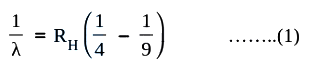
And for \(4^{\text {th }}\) to \(3^{\text {rd }}\) orbit transition
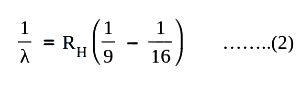
Taking ratio of eqn (1) \& (2)
\(\begin{aligned}
& \frac{\lambda_n}{\lambda}=\frac{5}{36} \times \frac{(16 \times 9)}{7}=\frac{20}{7} \\
& \Rightarrow \lambda_n=\frac{20}{7} \lambda
\end{aligned}\)
\(\frac{1}{\lambda}=\mathrm{R}_{\mathrm{H}} \mathrm{Z}^2\left(\frac{1}{\mathrm{n}_1^2}-\frac{1}{\mathrm{n}_2^2}\right)\)
For hydrogen, \(\mathrm{Z}=1\).
Given, for \(3^{\text {rd }}\) to \(2^{\text {nd }}\) orbit transition
And for \(4^{\text {th }}\) to \(3^{\text {rd }}\) orbit transition
Taking ratio of eqn (1) \& (2)
\(\begin{aligned}
& \frac{\lambda_n}{\lambda}=\frac{5}{36} \times \frac{(16 \times 9)}{7}=\frac{20}{7} \\
& \Rightarrow \lambda_n=\frac{20}{7} \lambda
\end{aligned}\)
See the Complete Solution
Get step-by-step explanations for this and 2.5 Lakh+ more JEE, NEET & CET questions.
- Unlock all solutions
- Practice the full chapter
- Track accuracy across PYQs
4.8 rated on Google Play · 14,000+ reviews
More questions from Physics
- Two monochromatic beams of intensities I and 4I respectively are superposed to form a steady interference pattern. The maximum and minimum intensities in the pattern areMHT CET 2021 Easy
- In a Young's double slit experiment wavelength of light used is \(6000 Å\). The first order maxima and tenth order maxima fall at 14.50 mm and 16.75 mm from the particular reference point in the interference pattern respectively. If the wavelength is changed to \(5500 Å\) then the position of zero order and tenth order maxima are respectively [The other arrangements remaining same]MHT CET 2025 Medium
- The current flowing through an inductor of self-inductance ' L ' is continuously increasing at constant rate. The variation of induced e.m.f. (e) versus \(\mathrm{dI} / \mathrm{dt}\) is shown graphically by graph
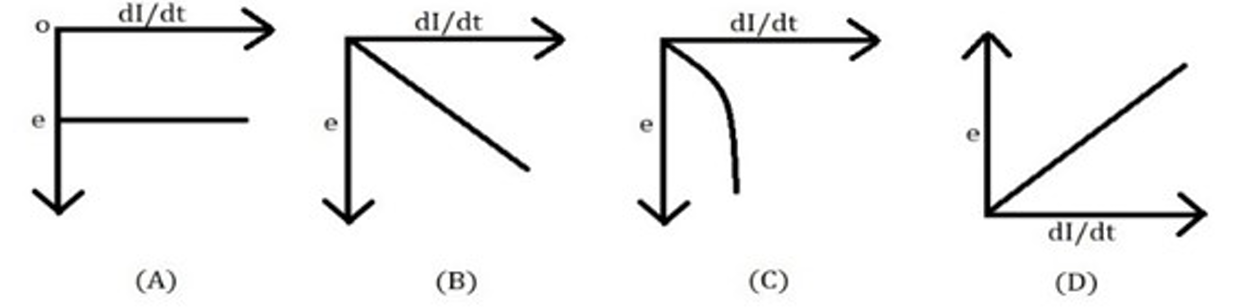 MHT CET 2025 Easy
 - A ring and a disc roll on the horizontal surface without slipping with same linear velocity. If both have same mass and total kinetic energy of the ring is 4 J then total kinetic energy of the disc isMHT CET 2016 Medium
- A radioactive nucleus emits \(4 \alpha\) particles and \(7 \beta\) particles in succession. The ratio of number of neutrons to that of protons is \([\mathrm{A}=\) mass number, \(\mathrm{Z}=\) atomic number \(]\)MHT CET 2020 Medium
- A person is observing a bacteria through a compound microscope. For better observation and to improve its resolving power he shouldMHT CET 2023 Easy
More PYQs from MHT CET
- Resolving power of telescope increases whenMHT CET 2016 Easy
- If \(\cos ^{-1} \sqrt{\mathrm{p}}+\cos ^{-1} \sqrt{1-\mathrm{p}}+\cos ^{-1} \sqrt{1-\mathrm{q}}=\frac{3 \pi}{4}\), then \(\mathrm{q}\)MHT CET 2023 Hard
- A progressive wave of frequency \(50 \mathrm{~Hz}\) is travelling with velocity \(350 \mathrm{~m} / \mathrm{s}\) through a medium. The change in phase at a given time interval of \(0.01 \mathrm{~s}\) isMHT CET 2022 Easy
- In a first order reaction \(60 \%\) of reactant decomposes in 4.606 \(\min\). What is half life of reaction? \(\left(\mathrm{k}=0.1989 \mathrm{~min}^{-1}\right)\)MHT CET 2021 Medium
- What will be the concentration of NaCl solution, if the molar conductivity and conductivity of NaCl solution is \(124 \cdot 3 \Omega^{-1} \mathrm{~cm}^{2} \mathrm{~mol}^{-1}\) and \(1 \cdot 243 \times 10^{-4} \Omega^{-1} \mathrm{~cm}^{2}\)
respectively?MHT CET 2020 Easy - When an electron in Hydrogen atom revolves in stationary orbit, itMHT CET 2016 Easy