


MHT CET · Physics · Ray Optics
If a ray of light in denser medium strikes a rarer medium at angle of incidence \(i\), the angles of reflection and refraction are \(r\) and \(r^{\prime}\) respectively. If the reflected and refracted rays are at right angles to each other, the critical angle for the given pair of media is
- A \(\sin ^{-1}\left(\tan r^{\prime}\right)\)
- B \(\tan ^{-1}(\sin \mathrm{i})\)
- C \(\sin ^{-1}(\tan r)\)
- D \(\cot ^{-1}(\tan \mathrm{i})\)
Answer & Solution
Correct Answer
(B) \(\tan ^{-1}(\sin \mathrm{i})\)
Step-by-step Solution
Detailed explanation
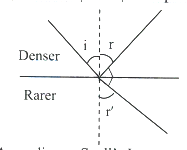
According to Snell's Law,
\(\begin{array}{ll}
& \frac{\sin i}{\sin r}=\frac{1}{n} \\
& \text { But } i=r, \\
\therefore \quad & \frac{\sin r}{\sin r^{\prime}}=\frac{1}{n} \\
& \text { From figure } r^{\prime}+r+90=180^{\circ} \\
\therefore \quad & r^{\prime}=180^{\circ}-90^{\circ}-r=90^{\circ}-r \\
\therefore \quad & \Rightarrow \frac{\sin r}{\sin \left(90^{\circ}-r\right)}=\frac{1}{n} \\
& \frac{\sin r}{\cos r}=\frac{1}{n}
\end{array}\)
\(\therefore \quad \tan \mathrm{r}=\frac{1}{\mathrm{n}}\)
Critical angle is given by \(\sin i_c=\frac{1}{n}\)
\(\begin{array}{ll}
\therefore & \tan r=\sin i_c \\
\therefore & i_c=\sin ^{-1}(\tan r)
\end{array}\)
See the Complete Solution
Get step-by-step explanations for this and 2.5 Lakh+ more JEE, NEET & CET questions.
- Unlock all solutions
- Practice the full chapter
- Track accuracy across PYQs
4.8 rated on Google Play · 14,000+ reviews
More questions from Physics
- A disc at rest is subjected to a uniform angular acceleration about its axis. Let \(\theta\) and \(\theta^1\) be the angle made by the disc in \(2^{\text {nd }}\) and \(3^{\text {rd }}\) second of its motion. The ratio \(\frac{\theta}{\theta^1}\) isMHT CET 2024 Hard
- A stone of mass 1 kg tied to a light inextensible string of length \(\mathrm{L}=\frac{5}{3} \mathrm{~m}\) is rotating in a circular path of radius L in a vertical plane. If the ratio of maximum tension in the string to the minimum tension in the string is 3 , the speed of the stone at the highest point of the circle is ( \(\mathrm{g}=\) acceleration due to gravity)MHT CET 2025 Medium
- The magnitude of magnetic fields at a distacne 'r' from the centre of a short bar magnet, in longitudinal position to transverse position is in the ratioMHT CET 2020 Medium
- An annular ring has mass 10 kg and inner and outer radii are 10 m and 5 m respectively. Its moment of inertia about an axis passing through its centre and perpendicular to its plane isMHT CET 2024 Hard
- The magnetic moment produced in a sample of 2 gram is \(8 \times 10^{-7} \mathrm{~A} / \mathrm{m}^{2}\). If its density is \(4 \mathrm{~g} / \mathrm{cm}^{3}\), then the magnetization of the sample isMHT CET 2020 Easy
- What is the linear velocity if angular velocity \(\vec{\omega}=3 \hat{i}-4 \hat{j}+\hat{k}\) and radius \(\vec{r}=(5 \hat{i}-6 \hat{j}+6 \hat{k})\) ?MHT CET 2025 Medium
More PYQs from MHT CET
- The order and degree of the differential equation \(\frac{d^{2} y}{d x^{2}}=\sqrt[3]{1-\left(\frac{d y}{d x}\right)^{4}}\) are respectivelyMHT CET 2009 Easy
- End correction at open end for air column in a pipe of length ' \(l\) ' is ' \(e\) '. For its second overtone of an opern pipe, the wavelength of the wave isMHT CET 2023 Medium
- Which among the group -15 elements does NOT exist as tetra atomic molecule?MHT CET 2018 Easy
- If current of 4 A produces magnetic flux of \(3 \times 10^{-3} \mathrm{~Wb}\) through a coil of 400 turns, the energy stored in the coil will beMHT CET 2024 Easy
- In common emitter amplifier, a change of \(0.2 \mathrm{~mA}\) in the base current causes a change of \(5 \mathrm{~mA}\) in the collector current. If input resistance is \(2 \mathrm{k} \Omega\) and voltage gain is 75 , load resistance used in the circuit isMHT CET 2021 Medium
- A, B, C, D are four points in a plane with position vectors \(\overline{\mathrm{a}}, \overline{\mathrm{b}}, \overline{\mathrm{c}}, \overline{\mathrm{d}}\) respectively such that \((\overline{\mathrm{a}}-\overline{\mathrm{d}}) \cdot(\overline{\mathrm{b}}-\overline{\mathrm{c}})=(\overline{\mathrm{b}}-\overline{\mathrm{d}}) \cdot(\overline{\mathrm{c}}-\overline{\mathrm{a}})=0\). The point \(\mathrm{D}\), then is the of \(\triangle \mathrm{ABC}\)MHT CET 2023 Medium