


MHT CET · Physics · Nuclear Physics
Half-lives of two radioactive elements \(A\) and \(B\) are 30 minute and 60 minute respectively. Initially the samples have equal number of nuclei. After 120 minute the ratio of decayed numbers of nuclei of \(B\) to that of \(A\) will be
- A \(1: 15\)
- B \(1: 4\)
- C \(4: 5\)
- D \(5: 4\)
Answer & Solution
Correct Answer
(C) \(4: 5\)
Step-by-step Solution
Detailed explanation
For radioactive decay, amount of sample remaining is given by,
\(\mathrm{N}=\mathrm{N}_{\mathrm{o}}\left(\frac{1}{2}\right)^\lambda\)
\(N_o\) is initial sample and \(\lambda\) is decay constant.
Decay constant, \(\lambda=\left(\frac{\mathrm{t}}{\mathrm{t}_{1 / 2}}\right)=\frac{120}{\mathrm{t}_{1 / 2}}\)
... (given)
For element A,
\(\mathrm{N}_{\mathrm{A}}=\mathrm{N}_{\mathrm{o}}\left(\frac{1}{2}\right)^{\frac{120}{30}}=\frac{\mathrm{N}_{\mathrm{o}}}{2^4}\)
...[From(i)]
Amount of sample A decayed,
\(N_A^{\prime}=N_o-N_A=N_o-\frac{N_0}{2^4}=\frac{15}{16} N_0...(i)\)
For element B,
\(\mathrm{N}_{\mathrm{B}}=\mathrm{N}_{\mathrm{o}}\left(\frac{1}{2}\right)^{\frac{120}{60}}=\frac{\mathrm{N}_0}{2^2}..[From(i)]\)
Amount of sample B decayed,
\(\mathrm{N}_{\mathrm{B}}{ }^{\prime}=\mathrm{N}_{\mathrm{o}}-\mathrm{N}_{\mathrm{B}}=\mathrm{N}_{\mathrm{o}}-\frac{\mathrm{N}_{\mathrm{o}}}{2^2}=\frac{3}{4} \mathrm{~N}_{\mathrm{O}}...(iii)\)
From (ii) and (iii),
\(\mathrm{N}=\mathrm{N}_{\mathrm{o}}\left(\frac{1}{2}\right)^\lambda\)
\(N_o\) is initial sample and \(\lambda\) is decay constant.
Decay constant, \(\lambda=\left(\frac{\mathrm{t}}{\mathrm{t}_{1 / 2}}\right)=\frac{120}{\mathrm{t}_{1 / 2}}\)
... (given)
For element A,
\(\mathrm{N}_{\mathrm{A}}=\mathrm{N}_{\mathrm{o}}\left(\frac{1}{2}\right)^{\frac{120}{30}}=\frac{\mathrm{N}_{\mathrm{o}}}{2^4}\)
...[From(i)]
Amount of sample A decayed,
\(N_A^{\prime}=N_o-N_A=N_o-\frac{N_0}{2^4}=\frac{15}{16} N_0...(i)\)
For element B,
\(\mathrm{N}_{\mathrm{B}}=\mathrm{N}_{\mathrm{o}}\left(\frac{1}{2}\right)^{\frac{120}{60}}=\frac{\mathrm{N}_0}{2^2}..[From(i)]\)
Amount of sample B decayed,
\(\mathrm{N}_{\mathrm{B}}{ }^{\prime}=\mathrm{N}_{\mathrm{o}}-\mathrm{N}_{\mathrm{B}}=\mathrm{N}_{\mathrm{o}}-\frac{\mathrm{N}_{\mathrm{o}}}{2^2}=\frac{3}{4} \mathrm{~N}_{\mathrm{O}}...(iii)\)
From (ii) and (iii),
See the Complete Solution
Get step-by-step explanations for this and 2.5 Lakh+ more JEE, NEET & CET questions.
- Unlock all solutions
- Practice the full chapter
- Track accuracy across PYQs
4.8 rated on Google Play · 14,000+ reviews
More questions from Physics
- Two identical current carrying coils with same centre are placed with their planes perpendicular to each other. If current \(I=\sqrt{2} \mathrm{~A}\) and radius of the coil is \(\mathrm{R}=1 \mathrm{~m}\), then magnetic field at centre is equal to ( \(\mu_0=\) permeability of free space)MHT CET 2024 Medium
- A hollow pipe of length \(0.8 \mathrm{~m}\) is closed at one end. At its open end, a \(0.8 \mathrm{~m}\) long uniform string is vibrating in its second harmonic and it resonates with the fundamental frequency of pipe. If the tension in the sting is \(50 \mathrm{~N}\) and speed of sound in air is \(320 \mathrm{~m} / \mathrm{s}\), the mass of the strings isMHT CET 2022 Hard
- In a biprism experiment, monochromatic light of wavelength ' \(\gamma\) ' is used. The distance between the two coherent sources ' \(d\) ' is kept constant. If the distance between slit and eyepiece ' \(D\) ' is varied as \(\mathrm{D}_1, \mathrm{D}_2, \mathrm{D}_3, \mathrm{D}_4\) and corresponding measured fringe widths are \(\mathrm{W}_1, \mathrm{~W}_2, \mathrm{~W}_3, \mathrm{~W}_4\) thenMHT CET 2024 Easy
- A long straight wire carrying a current of \(25 \mathrm{~A}\) rests on the table. Another wire PQ of length \(1 \mathrm{~m}\) and mass \(2.5 \mathrm{~g}\) carries the same current but in the opposite direction. The wire PQ is free to slide up and down. To what height will wire \(\mathrm{PQ}\) rise? \(\left(\mu_0=4 \pi \times 10^{-7}\right.\) SI unit \()\)
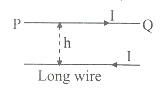 MHT CET 2023 Medium
 - The amplitude of a particle executing S.H.M. is \(3 \mathrm{~cm}\). The displacement at which its kinetic energy will be \(25 \%\) more than the potential energy isMHT CET 2023 Medium
- Let ' \(\mathrm{R}_1\) ' and ' \(\mathrm{R}_2\) ' are radii of two mercury drops. A big mercury drop is formed from then under isothermal conditions. The radius of the resultant drop isMHT CET 2021 Medium
More PYQs from MHT CET
- The differential equation of an ellipse whose major axis is twice its minor axis, isMHT CET 2021 Easy
- Find solubility of \(\mathrm{PbI}_2\) if its solubility product is \(7.0 \times 10^{-9}\).MHT CET 2023 Medium
- How many moles of ethene are required to prepare \(6.0 \mathrm{~g}\) ethane by hydrogenation process?MHT CET 2020 Medium
- Which among the following is an example of amorphous solid?MHT CET 2020 Easy
- Ratio of centripetal acceleration for an electron revolving in \(3^{\text {rd }}\) orbit and \(5^{\text {th }}\) Bohr orbit of hydrogen atom isMHT CET 2022 Medium
- If the lines \(\frac{x-1}{2}=\frac{y+1}{3}=\frac{z-1}{4}\) and \(\frac{x-3}{1}=\frac{y-k}{2}=\frac{z}{1}\) intersect, then \(k=\)MHT CET 2020 Easy