


MHT CET · Physics · Dual Nature of Matter
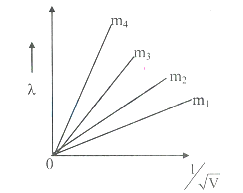
Graph shows the variation of de-Broglie wavelength \((\lambda)\) versus \(\frac{1}{\sqrt{V}}\) where ' \(V\) ' is the accelerating potential for four particles A, B, C, \(\mathrm{D}\) carrying same charge but of masses \(\mathrm{m}_1, \mathrm{~m}_2\), \(\mathrm{m}_3, \mathrm{~m}_4\). Which on represents a particle of largest mass?
- A \(\mathrm{m}_1\)
- B \(\mathrm{m}_2\)
- C \(\mathrm{m}_3\)
- D \(\mathrm{m}_4\)
Answer & Solution
Correct Answer
(A) \(\mathrm{m}_1\)
Step-by-step Solution
Detailed explanation
de Broglie wayelength \(\lambda=\frac{\mathrm{h}}{\mathrm{p}}\)
\(\therefore \quad \lambda=\frac{\mathrm{h}}{\sqrt{2 \mathrm{mqv}}}\)
\(\therefore \quad \lambda \sqrt{\mathrm{v}}=\frac{\mathrm{h}}{\sqrt{2 \mathrm{mq}}} \Rightarrow \frac{\lambda}{\left(\frac{1}{\sqrt{\mathrm{v}}}\right)}=\frac{1}{\sqrt{2 \mathrm{mq}}}\)
\(\therefore \quad\) Slope of the graph \(=\frac{1}{\sqrt{2 \mathrm{mq}}}\)
The slope will be maximum for minimum mass.
\(\therefore \quad \mathrm{m}_4\) is minimum and \(\mathrm{m}_1\) will be minimum.
\(\therefore \quad \lambda=\frac{\mathrm{h}}{\sqrt{2 \mathrm{mqv}}}\)
\(\therefore \quad \lambda \sqrt{\mathrm{v}}=\frac{\mathrm{h}}{\sqrt{2 \mathrm{mq}}} \Rightarrow \frac{\lambda}{\left(\frac{1}{\sqrt{\mathrm{v}}}\right)}=\frac{1}{\sqrt{2 \mathrm{mq}}}\)
\(\therefore \quad\) Slope of the graph \(=\frac{1}{\sqrt{2 \mathrm{mq}}}\)
The slope will be maximum for minimum mass.
\(\therefore \quad \mathrm{m}_4\) is minimum and \(\mathrm{m}_1\) will be minimum.
See the Complete Solution
Get step-by-step explanations for this and 2.5 Lakh+ more JEE, NEET & CET questions.
- Unlock all solutions
- Practice the full chapter
- Track accuracy across PYQs
4.8 rated on Google Play · 14,000+ reviews
More questions from Physics
- The ratio of weight of a man in a stationery lift and weight when the lift is moving downward with a uniform acceleration ' \(a\) ' is \(3: 2\). Then the value of ' \(a\) ' isMHT CET 2024 Medium
- If \(\vec{A}=\hat{i}+\hat{j}+3 \hat{k}, \vec{B}=-\hat{i}+\hat{j}+4 \hat{k}\) and \(\vec{C}=2 \hat{i}-2 \hat{j}-8 \hat{k}\), then the angle between the vectors \(\vec{P}=\vec{A}+\vec{B}+\vec{C}\) and \(\vec{Q}=(\vec{A} \times \vec{B})\) is (in degree)MHT CET 2025 Medium
- A single slit diffraction pattern is formed with white light. For what wavelength of light the \(4^{\text {th }}\) secondary maximum in diffraction pattern coincides with the \(3^{\text {rd }}\) secondary maximum in the pattern of light of wavelength ' \(\lambda\) ' ?MHT CET 2025 Medium
- An electric dipole will have minimum potential energy when it subtends an angle
\(\left[\begin{array}{l}
\cos 0^{\circ}=1 \
\sin 0^{\circ}=0
\end{array}\right]\left[\begin{array}{l}
\cos 90^{\circ}=0 \
\cos \pi=-1
\end{array}\right]\)MHT CET 2024 Easy - An open organ pipe and a closed organ pipe have the frequency of their first overtone identical. The ratio of length of open pipe to that of closed pipe isMHT CET 2020 Easy
- The de-Broglie wavelength \((\lambda)\) of a particleMHT CET 2025 Easy
More PYQs from MHT CET
- What is internal energy change when \(62 \mathrm{~J}\) of work is done on the system and \(128 \mathrm{~J}\) of heat is transferred to surrounding?MHT CET 2021 Medium
- How many metamers are possible for molecular formula \(\mathrm{C}_{4} \mathrm{H}_{11} \mathrm{~N} ?\)MHT CET 2011 Medium
- The intensity of light coming from one of the slits in Young's double slit experiment is double the intensity from the other slit. The ratio of the maximum intensity to the minimum intensity in the interference fringe pattern observed isMHT CET 2024 Medium
- The work done in blowing a soap bubble of radius \(R\) is \(W_1\) at room temperature. Now the soap solution is heated. From the heated solution another soap bubble of radius \(2 R\) is blown and the work done is \(W_2\). ThenMHT CET 2022 Hard
- A pair of hormones produced by kidneys isMHT CET 2016 Easy
- If \(x=e^{(y+e)^{(y+e)}(y+\ldots \ldots \infty)}\), then \(\frac{d y}{d x}=\)MHT CET 2020 Medium