


MHT CET · Physics · Mathematics in Physics
Given \(\vec{A}=(2 \hat{i}-3 \hat{j}+\hat{k}), \vec{B}=(3 \hat{i}+\hat{j}-2 \hat{k})\) and \(\vec{C}=(3 \hat{i}+2 \hat{j}+\hat{k})\). \((\vec{A}+\vec{B}) \cdot \vec{C}\) will be
- A \(10\)
- B \(12\)
- C \(18\)
- D \(20\)
Answer & Solution
Correct Answer
(A) \(10\)
Step-by-step Solution
Detailed explanation
\( \vec{A}+\vec{B} = (2+3)\hat{i} + (-3+1)\hat{j} + (1-2)\hat{k} = 5\hat{i} - 2\hat{j} - \hat{k} \) \( (\vec{A}+\vec{B}) \cdot \vec{C} = (5)(3) + (-2)(2) + (-1)(1) = 15 - 4 - 1 = 10 \)
See the Complete Solution
Get step-by-step explanations for this and 2.5 Lakh+ more JEE, NEET & CET questions.
- Unlock all solutions
- Practice the full chapter
- Track accuracy across PYQs
4.8 rated on Google Play · 14,000+ reviews
More questions from Physics
- Kirchhoff's current law and voltage law respectively are based on the law of conservation ofMHT CET 2020 Easy
- A monoatomic ideal gas initially at temperature ' \(\mathrm{T}_1\) ' is enclosed in a cylinder fitted with massless, frictionless piston. By releasing the piston suddenly the gas is allowed to expand to adiabatically to a temperature ' \(\mathrm{T}_2\) '. If ' \(\mathrm{L}_1\) ' and ' \(\mathrm{L}_2\) ' are the lengths of the gas columns before and after expansion respectively, then \(\frac{T_2}{T_1}\) isMHT CET 2023 Medium
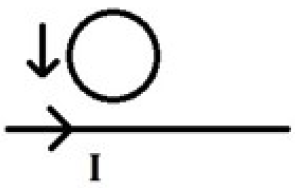
- A conducting ring of certain resistance is falling towards a current carrying straight long conductor. The ring and conductor are in the same plane. Then
 MHT CET 2025 Medium
 - A simple pendulum of length \(l_1\) has time period \(T_1\). Another simple pendulum of length \(l_2\left(l_1 \gt l_2\right)\) has time period \(T_2\). Then the time period of the pendulum of length \(\left(l_1-l_2\right)\) will beMHT CET 2024 Medium
- If work done in blowing a soap bubble of volume ' \(\mathrm{V}\) ' is \(\mathrm{W}\) then the work done in blowing the bubble of volume \(2 \mathrm{~V}\) from same soap solution isMHT CET 2023 Easy
- In Young's double slit experiment, the two slits are \(d\) distance apart. Interference pattern is observed on the screen at a distance \(D\) from the slits. Fist dark fringe is observed on the screen directly opposite to one of the slits. The wavelength of the light is.MHT CET 2022 Medium
More PYQs from MHT CET
- The solubility of salt \(\mathrm{BA}_2\) is \(4 \times 10^{-4} \mathrm{~mol~} \mathrm{dm}^{-3}\). What is solubility product of the salt?MHT CET 2025 Easy
- A student measures time for 20 oscillations of a simple pendulum as \(30 \mathrm{~s}, 32 \mathrm{~s}, 35 \mathrm{~s}\) and 35 s . If the minimum division in the measuring clock is \(1 s\), then correct mean time (in second) isMHT CET 2025 Easy
- Two long conductors separated by a distance 'd' carry currents ' \(\mathrm{I}_1\) ' and ' \(\mathrm{I}_2\) ' in the same directions. They exert a force ' F ' on each other. The distance between them is increased to ' 3 d '. If new repulsive force of magnitude '2/3 F' is found between these conductors, the required change in the magnitude and direction of one of the currents in the conductor is respectively [length of the conductors is constant]MHT CET 2025 Medium
- The area bounded by the parabola \(y^2=x\), the straight line \(y=4\) and \(\mathrm{Y}\) axis isMHT CET 2021 Easy
- In the equation, \(\mathrm{BiO}_3^{-}+6 \mathrm{H}^{+}+x ~\mathrm{e}^{-} \rightarrow \mathrm{Bi}^{3+}+3 \mathrm{H}_2 \mathrm{O}.\) What is the value of \(x\) ?MHT CET 2025 Easy
- _____________ numbers greater than a million can be formed with the digits \(2,3,0,3,4,2,3\).MHT CET 2024 Easy